If you’ve found yourself lying awake wondering what age should a kid get social media, you are not alone — and you are not overreacting. It’s one of the most-asked questions in parenting right now, and it deserves a real answer, not a guilt trip. The truth is there’s no single magic number that works for every child. But there is a clear, research-grounded way to think it through so you can make the call with confidence instead of fear. This guide walks you through the legal minimum, what the experts actually say, the signs your child may (or may not) be ready, and how to set them up to thrive — not just survive — online.
Table of Contents
What Age Should a Kid Get Social Media? The Short Answer
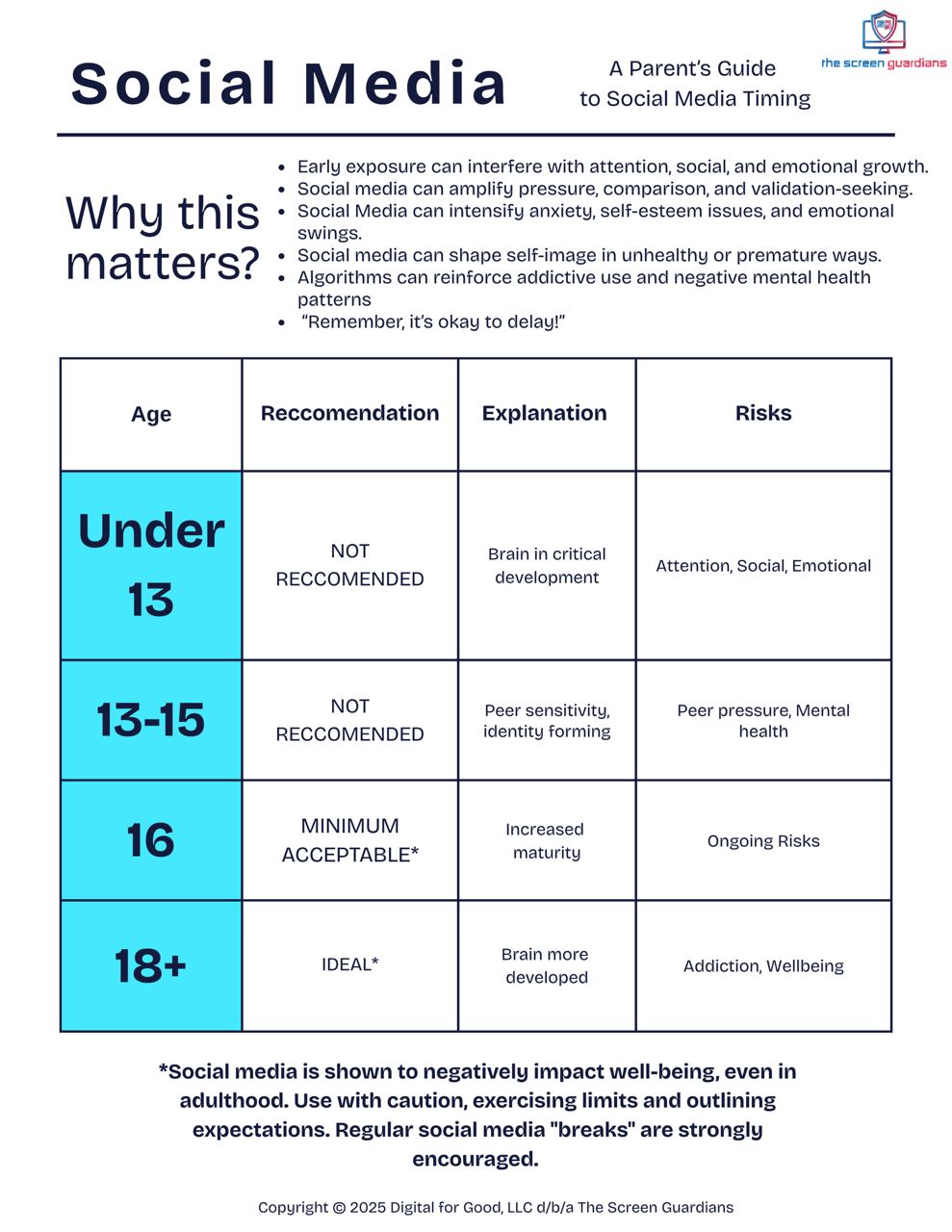
Here’s the honest version: most platforms set the floor at 13, most experts now say that’s too young for many kids, and a growing number of voices argue the real readiness window is closer to 15 or 16.
That gap — between what’s legally allowed and what’s developmentally wise — is exactly where the stress lives for parents. So let’s close it.
Age is the starting point of the conversation, not the end of it. A mature 15-year-old and an anxious, impulsive 15-year-old are not the same kid, even though the calendar says they are. Readiness is about the brain and the relationship — not just the birthday. For the bigger decision beyond social media, here’s how we decide what our kids actually need.
Related Article > Screen Time by Age: The Complete Parent’s Guide (Ages 2–18)
The Legal Minimum: Why 13 Is the Number on the Box
Nearly every major platform — Instagram, TikTok, Snapchat, Facebook, and YouTube — requires users to be at least 13. That number isn’t based on child development. It comes from a U.S. privacy law called the Children’s Online Privacy Protection Act (COPPA), which restricts how companies collect data from kids under 13.
In other words: 13 is a data privacy threshold, not a your-child-is-ready threshold. Platforms picked it to stay on the right side of the law, not because something magical happens on the thirteenth birthday.
That distinction matters. When we treat 13 as the green light, we hand a powerful, adult-designed tool to a brain that’s still very much under construction.
Related Article > Social Media Effects on Teen Mental Health
What the Experts Actually Recommend
Pediatric and mental-health experts have grown noticeably more cautious in the last couple of years. The consensus isn’t “never” — it’s “later, and with support.”
A few themes show up again and again:
- 13 is often too early. Many clinicians now point to 15 or 16 as a more realistic readiness window, because that’s when the social and emotional skills to cope with social media tend to come online.
- Timing risk differs by child. Research suggests girls tend to be most vulnerable to social media’s effects around ages 11–13, and boys around 14–15 — useful to know when you’re weighing the “when.”
- Maturity beats age. Experts increasingly say to assess the individual child — emotional regulation, impulse control, honesty — rather than defaulting to a number.
Some countries are taking this further. In December 2025, Australia became the first nation to ban social media for kids under 16 across ten major platforms — and several other countries are now weighing similar moves. Whatever you think of a national ban, it signals how seriously the readiness question is being taken worldwide.
Why a Developing Brain Changes the Whole Equation
This is the part that brings so many parents relief, because it explains why this is hard — and it isn’t because your kid is “bad” or you’re “behind.”
The prefrontal cortex — the part of the brain responsible for judgment, impulse control, and weighing consequences — isn’t fully developed until the mid-twenties. Social media, meanwhile, is engineered to trigger dopamine: the little hit of reward that keeps us scrolling, refreshing, and checking.
So you have a brain that’s wired to seek reward and not yet wired to pump the brakes, meeting a product designed to maximize exactly that loop. Logic goes out the window. Impulse runs the show. Dopamine. Dopamine. Dopamine.
That’s not a character flaw in your child. It’s biology meeting design. And once you see it that way, the goal shifts from control to preparation.
Signs Your Child May Be Ready (and Signs to Wait)
Forget the birthday for a second. Here are the readiness signals that actually matter.
Green flags — leaning toward ready:
- They can handle disappointment or conflict without spiraling.
- They come to you when something feels off — and tell the truth even when it’s uncomfortable.
- They can put a device down when asked, most of the time, without a meltdown.
- They understand that what goes online stays online.
Yellow flags — a sign to wait or go slow:
- Big emotional swings tied to peer approval or being left out.
- Difficulty with honesty around screens or rules.
- Sleep, school, or in-person friendships already feel fragile.
- Strong FOMO-driven pressure: “Everyone has it but me.”
That last one is real, and it’s hard. But “everyone has it” has never been a developmental readiness test. It’s a feeling — and feelings are something you can talk through together.
Related Article > Why Kids Without Phones Build the Confidence You Want
If You Decide Yes: How to Start Well
Saying yes doesn’t mean handing over the keys and walking away. A strong start looks like a slow, supported on-ramp:
- Start with one platform, not five. Less to monitor, less to manage, less to learn at once.
- Set it up together. Walk through privacy settings, who can contact them, and what a “teen account” limits.
- Agree on the why behind the rules. Kids follow boundaries they understand far better than ones they don’t.
- Keep talking. The goal isn’t surveillance — it’s connection. Check in with curiosity, not interrogation.
Remember: rules without understanding often breed rebellion. But when kids learn how technology affects their brain, they become more curious — not just compliant. Education is the greatest form of protection.
Related Article > What Happens When Teens Quit Social Media? Giuliana’s Story
You Don’t Have to Decide This Alone
If there’s one thing to take from all of this, it’s that the “right age” is really the right combination of maturity, conversation, and support — and none of that requires you to be a tech expert. It just requires you to be a steady, present adult who’s willing to keep showing up.
Inside The Parent Portal, we give you exactly that kind of support — coaching videos, conversation starters, and scripts for the hard talks, all grounded in research, not fear. It’s a calm place to land when screen decisions feel overwhelming. Because you shouldn’t have to navigate this season of parenting by yourself.
Start where you are. We’ll walk this digital parenting road with you — step by step.
Frequently Asked Questions
Q: What age should a kid get social media according to most experts?
A: Most platforms allow accounts at 13, but a growing number of experts say that’s too young and point to 15 or 16 as a more realistic readiness window. The bigger factor than age is your individual child’s emotional maturity, impulse control, and honesty.
Q: Why is 13 the minimum age on Instagram, TikTok, and Snapchat?
A: The age 13 comes from COPPA, a U.S. data-privacy law that limits how companies collect information from children under 13. It’s a legal and privacy threshold — not a sign that a 13-year-old is developmentally ready for social media.
Q: My child says “everyone” has social media. Should that change my decision?
A: Peer pressure is real, but “everyone has it” isn’t a readiness test. Use it as a conversation starter about FOMO, comparison, and why your family’s timeline can be different — without shame on either side.
Q: How do I know if my child is mature enough for social media?
A: Look for green flags like handling conflict without spiraling, telling the truth about online activity, and being able to put a device down when asked. Yellow flags — big mood swings tied to peer approval, trouble with honesty, or fragile sleep and friendships — are signs to wait.
Q: Is it bad to wait until 16 to allow social media?
A: Not at all. Many experts and even some governments are moving toward later access. Waiting gives the brain more time to develop judgment and impulse control, and it gives you more time to build the skills and trust that make social media safer.