
If you saw the headlines last week and felt a little jolt of hope—followed by a wave of “wait, what does this actually mean for my kid?”—you’re not alone. On June 29, 2026, the U.S. House passed a sweeping new kids online safety law called the KIDS Act, and your feed probably lit up with big claims about what it will and won’t do. Here’s the calm, plain-English breakdown: what the bill actually says, what it doesn’t, why some parents are cheering it and others are fighting it—and what your role as a parent still is. Grounded in facts, not fear. Because you deserve clarity, not another reason to panic.
Table of Contents
What the KIDS Act Actually Does
The KIDS Act (short for the Kids Internet and Digital Safety Act) isn’t one single rule. It’s a bundle of more than a dozen bills rolled into one package, passed 267–117. Think of it as a set of new defaults and guardrails aimed at the platforms your kids already use.
Here’s what’s inside, in language that actually makes sense:
- Algorithms off by default for kids. Social platforms would turn off the endless, personalized recommendation feed for minors unless it’s switched on.
- Strongest privacy settings by default. Minors’ accounts would start on the most protective settings—not the most public ones.
- More parental controls and design changes meant to reduce the compulsive, can’t-put-it-down pull of certain apps.
- Messaging limits. Private messaging would be blocked for children under 13, and disappearing messages removed for teens under 17.
- AI chatbot safeguards. A chatbot would have to tell a minor upfront that it’s “not a natural person,” share crisis resources if a child mentions self-harm, and nudge kids to take a break after three hours.
- Age verification for websites hosting adult content.
- Limits on targeted ads built from minors’ personal data.
On paper, that’s real movement—the biggest federal push on child online safety we’ve seen. But whether it’s strong enough is exactly what’s being argued right now.
What This Kids Online Safety Law Doesn’t Do (Yet)
Here’s the part the headlines tend to skip. Passing the House is a big step—but it’s a step, not the finish line.
- It’s not law yet. The bill still has to clear the Senate, where lawmakers have their own competing proposals to reconcile. That takes time.
- It won’t change your child’s apps overnight. Even after a bill becomes law, platforms get a window to comply.
- It can’t have the conversation for you. No default setting knows your child the way you do.
Why Some Parents Are Cheering—and Others Are Fighting It
This is where it gets interesting, and where a lot of the noise online is coming from. The KIDS Act is being opposed from two very different directions—and it helps to know which is which.
Privacy and free-speech groups (like the ACLU and EFF) worry the bill goes too far—that age-verification requirements could force everyone, adults included, to hand over IDs to use the internet, and that vague safety standards could pressure platforms to over-remove lawful content.
Many child-safety advocates, on the other hand, argue the House bill doesn’t go far enough. Their biggest concern: the House version dropped the “duty of care”—a provision (still alive in the Senate’s version) that would legally require platforms to take reasonable steps to prevent design-driven harms like content that fuels eating disorders, self-harm, and addiction. In its place, the House bill asks companies to run annual safety audits and keep “reasonable harm-reduction policies.” Critics—including a Catholic University law professor and the Senate bill’s own co-authors—say that swap turns a real legal obligation into a lighter-weight promise, and could even give platforms a shield in court. There’s also a live debate over whether the deal is tied to preempting some state AI laws, which advocates fear could tie states’ hands.
The bill’s House sponsors push back that it’s strong, bipartisan, and passable now—and that a good bill today beats a perfect bill that stalls forever.
Our take, in true Screen Guardians fashion: both things can be true at once. This is real progress and a bill worth scrutinizing closely. You don’t have to pick a jersey to pay attention. If this issue matters to you, the most powerful thing you can do is stay informed and let your own representatives know what you want to see—strong safeguards that put kids ahead of platforms.
Why a New Kids Online Safety Law Still Isn’t Enough
We’ve seen this pattern play out around the world. Australia banned social media for under-16s and still found the vast majority of teens online through workarounds. England made schools phone-free by default. Apple keeps rolling out new parental controls. All of it helps. None of it replaces a connected, curious adult at home.
Here’s why: rules without understanding often breed rebellion. But when kids learn why their brain responds to technology—the dopamine loops, the design tricks, the pull of a still-developing prefrontal cortex—they become more curious, not just more compliant. That’s the resilience no bill can legislate.
Policy sets the floor. Understanding builds the resilience. That’s the gap we’re here to help you fill.
What You Can Do Tonight
You don’t need to be a tech expert. You just need to be present. Start here:
- Name it out loud. Tell your kid you saw the news about a new online safety law and ask what they think. Curiosity opens doors that lectures close.
- Check one setting together. Sit down and look at the privacy and screen-time settings on one app—side by side, not over their shoulder.
- Talk about AI chatbots. Ask if they’ve ever chatted with an AI “friend.” No judgment—just an open door.
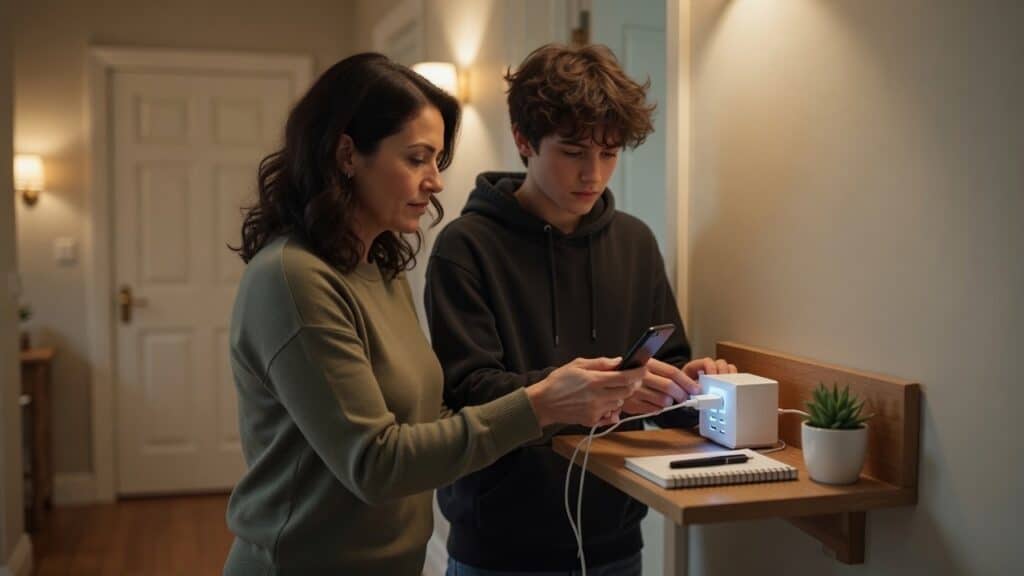
- Decide on one small habit. Where does the phone sleep? A charging station outside the bedroom is one of the highest-impact swaps a family can make.
A new law can’t have the conversation for you. But it can be the reason you start one tonight. And if you want scripts, coaching videos, and conversation starters for the hard talks, that’s exactly what we built the Parent Portal for—a calm, judgment-free place to land when screen stress feels overwhelming.
Frequently Asked Questions
Q: Is the KIDS Act a law now?
A: Not yet. The House passed it on June 29, 2026, but it still needs to pass the Senate and be signed before it becomes law. Even then, platforms would get time to comply, so changes wouldn’t happen overnight.
Q: Why are some child-safety advocates opposing a kids online safety law?
A: Because the House version dropped the “duty of care”—a rule that would legally require platforms to prevent design-driven harms like content promoting eating disorders, self-harm, and addiction. Critics argue that without it, the bill leans on weaker company policies and could even shield platforms from lawsuits. Supporters counter that it’s still a strong, passable step forward.
Q: What does this Kids Online Safety Law do about AI chatbots?
A: It would require chatbots to tell minors they’re “not a natural person,” share crisis resources if a child mentions self-harm, and encourage a break after three hours of use.
Q: Will the KIDS Act keep my child safe online by itself?
A: It helps—by making safer settings the default and adding guardrails. But no law replaces an involved parent. Education and open conversation are still the strongest form of protection.
The Bottom Line
The KIDS Act is a genuine milestone—and a genuinely contested one. It’s the biggest federal push yet to make the internet safer for kids, and at the same time, thoughtful parents and advocates are asking hard questions about whether it goes far enough. Both can be true. But a bill can only set the stage. What actually protects your child is a steady, curious adult who understands the digital world they’re growing up in and keeps the conversation open. You don’t have to navigate it alone. Read the full breakdown of the vote in The Hill’s coverage, then start where you are. Want real tools, real voices, and real support? Join our newsletter and let’s walk this digital parenting road together—step by step.