Contributed by Susan Dunaway, neurotherapist
If you’re like most parents you started worrying about your child the moment you became a parent.
That’s not a flaw. It’s biology. We are hardwired to protect our kids. Most of the time, that instinct serves us well. It’s why we research car seats and cribs. Why we babyproof cabinets. Why we shout reminders out the door: “Wear your helmet! Be careful! Call me when you get there!”
Behind every worry is an unspoken I love you.
But when it comes to phones, that same loving instinct can quietly backfire. The idea that kids without phones are less safe — or that we must always be able to reach them — is one of the most widely accepted parenting beliefs of our time. And it’s worth examining.
Table of Contents
The Worry That Drives the Device Decision
Phone companies understand something important about parents: we are biologically wired to fear for our children. That fear is a feature, not a bug. It’s kept kids alive for generations.
Smart companies use this wiring ethically — the car with the highest safety rating should sell the most cars. That kind of competition raises the bar for everyone.
But some companies take advantage of our wired-in worry and sell us an idea that can actually decrease our children’s long-term well-being: the belief that we must always know exactly where our kids are, and they must always be able to contact us.
I know — this pushes uncomfortable buttons. Hear me out.
As soon as our kids walk out the door, the most terrible “what-ifs” flood our imagination:
- What if they get hurt?
- What if they get lost?
- What if they get kidnapped?
- What if they’re in trouble and don’t know what to do?
(As an aside, I grew up in a small-town funeral home. I’ll bet you can’t out-“what-if” me.)
Here’s the truth: the most terrifying things almost never happen. And the decision to hand a child a device is usually driven less by their actual risk and more by our very real anxiety.
What I Learned From My Son’s After-School Adventure
When one of my sons was in early elementary school, we had an after-school mix-up.
He thought he was supposed to walk to a friend’s house. That friend wasn’t home. So he walked back to the school. The school was locked. So he walked to the home of a different family friend, who called me and kept him safe until we could pick him up.
For a stretch of that afternoon, none of the adults knew exactly where he was. That was scary — for us.
But it wasn’t scary for him. He thought it was a great adventure.
He problem-solved. He figured it out. He knew the safe people in the neighborhood. When he came home that night, he was so proud of himself. His confidence grew. At no point was he in any actual danger.
And because he didn’t have a device, he couldn’t outsource the solution to us. He had to rely on himself. And he did.
Now ask yourself: if he’d had a phone, how would it have gone differently?
The Hidden Cost When Kids Without Phones Become Kids With Phones
If he’d had a device, as soon as he realized the first friend wasn’t home, he would have called us. We would have taken over. We would have told him exactly what to do.
He would have done it. He would have been fine. And we would have felt a lot less anxiety.
But what else would have happened?
- He would have learned that adults solve problems — and absorbed the underlying message that he couldn’t.
- He might have heard the stress in our voices and decided this was a scary situation instead of an adventure.
- The next time he felt unsure, he wouldn’t have that earlier experience to lean into.
Every time we reach in to fix, we quietly take away a chance for them to figure it out. Multiply that by a childhood, and you start to see the cost.
I wonder how many chances to problem-solve — and build the self-reliance that comes with it — are quietly erased simply because kids have too-quick access to adults. Research groups like Common Sense Media have documented how constant connectivity reshapes the developmental experiences kids used to stumble into on their own.
Begin With the End in Mind
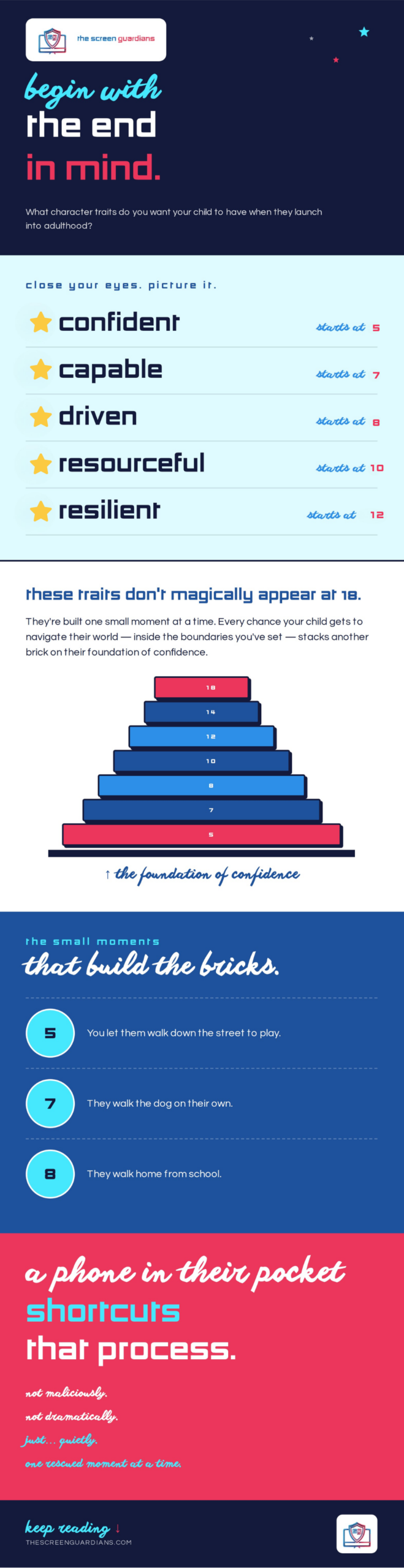
At The Screen Guardians, we talk about beginning with the end in mind.
What character traits do you want your child to have when they launch into adulthood? Close your eyes for a second and picture it.
I’d guess the list looks something like this:
- Confident
- Capable
- Driven
- Resourceful
- Resilient
- Believing in their ability to handle hard things
Those traits don’t magically appear at 18. They begin at 5, when you let them walk down the street to play. At 7, when they walk the dog on their own. At 8, when they walk home from school.
Every small moment they’re allowed to navigate their environment — inside the boundaries and expectations you’ve set — stacks another brick on their foundation of confidence.
A phone in their pocket shortcuts that process. Not maliciously. Not dramatically. Just… quietly. One rescued moment at a time.
How to Create Device-Free Windows (Even If You Already Gave Them a Phone)
If you’re reading this thinking, “It really doesn’t matter what you say — my child already has a device,” you’re not alone. And this is not a guilt trip.
Start where you are.
Look for smaller windows where your child can be device-free:
- Walking the dog around the block
- Riding bikes to a friend’s house
- Running into the store for a single item
- Going to a neighborhood park
- Sleepovers and playdates at trusted homes
Name the pattern out loud: “Sometimes we bring the phone. Sometimes we leave it at home. You don’t always need it.”
These device-free windows will likely grow in frequency and length as both of you get more comfortable. That’s the goal — not a phone ban, but practice being capable without the tether.
And parents, here’s your assignment: take deep breaths. If we can imagine worst-case scenarios, we can imagine best-case ones. Picture them coming home just fine. Praise both your child and yourself when they do.
And if there is a snafu? Listen to the adventure. Praise the problem-solving. Let the story become the lesson.
It isn’t easy. But it is so worth it.
Frequently Asked Questions
Q: At what age should kids without phones start getting one?
A: There’s no universal “right age,” but research strongly supports delaying smartphones until at least middle school, with a growing movement of parents waiting until closer to 14. Focus less on a specific birthday and more on your child’s maturity, real need, and demonstrated ability to handle low-stakes responsibility first.
Q: Isn’t it safer for my child to always have a phone?
A: Safety is more complex than access. A phone doesn’t prevent most of the scenarios parents fear. And in many cases, it replaces the very problem-solving skills that keep kids genuinely safe. Knowing safe adults in the neighborhood, memorizing a parent’s number, and practicing independence all build real-world safety.
Q: What if my child is the only one in their class without a phone?
A: You’re not alone — more parents than ever are choosing to wait. Talk to other parents, lean on your community, and remember: every brave parenting decision that protects childhood makes it easier for the next family to do the same.
Q: How do I handle the anxiety I feel when my child is away without a device?
A: Breathe. Picture them fine. Trust the skills you’ve taught them. Anxiety lies to us — it tells us catastrophe is imminent when the odds are overwhelmingly against it. Over time, practicing independence is good for you, too.
The Takeaway
Raising confident, capable kids is a long game, played one small moment at a time.
Every time you let your child problem-solve without reaching for a device — yours or theirs — you are depositing into the most important account they’ll ever own: their belief in themselves.
This isn’t about being anti-technology. It’s about being pro-child. Devices are tools. Self-reliance is character. Tools can be added later. Character takes years to build.
If you’d like more support in this work, the Parent Portal includes our 4 Questions to Ask Yourself Before Getting Your Child a Device and the Growing Into Tech Roadmap — built to help you navigate these exact moments with clarity and calm.
You don’t have to figure this out alone. Start where you are.