
If you just got the email that your child’s school is going phone-free this fall, you might be feeling two things at once. Relief. And a little bit of, “…okay, but what about at home?”
You’re not alone in that. This year, phone-free schools are moving from a good idea to the law of the land — and the shift is landing in a lot of living rooms at the same time. The good news? A school phone policy can be one of the most helpful things to ever happen to your family’s screen-time battles. If you let it.
Here’s what’s actually happening this fall, why a ban is a great first step (but not the whole answer), and a calm, no-fight way to bring the same shift home.
Table of Contents
Phone-free schools are becoming law this fall
The back-to-school story of 2026 isn’t a new lunchbox trend. It’s policy.
- California: AB 3216 requires every K–12 district to adopt a policy limiting or banning smartphones — with a deadline of July 1, 2026.
- Georgia: The Distraction-Free Education Act takes effect for the 2026–27 school year, restricting phones for younger grades.
- And plenty more: Michigan, Massachusetts, Arizona, and Illinois all have policies landing for the coming school year.
Zoom out and the map is striking: some form of school cellphone policy now covers 35 states plus Washington, D.C. Illinois coverage this month put the goal in plain terms — help students focus.
So if it feels like “everyone’s school” is doing this at once… that’s because, more or less, they are.
A phone ban is a great first step — but a locked-up phone doesn’t teach
Here’s the honest part. A phone ban is a boundary. And boundaries are good — they protect focus, sleep, and real-life connection during the school day.
But a phone that’s zipped in a pouch from 8 to 3 is still waiting in a backpack at 3:01. The bell rings, and the same device is right back in your child’s hands — often with zero guidance about how to use it well.
That’s the gap. A ban removes the phone. It doesn’t teach the skill.
Rules without understanding often breed rebellion. But when kids learn how technology affects their brain, they become more curious — not just compliant.
This is the heart of what we believe at The Screen Guardians: education is the greatest form of protection. Not anti-technology. Pro-child.
How to make the same shift feel doable at home (without a fight)
You don’t need a 40-page family media plan this weekend. You need a few small, repeatable moves — and permission to start where you are.
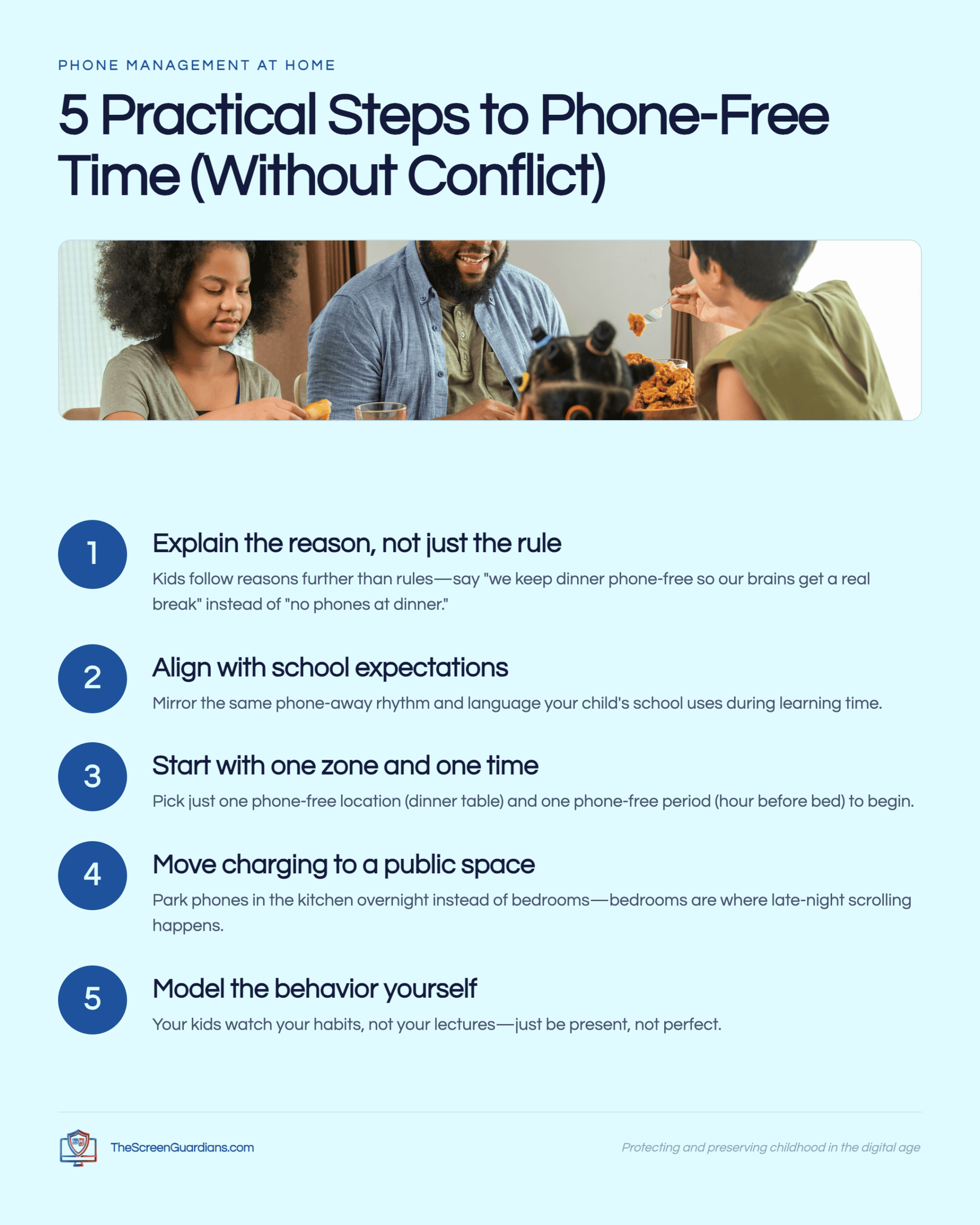
- Name the “why,” not just the rule. Instead of “no phones at dinner,” try “we keep dinner phone-free so our brains get a real break.” Kids follow reasons further than they follow rules.
- Match the school’s rhythm. If phones are away during learning at school, mirror it during homework at home. Same language, same expectation — less confusion.
- Create one phone-free zone and one phone-free time. Pick just one of each to start. The dinner table. The hour before bed. Small and consistent beats big and short-lived.
- Park phones somewhere public to charge overnight. Bedrooms are where the late-night scroll lives. A kitchen charging spot protects sleep for everyone — including you.
- Talk about how the apps are built. When kids understand that endless scroll and autoplay are designed to keep them hooked, shame goes down and agency goes up.
- Go first. Your kids are watching your thumbs, not your lectures. You don’t have to be perfect. Just present.
Notice what’s not on that list: guilt. There’s no judgment here. If your family’s current normal is phones everywhere, all the time — you’re not behind. You’re right on time.
The real magic: shared language between school and home
Here’s what makes this school year different from every “we should really cut back on screens” January before it.
For the first time, your child’s school is saying the same thing you are. That alignment is powerful. When the message at school and the message at home match, kids stop hearing “my strict parent” and start hearing “this is just how it works.”
That shared language — between teacher, parent, and child — is exactly what a strong school program is built to create. A phone ban sets the boundary. A digital wellness curriculum teaches the skill underneath it. Together, they’re what actually sticks.
If you’re a parent who’d love your child’s school to go beyond the ban, that’s a conversation worth starting with them. The programs that work don’t just remove phones — they teach kids how their developing brains respond to technology in the first place.
You’ve got this — and you’re not doing it alone
A phone-free school year isn’t something happening to your family. It’s a rare open door — a moment when the culture, the law, and your own instincts are finally pointing the same direction.
You don’t have to overhaul everything by Monday. Pick one small shift from the list above and try it this week. Then another. That’s how lasting change actually happens — not in a dramatic crackdown, but in calm, consistent, connected steps.
And if you’d like real tools and a judgment-free place to land while you figure it out, that’s exactly why we built The Parent Portal — scripts for the hard conversations, coaching videos, and a community walking this road with you. Prefer to dip a toe in first? Our free parent course is a calm place to start.
You don’t have to navigate screen time alone. Start where you are.
Frequently Asked Questions
When do phone-free schools become law?
It varies by state. California’s AB 3216 requires K–12 districts to have a policy in place by July 1, 2026, and Georgia’s Distraction-Free Education Act takes effect for the 2026–27 school year. Some form of school cellphone policy now covers 35 states plus Washington, D.C.
Do phone-free schools mean my child can’t have a phone at all?
Usually not. Most policies restrict phone use during the school day — often “bell to bell” — rather than banning devices from campus entirely. Check your specific district’s policy for the details, including any exceptions for medical needs or emergencies.
How do I set screen-time rules at home without a huge fight?
Start small and lead with the reason behind the rule. Pick one phone-free zone (like the dinner table) and one phone-free time (like the hour before bed), keep phones charging outside bedrooms overnight, and model the habit yourself. Consistency matters more than perfection.
Why isn’t a phone ban enough on its own?
A ban removes the phone but doesn’t teach the skill of using it well. When the school day ends, the device comes right back. Pairing clear boundaries with education — teaching kids how technology affects their brains — is what builds lasting, healthy habits.