
If you have spent the last few years quietly worried about social media addiction in kids — and quietly wondering if you were overreacting — I want you to read this one slowly. In August 2026, Meta agreed to pay up to $17.1 billion to settle child-safety claims brought by attorneys general across the country. It is the largest settlement of its kind in the history of social media. And it did not happen because parents were being dramatic. It happened because the design was the problem all along. Here is what the settlement actually says, how to tell when your child has crossed from engagement into compulsion, and exactly what to say to them this week.
When we know better, we do better. That line has never applied more directly than it does right now.
Table of Contents
What Just Happened: The Meta Settlement, Explained
In late August 2026, Meta reached a settlement with a coalition of 52 attorneys general — 51 states and U.S. territories plus the District of Columbia — resolving claims that Instagram and Facebook were deliberately built to hook young users. It is the clearest official acknowledgment yet that social media addiction in kids is a design outcome, not a parenting failure. (NPR has a plain-language summary of the case if you want the news version.)
The number is up to $17.1 billion, paid out over ten years. Roughly $5.3 billion of that is conditional: it only gets released if TikTok and YouTube adopt comparable protections and contribute their share. In other words, the agreement was written with the assumption that Meta will not be the last company at this table.
Here is what actually changes for teen accounts:
- A two-hour default daily limit across Facebook and Instagram, with built-in pauses along the way. Only a parent can lift it.
- No access from midnight to 6 a.m., with notifications silenced from 10 p.m. to 7 a.m.
- No push notifications during the school day (8 a.m. to 3 p.m.).
- Limits on social-comparison features — visible like counts and appearance-altering beauty filters for minors.
- A non-personalized feed option, so the algorithm is not the only way to see content.
- Stronger age verification and parental controls, plus an independent auditor with real access to check the work.
D.C. Attorney General Brian Schwalb, announcing his office’s share, put the allegation plainly: Meta “intentionally exploited kids for profit and then lied about it, claiming its products were safe when its own internal” research showed otherwise.
One honest caveat, because you deserve the accurate version: Meta did not admit wrongdoing. Settling companies almost never do, and Meta has publicly denied the claims. A spokesperson said the protections “will only be truly effective if our peers — TikTok and YouTube — put the same measures in place.”
So no, this is not a confession. But look at the list above and ask yourself a simple question: what problem is each one of those changes solving? Nobody agrees to shut the doors at midnight, hide the like counts, and turn off school-day notifications for a product that was not pulling at kids in the first place.

Why Social Media Addiction in Kids Was Never an Accident
I was a nurse. I have studied addiction — how dopamine reward pathways work, how habits form, how craving gets built at a neurological level. So let me explain the mechanism in plain language, because once you see it, you cannot unsee it.
How your brain’s reward system actually works
Your brain releases dopamine when something good happens. When you eat food you love. When you finish something hard. When you connect with someone who matters to you. Dopamine is not “happiness” — it is anticipation. It is the chemical that says, “Good job. That is worth doing again.”
Healthy dopamine cycles complete themselves. You do the thing, you feel good, you learn, the loop closes.
Addiction happens when the loop never closes. When something is designed to deliver dopamine unpredictably and frequently, the brain gets stuck in a state of craving instead. It learns: I need to check that again. And again. And again.
That is how a slot machine works. It is also how these platforms were engineered.
The design choices behind the craving
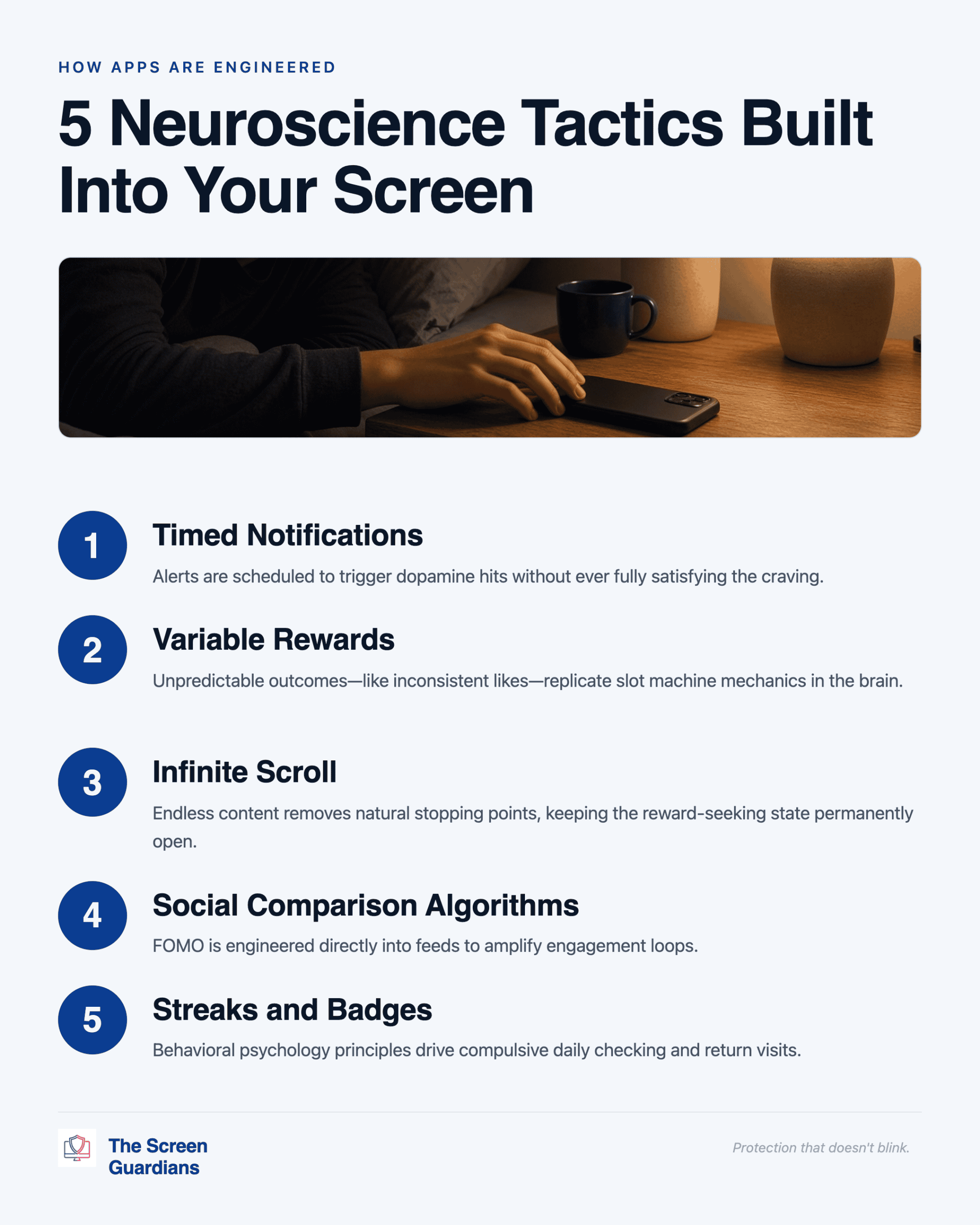
None of this was stumbled into. These companies hired neuroscientists and behavioral psychologists. They studied how human brains work, and then they built accordingly:
- Notifications timed to trigger dopamine without ever satisfying it.
- Variable rewards — sometimes the post gets likes, sometimes it does not. That is the slot machine, exactly.
- Infinite scroll, which removes every natural stopping point and keeps the craving state open indefinitely.
- Social comparison and FOMO, engineered straight into the algorithm.
- Streaks and badges, which is behavioral psychology 101 for creating compulsive checking.
And they aimed it at kids whose prefrontal cortex — the part of the brain that says this is a bad idea, stop — will not be fully formed until their mid-twenties. Our kids are neurologically outmatched by design. That is not a character flaw in your child. That is developmental biology meeting a product built by experts.
Why I Compare It to a Dealer’s Playbook
I know how this sounds. And I want to be clear that this is my read, as a nurse and a parent, not a legal finding.
But here is the pattern I keep seeing. A dealer knows the product is harmful and sells it anyway, because the profit outweighs the harm. They target the population that is easiest to hook. They deny the damage while the evidence stacks up. And they change only when there are legal and financial consequences.
Compare that to what the attorneys general alleged, and to a settlement that arrives with a court-appointed auditor attached. You can decide for yourself whether the comparison holds. I think it does.
7 Signs Social Media Addiction Has Crossed the Line
This is the question every parent actually needs answered. Not “is social media bad,” but “has it crossed the line for my kid?” Here is how I teach the difference.
Engagement sounds like: “I want to text my friend.” Compulsion sounds like: “I can’t stop checking my phone even though I’m trying.”
Connection sounds like: “I had a fun conversation with my friend.” Addiction sounds like: “I feel anxious if I don’t check in the next few minutes.”
Entertainment sounds like: “I watched a funny video.” Hijacking sounds like: “I’ve been scrolling for three hours and I don’t remember any of it.”
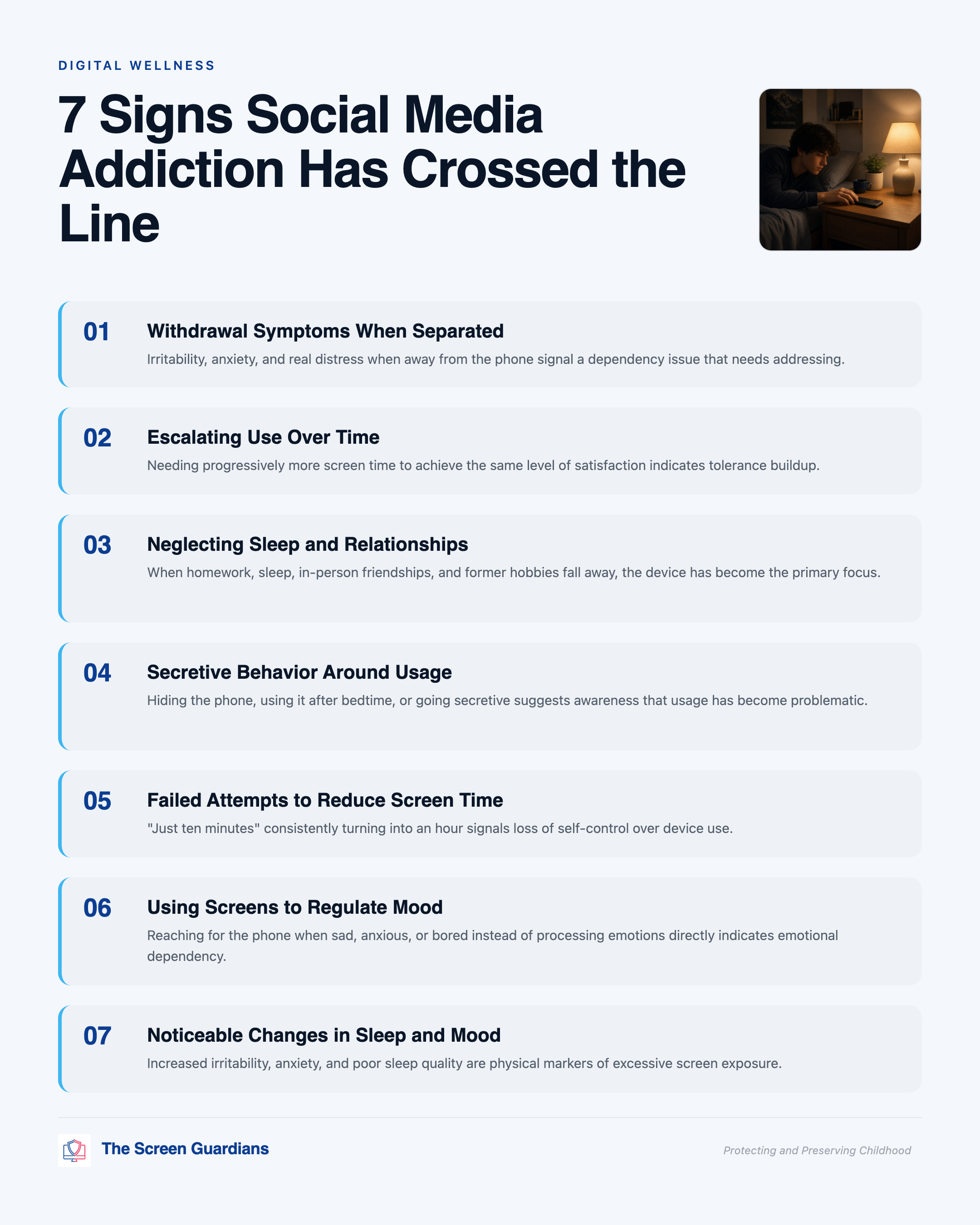
The line is not always obvious. But these are the signs it has been crossed:
- Withdrawal when separated from the phone — irritability, anxiety, real distress.
- Escalating use — needing more time to feel the same satisfaction.
- Neglecting other things — sleep, homework, in-person friendships, hobbies they used to love.
- Hiding or lying about use — sneaking the phone, using it after bedtime, going secretive.
- Failed attempts to cut back — “just ten minutes” turns into an hour, every time.
- Using it to cope — reaching for the phone when sad, anxious, or bored instead of feeling the feeling.
- Changes in mood and sleep — more irritable, more anxious, sleeping worse.
If you are seeing several of these, that is not a discipline problem. That is what social media addiction in kids actually looks like from the outside — and it calls for understanding and a plan, not shame and punishment. If you want a developmental baseline to compare against, our guide to screen time by age walks through what is typical from ages 2 to 18.
Why We Delay — and Why Restriction Alone Is Not the Answer
If you have ever wondered why The Screen Guardians takes such a deliberate approach — why we talk about delaying platforms, why we ask hard questions before saying yes — here is the honest answer. We understand the brain. Our team includes a brain health expert, Susan Dunaway, who was studying the impact of technology on developing brains long before most practitioners were even discussing it. We are not going to let you sort this out alone.
So we built a framework grounded in neuroscience that asks better questions:
- What is this platform’s incentive? (Hint: engagement, not your kid’s well-being.)
- Was it designed to exploit dopamine pathways? (See: essentially all of them.)
- What is it trying to make my kid crave — connection, status, entertainment, validation?
- Is my child developmentally ready for this?
- How will I know if it has crossed from entertainment into compulsion?
We delay not because technology is bad, but because brain development is worth protecting. There is no emergency here. Your eight-year-old does not need Instagram. Your eleven-year-old does not need TikTok. Every year you wait, the prefrontal cortex matures a little more, resistance to manipulation improves, and their sense of self solidifies. If you are weighing that decision right now, we walked through it honestly in what age a kid should get social media.
But here is the part I never want lost: restriction alone is not a solution. Take the phone away and your child has not gained a single new skill for the day it comes back. A limit buys you time. Education is what they keep. So every boundary we recommend gets paired with the understanding it is meant to build.

How to Talk to Your Kids About This
This settlement is a gift, because it hands you language and permission for a conversation that is otherwise hard to start. Here is how I would open it.
For younger kids (ages 8–12)
“Did you know apps are designed by people whose whole job is to make them as hard to put down as possible? Kind of like a video game is made to be fun — except these are made to keep you thinking about them all the time. A bunch of states just said that wasn’t okay, so now the apps have to change.”
Then stop talking and listen. Ask: Which app do you think about most? When you’re not using it, do you think about it? How do you feel when you can’t use it? Does using it make you feel better, or just make you want more?
For teens (ages 13–18)
“Something big just happened. Meta — the company behind Instagram and Facebook — agreed to pay up to $17 billion and change how those apps work for people your age. States argued they hired brain scientists and psychologists to figure out how to make it nearly impossible to stop scrolling. Meta says they didn’t do anything wrong. You can look at what they agreed to change and decide what you think.”
Then be real about the neuroscience: “Your brain has a reward system. When something good happens, it releases dopamine — the chemical that says do that again. That’s healthy. But these apps trigger dopamine in a way that keeps you craving without ever satisfying you. Like a slot machine. And the part of your brain that says this is a bad idea isn’t done developing until your mid-twenties. So you’re neurologically more vulnerable than an adult would be. That’s not a personal failing. That’s development — and it’s exactly why they target your age group.”
Then ask the harder questions: Do you think you’re addicted to any of your apps? How would you know? What would it feel like to take a break? What would happen if you couldn’t open it for a day?
Listen without judgment. The answers will tell you everything.
For every age: the real conversation
“I’m not saying you can never use these apps, though we may decide together that some aren’t a good fit right now. I’m saying I want you to use them intentionally — not because you feel like you have to. I want you to notice when they make you feel good and when they make you feel worse. And if you’re struggling to put it down, that’s not a character flaw. That’s the design. We can work on your relationship with it together.”
If You Said Yes and Now You Regret It
I need to say this directly, because I know some of you are reading this with a knot in your stomach.
If you said yes to an app or a platform and you would choose differently today, you did not fail your kid. You made a decision with the information available at the time, the same as every other parent, teacher, and school did. Nobody knew what we know now. That is the whole point.
Permission is not permanent. We are allowed to change our minds when we get better information. That is not inconsistency — that is wisdom. Just start with connection and conversation rather than confiscation, and make the changes slowly enough that your child can come with you.
And if you have been the parent saying “not yet” while everyone around you said yes? Your caution was not paranoia. Your delay was not deprivation. That uneasy feeling was not fear — it was pattern recognition. Honor that voice.
6 Things to Do With This Moment
- Have the conversation. Use the scripts above. Don’t shame, don’t panic, just be real.
- Watch for the signs. Withdrawal, mood changes, sleep disruption — take those seriously and early.
- Set boundaries with intention, not guilt. “We’re doing this because of how your brain works, not because I’m being mean.”
- Teach them the framework. Our Pause–Check–Choose system helps kids notice when they are being manipulated and choose differently.
- Model it. How is your own relationship with your phone? They are watching that more closely than they are listening to us.
- Keep learning. The research is still arriving. Stay curious, stay informed, stay connected to other parents doing this work.
Why The Screen Guardians Exists
Not to say no, though “not yet” is often the right answer. Not to shame anyone. And not to pretend technology is going away, because it is not.
We exist so that parents, educators, and kids can see the system clearly and make intentional choices inside it. Preventing social media addiction in kids is not about winning a fight over a device — it is about handing a child enough understanding that the device loses its grip. A settlement can force a company to change its features. Only education changes behavior. Only understanding builds real resistance to manipulation.
That is the work ahead. And after this month, I am more committed to it than ever. If you want the policy side of this conversation, we also broke down what the KIDS Act means for your family.
Where to Start
- Parents ready to understand and teach: the free Kids’ Digital Health Guide — grounded in neuroscience, with conversation starters you can use tonight.
- Schools and educators: The Screen Guardians K–12 Program. This settlement validates exactly what we teach, and classrooms are where shared language starts.
- Families walking this out together: the Parent Portal — community, tools, coaching, and real people on the same road.
We are not building a world without technology. We are building one where kids understand their own brains, parents trust their instincts, and no company gets to quietly choose profit over people. I am so glad you are here.
Katie Longhauser, RN, BSN — Founder & CEO, The Screen Guardians. Protecting and preserving childhood in the digital age. Not anti-technology. Pro-child.
Sources: D.C. Attorney General announcement, NPR, CBS News, PBS NewsHour
Frequently Asked Questions
Is social media addiction in kids a real medical diagnosis?
Not formally. “Social media addiction” is not a standalone diagnosis in the DSM-5, though problematic and compulsive use is widely studied and recognized clinically. What matters for your family is not the label — it is the pattern. If your child shows withdrawal, escalating use, failed attempts to cut back, and impact on sleep or mood, that pattern deserves attention regardless of what it is officially called.
Did Meta admit that its apps are addictive?
No. Meta settled without admitting wrongdoing and has publicly denied the claims. What it did agree to is a set of binding changes — daily time limits, overnight blocks, hidden like counts, restricted beauty filters, and an independent auditor — along with payments of up to $17.1 billion over ten years.
When do the new teen account protections take effect?
The changes roll out over the settlement period rather than all at once, and roughly $5.3 billion of the total is contingent on TikTok and YouTube adopting comparable measures. Do not wait on the rollout. The protections you set at home take effect the day you set them.
What age should kids get social media?
There is no single right answer, but developmentally, later is better — and the reasoning is in the brain science, not in fear. We break down how to make that call for your specific child, without pressure or guilt, in our guide on what age a kid should get social media.
How do I get my child off social media without a war?
Start with connection, not confiscation. Explain the design so they understand they are up against engineering rather than their own weakness, then change one thing at a time — overnight charging outside the bedroom is usually the highest-impact first step. Pair every limit with the understanding behind it, because restriction alone leaves them with no new skill for the day it lifts.
Where can I read the official settlement details?
The D.C. Attorney General’s office published a full breakdown of the terms and the required product changes in its official announcement of the Meta settlement.
What is your biggest question right now? What do you want to talk about with your kids? Tell me. This conversation matters, and you do not have to figure it out alone.