Screen Guardians Podcast 38 — parent advocacy in schools with Allie Terry and Liz Jenkins of G-Rated Schools
I want to start here: Everything our kids learn about how to live in this world is learned through relationships.
Not in isolation. Not in a vacuum. Through relationships.
Think about it.
They learn education through the adults who model it, who push them toward it, who show them why it matters. They learn how to regulate their emotions by watching us regulate ours—and by being held steady when we help them find their center when theirs is spinning. They learn critical thinking by watching us weigh options, ask hard questions, and admit when we’re wrong. They learn empathy by being seen, by being loved unconditionally, and by watching us extend that same compassion to others.
They learn technology’s role in their lives by observing how we relate to it. By watching our choices. By hearing our boundaries.
And then—if we’re lucky and intentional—they reach the highest level of growth: self-actualization. That moment when they do what they believe is right, not because we told them to or because they’re copying us, but because they’ve thought it through. Evaluated it. Weighed the consequences. And chosen the path they believe is best.
None of this happens in a vacuum.
Every single one of these skills—education, emotional regulation, critical thinking, empathy, healthy relationships with technology—is shaped and modeled and given to our kids through the relationships we build with them.
Which means we—parents—are not just one voice in the room.
We are the foundational voice.
Table of Contents
This is why Allie and Liz matter so much to me.
I’ve watched them from the beginning. We’d exchange messages. We’d have calls where we’d encourage each other in what felt like an uphill climb to bring awareness to the very real harms that kids are being exposed to online—right now, in our schools, on our watch.
And they didn’t stop.
Allie and Liz didn’t just worry about their kids. They didn’t just talk about it over coffee. They acted. They showed up. They spoke up. They held their district accountable. And what happened?
They helped create and foster monumental change.
Not just in one school. Not just in one community. In the largest school district in Utah. And now they’re leading legislative efforts at the state level—efforts that are gaining national attention and becoming the standard for how we protect our kids from screen overuse.
And I’m sitting here thinking: What if they’d thought, “We’re just moms”?
What if they’d let that story—I’m just one person, my voice doesn’t matter, I don’t want to be a bother—stop them?
The landscape would look completely different.
Here’s the real talk.
There are dozens—hundreds—of parents right now who have the same concerns. The same observations. The same gut-level alarm bells going off when they see weak policies, unprotective practices, and exposure happening on school grounds. In classrooms. With devices.
But they’re not saying anything.
Maybe they think their voice doesn’t matter. Maybe they’re worried about being that parent—the one who rocks the boat. The one who’s difficult. The one who might bother someone important.
I understand it. I lived it for a while.
I remember that feeling: smaller than it actually was, quieter than I needed to be, afraid of the wrong thing. Afraid of discomfort. Afraid of not being liked. Afraid of making things awkward.
And then something shifted.
I realized I was choosing between two kinds of disappointment: disappointing a grown adult responsible for providing a safe environment for my kids—or letting my kid down. Possibly putting them at risk for harm. Guaranteeing they’d carry some version of pain or heartache that I could have prevented.
When I framed it that way, the choice became clear.
My comfort in that moment wasn’t big enough. It’s never going to be.
So I got uncomfortable for them.
Because isn’t that my job?
Not to make my kids comfortable. Not to avoid rocking any boats. Not to be frictionless.
My job is to be the steady, protective adult. The one who sometimes has to be the voice in the room—even when my voice shakes. Even when I’m nervous. Even when I’d rather not.
Parent. Guardian. Protector. These roles don’t come with a comfort clause.
Allie and Liz know this. They live this. And they’ve shown us what it looks like to lean into that responsibility—not apologetically, not tentatively, but fully. With evidence. With persistence. With the kind of relentless care that says, “I’m doing this because my kid’s safety matters more than my convenience.”
And you know what? The standard they’ve set shouldn’t be exceptional.
It should be the norm.
Parents, your voice matters. Full stop.
Not might matter. Not could matter if you say it the right way.
Your voice matters.
You know your kids. You see the changes in them. You notice when they’re more anxious, more dysregulated, more withdrawn. You see the effects of screen overuse—on their sleep, their mood, their ability to be present with the people they love. You know what healthy development looks like, and you know when something feels off.
That knowledge is not nothing.
Your concerns about weak tech policies, about exposure to online harms, about the pressure kids are under—these aren’t helicoptering. They’re not overreacting. They’re not you being a difficult parent.
They’re you doing your job.
And when you speak up—when you ask hard questions, when you hold your school district accountable, when you push for better policies and protections—you’re not just protecting your own kid. You’re creating a safer environment for every child in that building. You’re modeling for your kids what it looks like to advocate for what’s right. You’re teaching them that their safety and their wellbeing are worth some discomfort. Worth some risk. Worth the courage it takes to speak.
That’s how change happens.
Not because one person got angry. But because one person—and then another, and then another—decided their kid was worth the uncomfortable conversation.
There’s no shame in finding your voice.
I spent time not using mine. I was afraid. I didn’t want to be pushy. I thought someone else would handle it. I told myself it wasn’t my place.
The truth was it was uncomfortable to speak up and go against the grain, but the risk of staying silent can be far too costly to ignore it.
If this lands in your lap today—if you’re reading this and you have that gut-level knowing that something isn’t right—I want to tell you: that feeling is real. That voice inside you that’s saying “we need to do better” or “my kid isn’t safe with these policies” or “the exposure they’re getting is not okay”—that’s not paranoia.
That’s you doing your job.
So.
Ask the questions.
Request the meetings.
Look at the data.
Bring your concerns to the table.
Support other parents who are doing the same.
And if you need language, resources, clarity on what digital health actually looks like—if you need to know you’re not alone in this—we’re here.
But the voice? That’s yours.
And it matters.
The work of protecting our kids isn’t meant to be done in silence.
Education is the greatest form of protection. Connection is the foundation for everything else. And parent voices—advocating, questioning, showing up, speaking up—are how we make sure that every kid has access to both.
Allie and Liz didn’t invent courage. They just used theirs.
And they showed us what’s possible when a mom says, “Not in my school. Not for our kids. Not on my watch.”
Will you be that voice too?
Your voice matters. Your kid is worth it. Let’s do this together.
What one parent can do this week
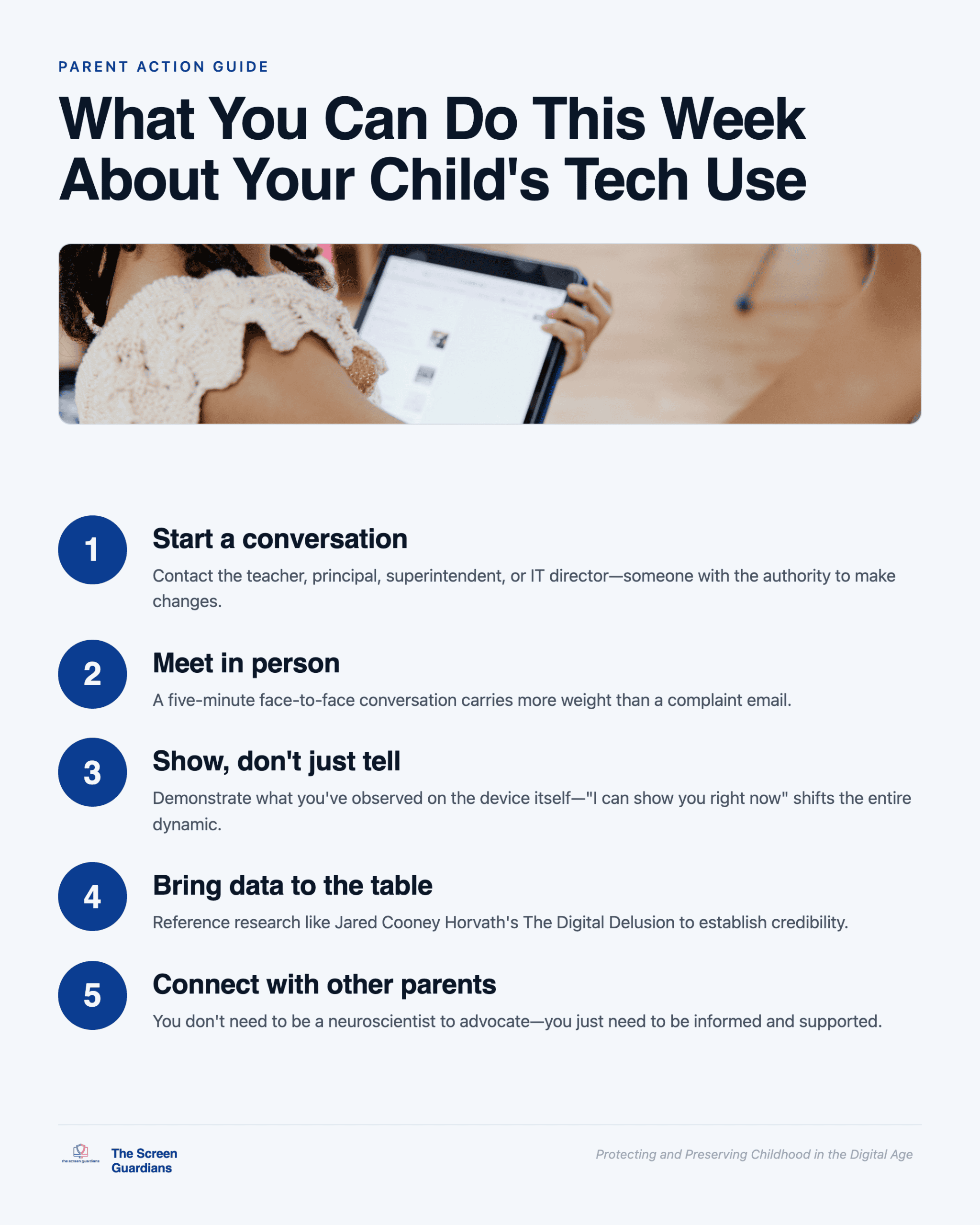
I asked them what they’d tell a parent in Utah, Kansas, or Florida who feels that something isn’t right but assumes they have no standing. Their answer was refreshingly small.
Start a conversation. With the teacher, the principal, the superintendent, the IT director — someone who can actually make a change.
“That is all good energy. But if you can focus it toward a conversation with someone who can help make a change, then do that.”
Go in person if you can. A five-minute conversation lands differently than an email that reads like a complaint. Try: Can you tell me more about how my child is using tech here?
Get on the device yourself. Allie’s most effective move was the simplest — she could say “I can show you right now,” and the conversation changed.
Bring the research. They both pointed to Jared Cooney Horvath’s book The Digital Delusion as a way to put the data in one place when you need to be taken seriously.
Find your people. Read the book together. Meet for coffee. You don’t have to be a neuroscientist to advocate for your own child — you just have to be their parent.
Listen to the full episode
There’s a lot more in the conversation than fits here — including how a teacher’s reliance on ed-tech dashboards has changed the way classrooms actually run, what happened when Liz opted her son out of the programs, and the AI chatbot legislation Allie and Liz are advising on now.
Listen to the full episode on the Screen Guardians Podcast.
If you’re ready to learn more.
Our K–12 program brings this conversation into schools—creating shared language between teachers, students, and parents about digital health and safety. Learn more about bringing The Screen Guardians to your school.
And if you’re navigating this as a parent—if you’re trying to figure out what healthy boundaries look like, how to talk to your kid about screen time, or how to show up at school with your concerns—join us in the Parent Portal. It’s a calm, judgment-free space where real parents figure this out together.
You don’t have to do this alone. And you don’t have to wait for someone else to speak up.
Your voice matters. Use it.