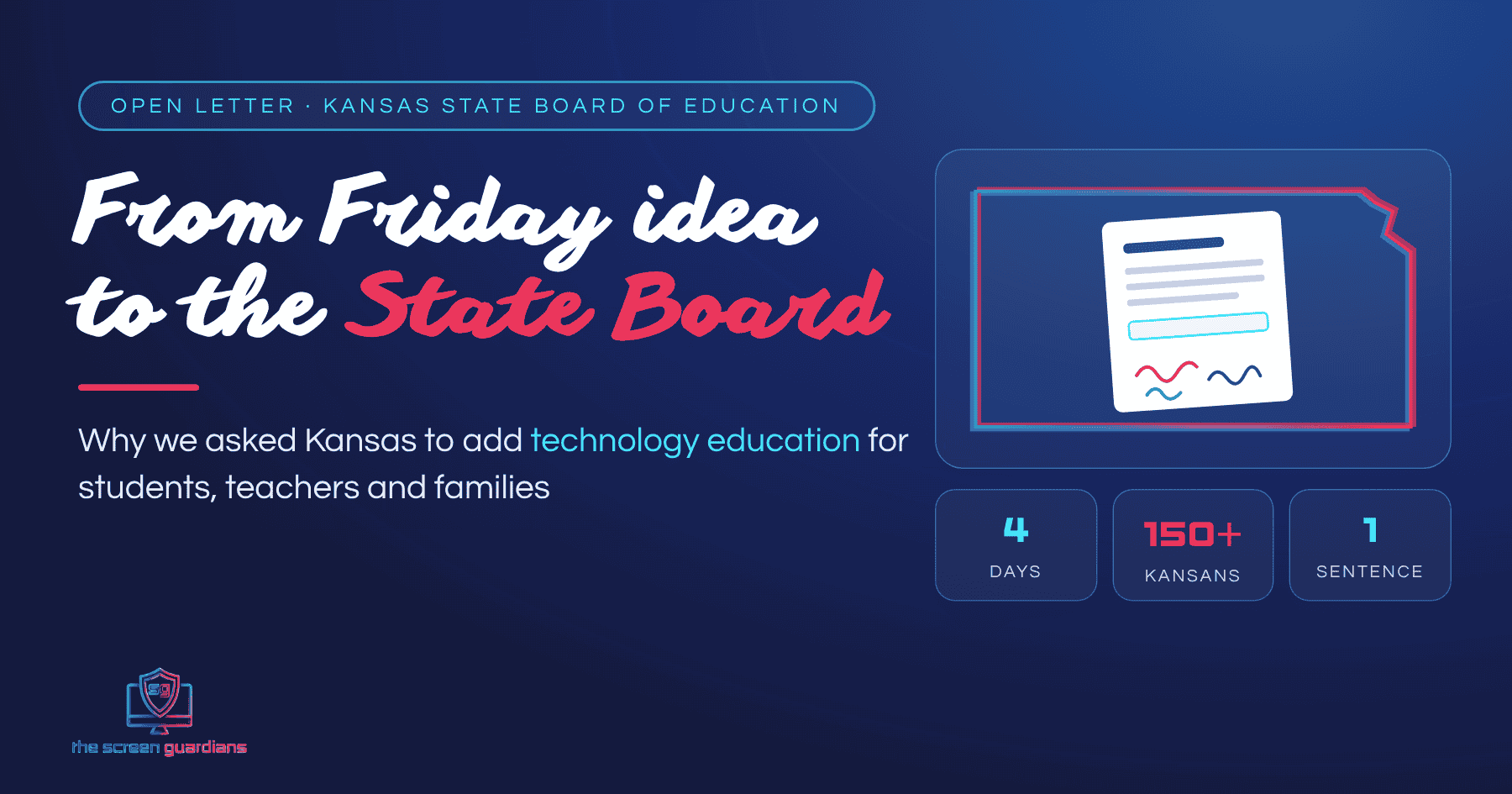
Four days. That’s how long it took for an idea to become an open letter signed by more than 150 Kansans and read aloud to the Kansas State Board of Education.
Before I share how it happened, I want to say thank you. To every parent, teacher, grandparent, administrator, health professional and student who added your name: you did this. I just carried it to Topeka.
Table of Contents
Friday to Tuesday
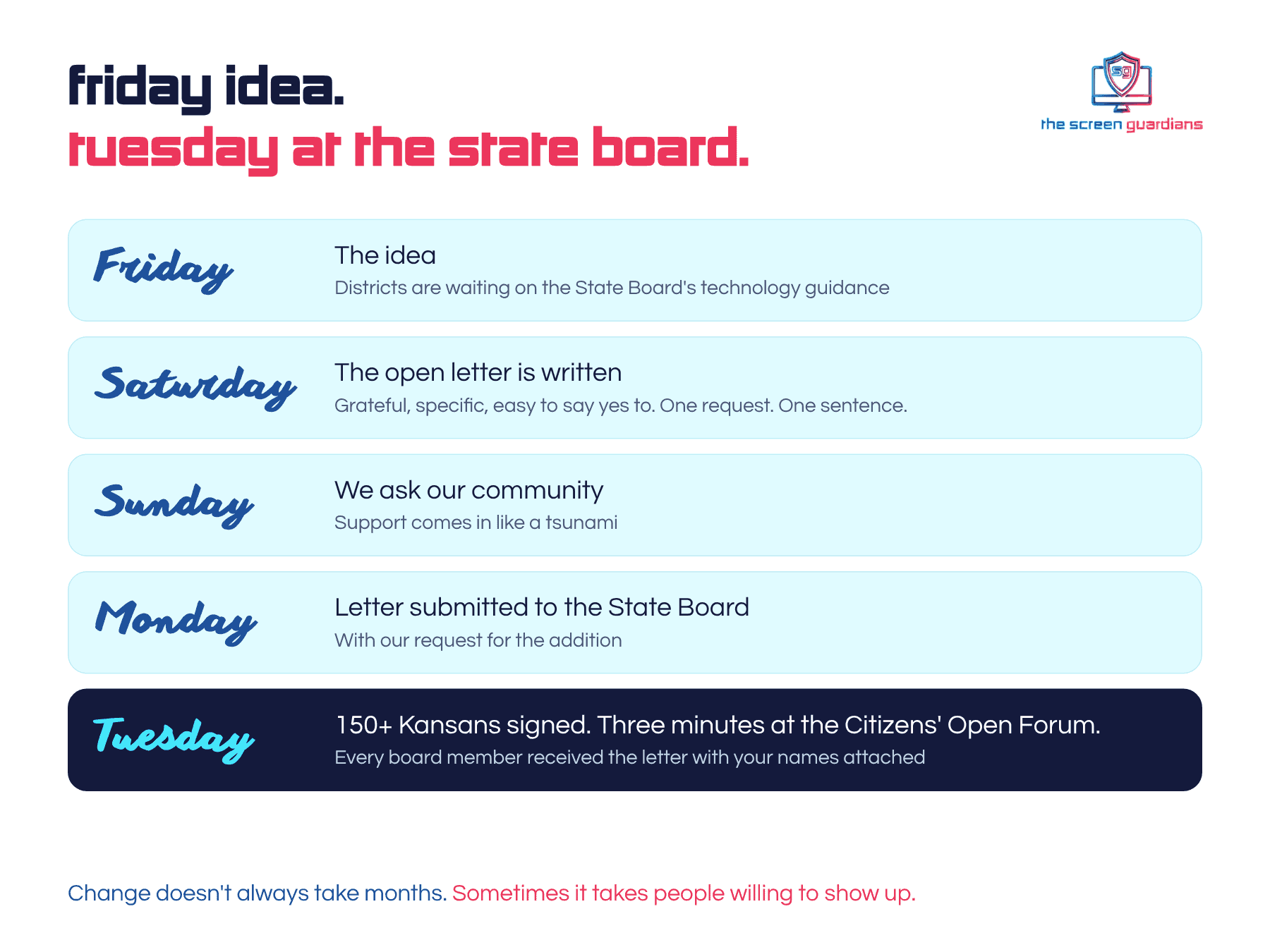
Friday: The idea came. Until then, I didn’t think we could do much to influence the board’s focus. Then I realized that school districts and local boards are waiting to hear what the State Board recommends on technology. If the board makes education part of its technology policy or guidelines, far more students, teachers and parents could receive the education we believe is pivotal for digital well-being.
Saturday: I wrote the open letter. I wanted it to be grateful, specific and easy to say yes to. One request. One sentence. Susan Dunaway, our CNO, reviewed it, gave feedback and proofread it.
Sunday: We reached out to our community and asked for support. I hoped a handful of people would sign. Then the support came like a tsunami.
Monday morning: We submitted the open letter to the State Board with our request for the addition.
Tuesday morning: More than 150 Kansans had signed. That morning I stood before the board during the Citizens’ Open Forum and shared our request in three minutes. Each member of the board, as well as Commissioner Dr. Jake Steel, Deputy Commissioner Dr. Zach Conrad and legal counsel, received a copy of the letter with your names attached.
The board was receptive, and I am deeply grateful for the time and care they gave us.
Why education, and why now
Our focus has always been education. I believed it would come to Kansas schools through a standard, a formal expectation that every student learns how technology affects their brain, their learning and their safety.
But over the past few months, the board has been focused on technology policy and guidelines. That’s important work. Boundaries matter. So we pivoted. Instead of waiting for a standard, we asked the board to extend the policy it was already writing to include technology education for everyone: students, teachers and families.
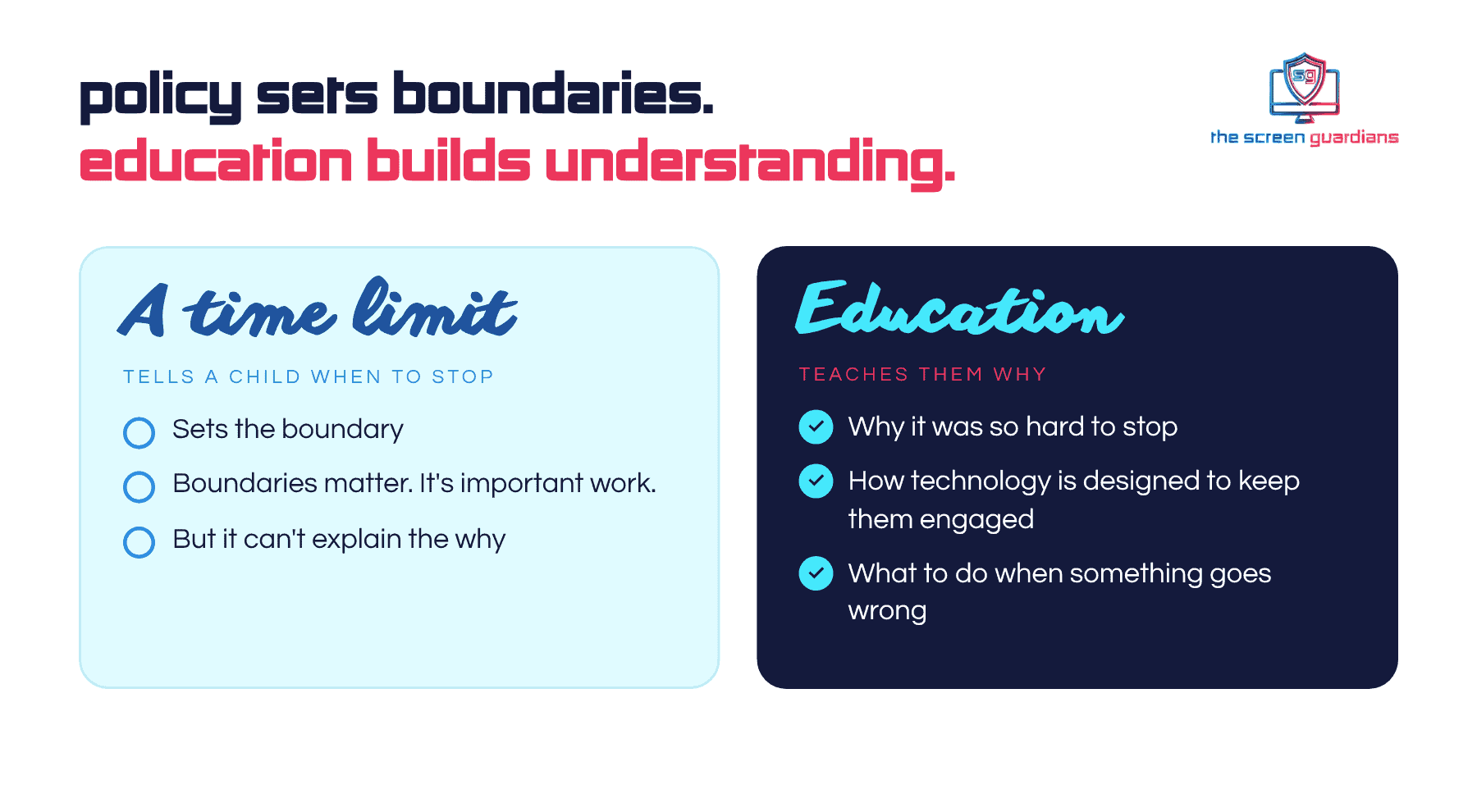
Here’s why that matters. Policies and guidelines establish boundaries, but education builds understanding. A time limit tells a child when to stop. It doesn’t teach them why it was so hard to stop, how technology is designed to keep them engaged, or what to do when something goes wrong.
That understanding has to be taught.
What we asked the Kansas State Board of Education to add
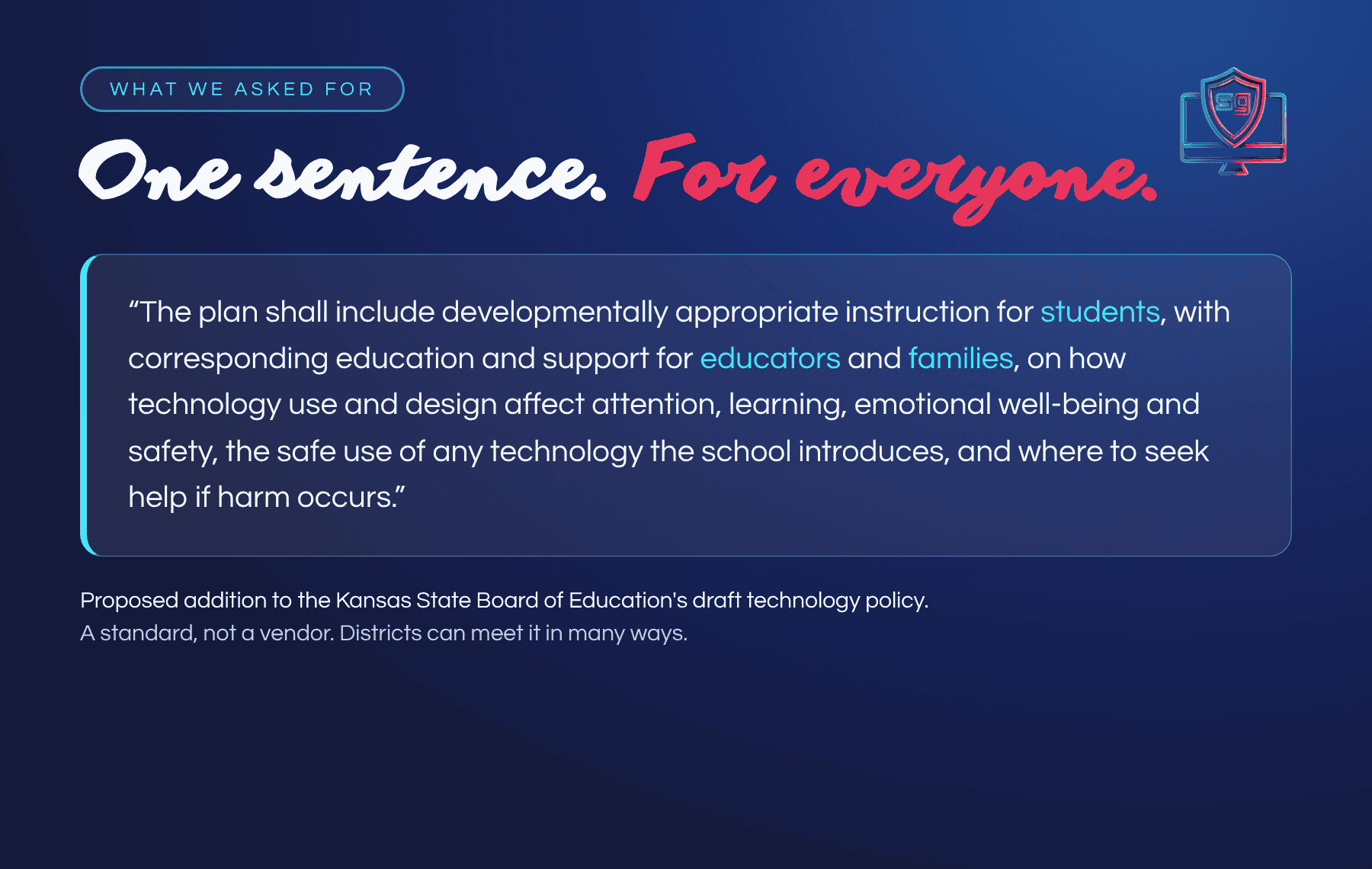
The draft policy already asks each district to address digital citizenship and student well-being. We asked the board to add one sentence:
“The plan shall include developmentally appropriate instruction for students, with corresponding education and support for educators and families, on how technology use and design affect attention, learning, emotional well-being and safety, the safe use of any technology the school introduces, and where to seek help if harm occurs.”
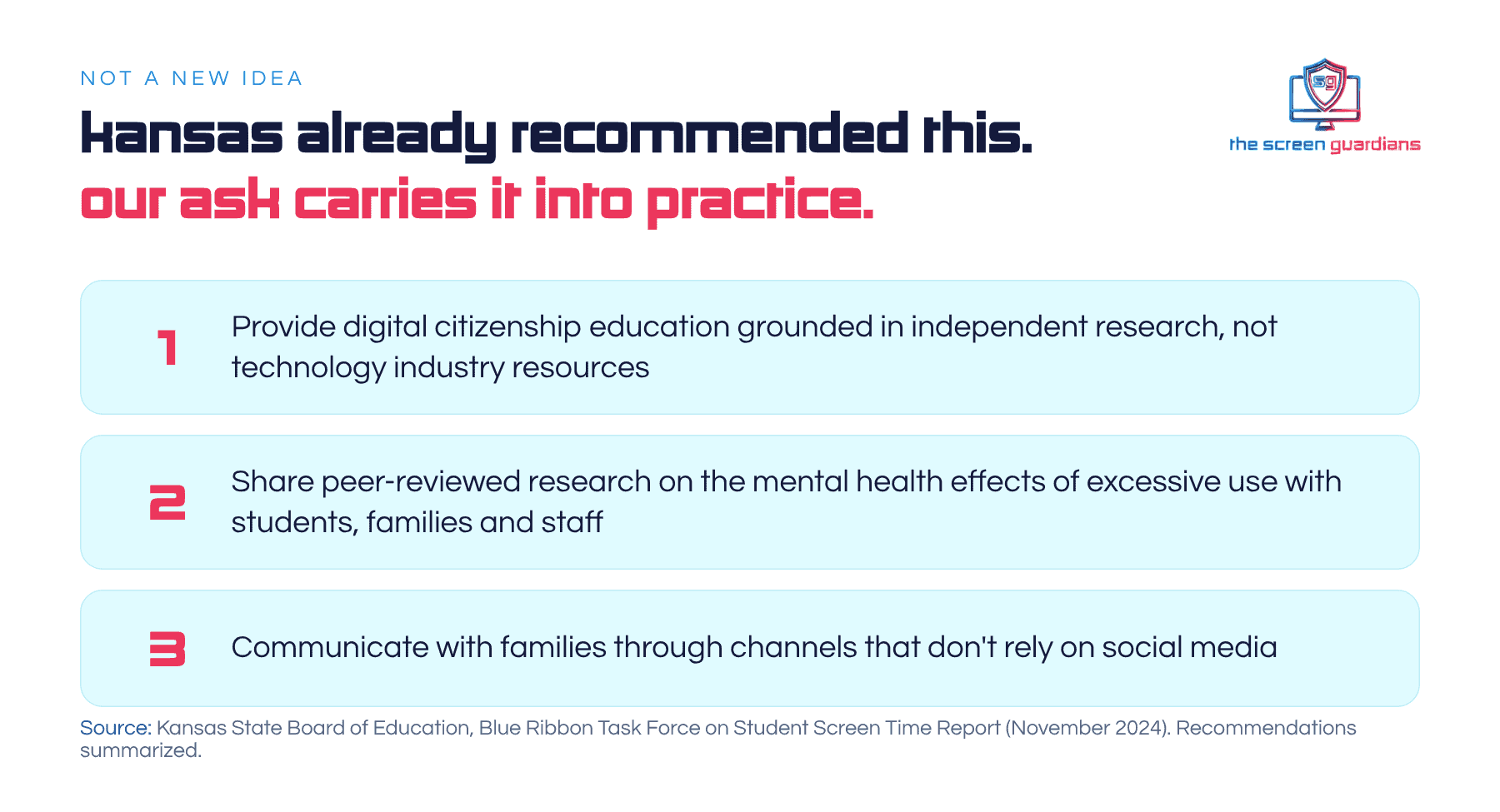
This isn’t a new idea. It builds on the board’s own Blue Ribbon Task Force on Student Screen Time, whose 2024 report recommended that districts:
- Provide digital citizenship education grounded in independent research, not technology industry resources
- Share peer-reviewed research on the mental health effects of excessive use with students, families and staff
- Communicate with families through channels that don’t rely on social media
Our request simply carries those recommendations into district practice. It’s a standard, not a vendor. Districts can meet it in many ways.
In your words
Seventy of you shared why you signed. Your words moved me, and I want the board to hear them too. A few of them:
“Being educated gives us a why, and when we have a why, we change!”
“Kids who understand how technology affects their attention, emotions, and relationships are better prepared than kids who are simply managed.”
“Kids are handed devices built to hook them before anyone teaches them how those devices work on the brain.”
“We need transparency. Not just policies, but the reasons and education behind them.”
“If not now, when?”
Some of you shared stories of loss that I will carry with me. Thank you for your courage in telling them.
As Syracuse Superintendent Paul Larkin put it, “Failing to address screen health in schools is almost education malpractice.”
What comes next
The board is still finalizing the policy, and we’ll keep you updated. In the meantime, you can read the full letter here. The signatures and statements in support are here too. You can also watch the meeting on the KSDE board meeting archive.
This week reminded me of something I believe deeply. Change doesn’t always take months. Sometimes it takes a clear idea, a community that cares, and people willing to show up.
A device policy tells children what they cannot do. Education tells them why, keeps them safe, and prepares them for the world they will live in. Kansas can lead on both.
Thank you for standing with our kids.
With gratitude, Katie
Frequently asked questions
What did The Screen Guardians ask the Kansas State Board of Education to add?
One sentence in the board’s draft technology policy. It asks each district’s plan to include developmentally appropriate instruction for students, with education and support for educators and families, on how technology use and design affect attention, learning, emotional well-being and safety, and where to seek help if harm occurs.
How many Kansans signed the open letter?
More than 150 Kansans signed in four days, including parents, teachers, grandparents, administrators, health professionals and students. Seventy of them shared why they signed.
What is the Blue Ribbon Task Force on Student Screen Time?
It is a task force convened by the Kansas State Board of Education. Its 2024 report recommended that districts provide digital citizenship education grounded in independent research, share peer-reviewed research on the mental health effects of excessive use, and communicate with families without relying on social media.
Why isn’t a school technology policy enough on its own?
Policies and guidelines set boundaries, and boundaries matter. But a time limit only tells a child when to stop. Education teaches them why it was hard to stop, how technology is designed to keep them engaged, and what to do when something goes wrong.
Does this request require districts to use a specific program?
No. It’s a standard, not a vendor. Districts can meet it in many ways.
If you’re ready to learn more
Want this education in your school now? The Screen Guardians is a K–12 digital health and safety program that teaches students, teachers and parents together. See how The Screen Guardians works.
Want to go deeper at home? The Parent Portal has videos, guides and scripts for the hard conversations. You can also read why we spoke before the Kansas Legislature on student well-being in a digital age.
Education is the greatest form of protection.