We talk a lot about what’s happening to kids with screens in the classroom. But here’s a question we don’t ask nearly enough: who is teaching the teachers?
In Episode 31 of The Screen Guardians Podcast, host Katie sits down with Dr. Elizabeth Walter — an assistant professor at Rockhurst University who prepares the next generation of educators, a former English teacher, a mom of two elementary-age kids, and the academic vice president of her children’s PTA. She lives this conversation from every angle: the lecture hall, the classroom, the dinner table, and the school board meeting.
What follows is one of the most hopeful, grounded conversations we’ve had about technology and learning. No fear. No shame. Just clear eyes and a deep belief that we can do better — because our kids are worth it.
Table of Contents
Pedagogy hasn’t changed. The classroom has.
Ask Dr. Walter if education has really changed and she’ll tell you: yes and no. How kids actually learn hasn’t changed. Good teaching is still good teaching. But education has a habit, she says, of “falling for the new and the bright and the shiny” — adopting the next big thing before we’ve asked whether it actually works. (Remember when phonics got tossed out… and then quietly came back as the science of reading?) Technology, she warns, is the newest version of that pendulum swing — and we may have pushed it too far.
The “digital native” myth
Here’s a line that stuck with us: “They’re digital natives in the social world… but I have students who don’t know how to double-space a document.” Today’s young people can film and edit a TikTok in their sleep. That doesn’t mean they know how to learn, focus, or stay safe online.
Dr. Walter estimates that teacher training is roughly 99% pedagogy and strategy and just 1% specific tools — on purpose. The moment you commission a textbook on a platform, it’s obsolete. So instead of teaching the app, she teaches something more durable: How do we hold kids’ attention? And how do we keep them safe — physically, mentally, and emotionally?
Why every future teacher researches a school’s tech policy
One of the most eye-opening assignments in her classroom management course: before her students ever apply for a job, she has them research the tech policies of the schools they hope to teach in. They read the acceptable use policies (AUPs), the contracts parents and students sign — and then they hunt for the holes.
Why? Because a weak, vague policy doesn’t just fail kids. It leaves teachers dangling, often holding liability they never signed up for. (Picture being told to confiscate a student’s $2,500 phone… and then it goes missing off your desk.)
The case for cell phone bans — and why teachers are relieved
This is where Dr. Walter gets genuinely excited. Both Missouri and Kansas have passed bell-to-bell cell phone bans, and she sees them as a gift — not because phones are evil, but because consistent, school-wide policy takes enforcement off the individual teacher’s plate.
When phone rules are left to each teacher, you get chaos: the “cool” teacher who lets everything slide, the new teacher who’s afraid to push back, and the veteran who becomes “the bad guy.” Kids — like all of us — feel safer with clear, fair, consistent parameters. “We’re going to look back on phones in school,” she says, “the way we look back on smoking lounges in high schools.”
What actually makes a great teacher
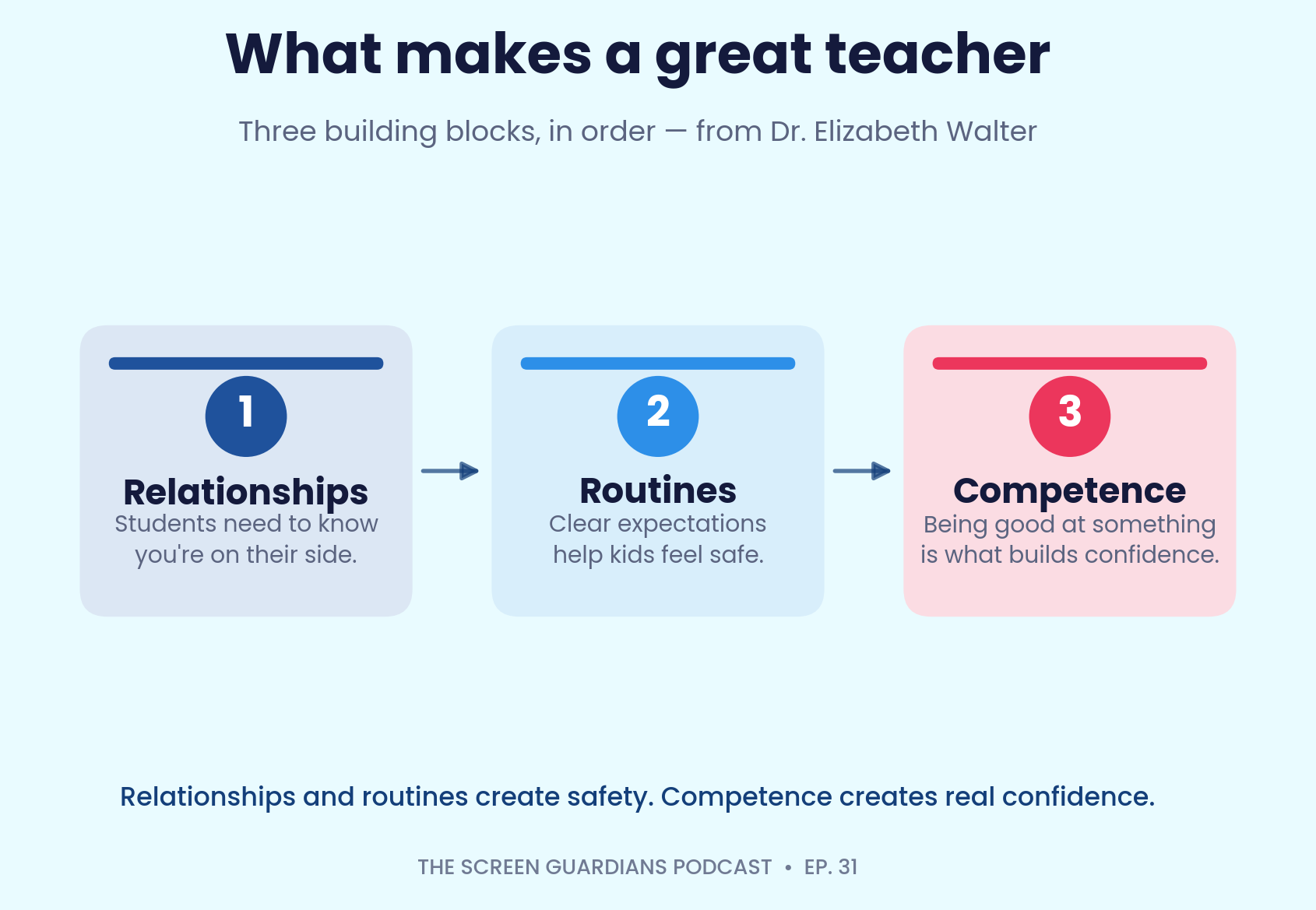
Strip away the tech debate and Dr. Walter’s philosophy is timeless. Great teaching, she says, starts with relationships — students need to know you’re on their side. Then come routines and procedures, because clear expectations help kids feel safe (yes, even the ones who push back — testing limits is developmentally normal). And finally, the heart of it all: competence.
“The biggest builder of self-esteem is being good at something,” she reminds us. Help a child read well, write with confidence, and master the material — and you’ve done more for their mental health than almost anything else.
What about the research on classroom devices?
We had to ask: does technology have a “best fit” in learning? Her honest answer: the research doesn’t support what we’ve been sold. A lot of ed-tech research, she notes, is commissioned and paid for by ed-tech companies. Meanwhile, test scores have been trending down (a slide that predates COVID), and her colleagues in the English department have gone back to handwritten blue books because of AI.
Districts have poured millions into devices — her own just approved a $12 million iPad refresh — without the data to show it’s making kids better readers, better thinkers, or better humans. “Show me the data,” she says. “No one’s been able to.”
The most powerful thing a worried parent can do
If you’re a parent reading this and feeling out of your depth, Dr. Walter has a message for you: you are the expert in your kid. You don’t need a doctorate in education to notice that extra screen time leaves your child dysregulated, or that something feels off.
Knowledge is power — so read up, go to the school board meetings, join the PTA, and speak up. “You have a seat at the table,” she says. She’s also clear-eyed about the growing divide between families who have the bandwidth and information to set limits and those who don’t. Her posture throughout? Meet people where they are. No judgment. We’re all just doing our best.
When you know better, you do better
Maybe the most freeing idea in the whole episode: none of us has to have done this perfectly. Dr. Walter shares how she once thought a phone face-down on a desk was a fine policy — until she read the research on how even a nearby phone fractures our attention. So she changed. “When you know better, you do better.” That grace extends to the parent handing a toddler a phone in the grocery store, the district locked into a contract, and every teacher learning as they go.
Her closing belief is one we share at The Screen Guardians: doing hard things is hard — but it’s also worth it. Getting back to balance, between tech and analog, restriction and understanding, is exciting. And our kids are worth the effort.
Listen to the full episode
There’s so much more in the full conversation — including a skeptical mom’s powerful aha moment and why cell-phone-free schools never seem to go back. Listen to Episode 31 with Dr. Elizabeth Walter on The Screen Guardians Podcast.
And if this stirred something in you, remember: you don’t have to navigate screen time alone. Start where you are. Explore our free parent course, join us inside the Parent Portal, or subscribe to the newsletter for grounded, judgment-free support. We’re walking this road right alongside you — step by step.