If you’ve ever felt the pit-in-your-stomach worry about your kid’s phone, their group chats, or who might be messaging them in a game lobby — you’re not alone. And if you’ve ever wondered why we, as a community, are so good at responding to harm but not as intentional about preventing it before it ever begins, this post is for you. Learning how to protect kids online doesn’t start when something goes wrong. It starts long before the first message ever lands.
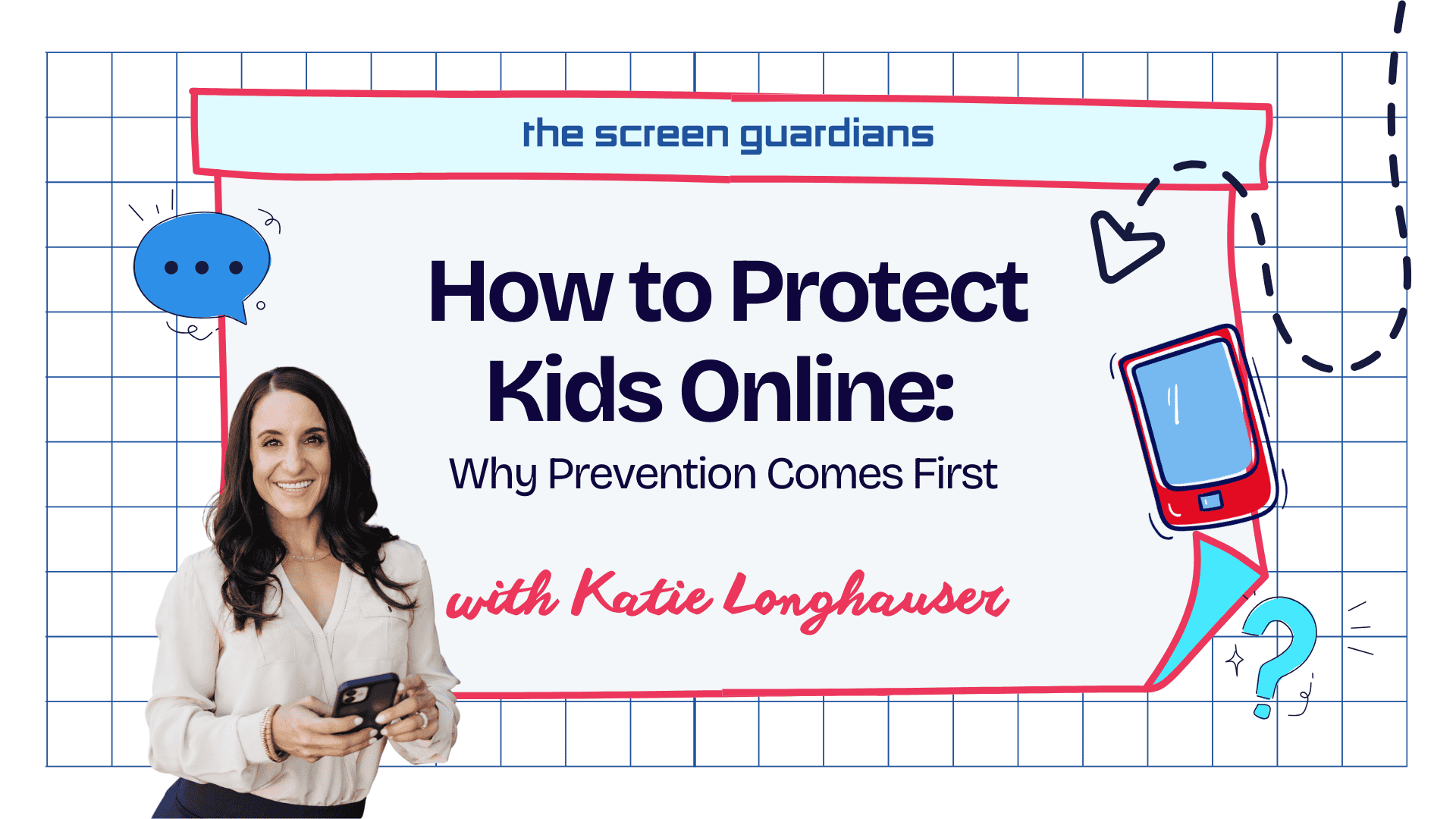
This post is a deeper look at a recent solo episode of The Screen Guardians Podcast — “Are We Showing Up Too Late?” — where I shared a question I haven’t been able to shake: What if prevention became the first layer of protection, not the second?
Table of Contents
Why “How to Protect Kids Online” Has to Begin Before the First Message
Most of the systems we’ve built — law enforcement, healthcare, nonprofits — are designed to respond. Crime happens, then we investigate. Illness presents, then we treat. A child is exploited, then we step in to support recovery. That work is sacred. It is necessary. People who do it deserve every dollar and every ounce of energy our communities can give.
But it raises a quiet question: if we’re so good at showing up after the harm, why aren’t we as intentional about showing up before?
This past weekend, my church gave generously to an organization that supports victims of human trafficking. With the World Cup coming to Kansas City this summer, local trafficking-response groups are bracing for an increase in incidents. As a mom in the suburbs of Kansas City, I sat in that pew thinking about my own kids and the kids in our schools — and I kept landing on the same word: prevention.
Prevention is the foundation of The Screen Guardians. Education before harm. Conversations before crisis. Awareness before exploitation.
The Starting Line of Harm Has Moved
Here’s what’s changed for this generation of kids: risk no longer begins in the physical world. It begins online.
It begins with a message in a game chat. A direct message on a social app. A friend request from someone who seems harmless. According to the National Center for Missing & Exploited Children, online enticement reports have multiplied dramatically in recent years — and the grooming process almost always starts with something that doesn’t feel dangerous in the moment.
It feels friendly. It feels exciting. The child feels seen, complimented, important. And by the time anyone notices, the conversation has already moved somewhere it shouldn’t.
If exploitation can begin with a simple message, then prevention has to begin before the message ever happens.
Why Prevention Feels Invisible (and Response Feels Urgent)
Prevention is hard to rally around because it’s, by definition, invisible. A victim is visible. Pain is visible. Crisis moves us to act. Prevention, though, looks like:
- A conversation that might stop something early
- An education program that might change a decision
- A piece of awareness that might shift the path
- A skill a child might never need to use
It’s all hypothetical. So it’s harder to fund, harder to prioritize, harder to feel.
But just because prevention is quieter doesn’t mean it’s less powerful. The kids whose parents have already had the talk. The students who recognize a tricky person on the first message. The families who built a Recovery Plan before anything ever went wrong. Those kids never make the headlines — and that is exactly the point.
What Online Safety Education for Parents Actually Looks Like
When I talk about online safety education, I’m not talking about scaring kids or installing more surveillance. I’m talking about preparation, not fear. I’m talking about giving kids — and the adults guiding them — the tools they need before they need them.
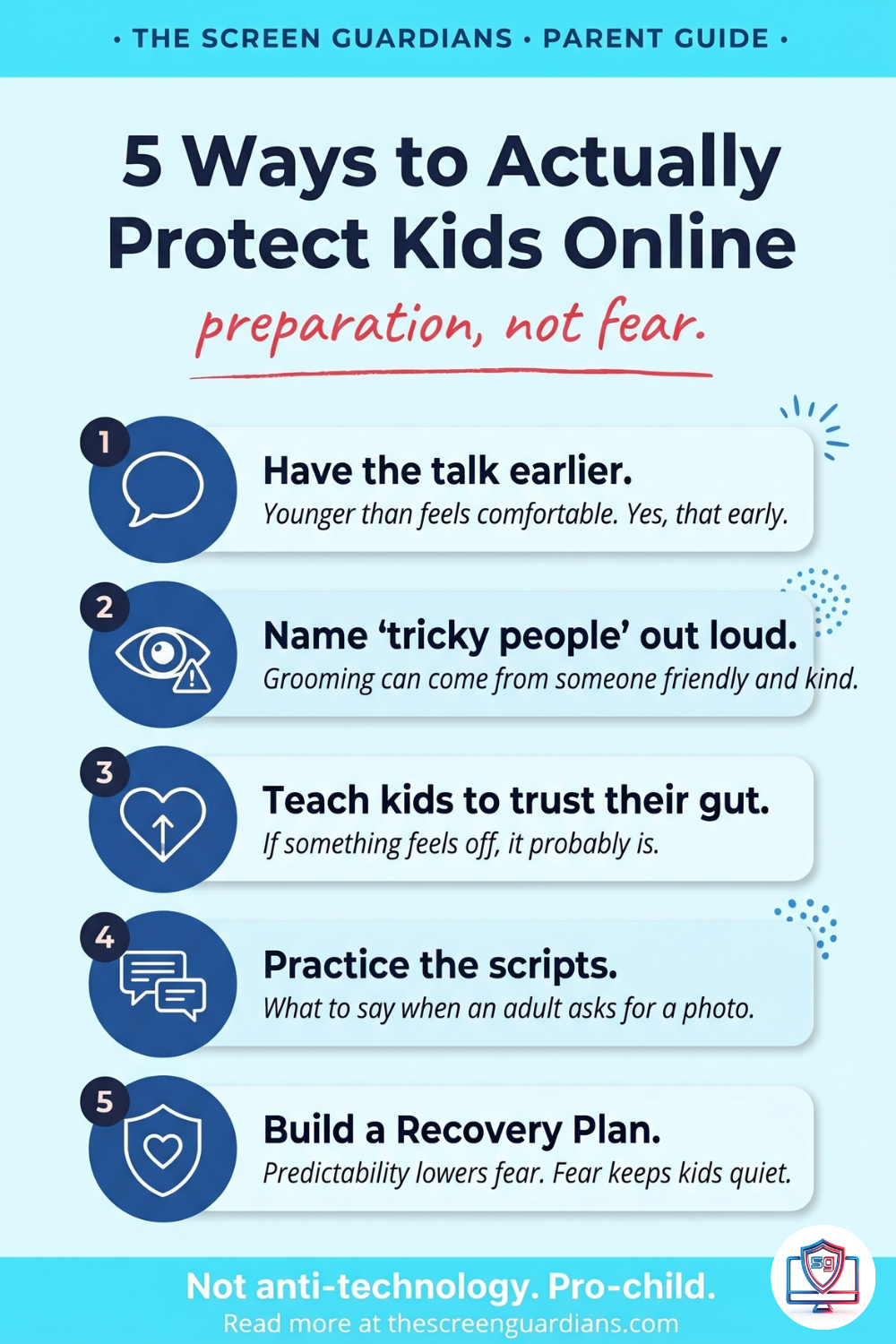
Here is what real prevention looks like at the family level:
- Earlier conversations than feel comfortable. If the average kid sees explicit content younger than we’d like to admit, our conversations need to start younger than we’d like to admit.
- Naming “tricky people” out loud. Kids should know that grooming can come from someone friendly, complimentary, and seemingly safe — including online.
- Teaching kids to trust their gut. “If something feels off, it probably is. You won’t be in trouble for telling me.”
- Practicing scripts. What do you say when an adult asks for a photo? When a stranger sends a friend request? When a “friend” of a friend wants to move to another app?
- Building a Recovery Plan in advance. Kids who know what will happen if they make a mistake are far more likely to come to us when they do.
None of this is anti-technology. It’s pro-child. It’s how we protect kids online without locking them out of the world they’re going to live in for the rest of their lives.
What Schools and Communities Can Do
Prevention also has to scale beyond the dinner table. Schools can teach digital health alongside digital skills. Communities can build shared language around safety, so that whether a child is at home, in a classroom, at a friend’s house, or at a tournament, the message is consistent. The American Academy of Pediatrics has been clear for years: a Family Media Plan and proactive digital health education make a measurable difference in outcomes — long before a problem is ever flagged.
This is exactly why our K–12 program at The Screen Guardians is delivered by classroom teachers, supported by parent companions, and built around brain science. Education and connection between school and home are how prevention becomes a community practice instead of a private burden.
Moving the Starting Line: Prevention First, Response When Needed
Right now, the cultural model is: harm happens → we respond → we help people recover. What if we expanded it to: prevention first → awareness second → support and recovery when needed?
We are not removing response. We are moving the starting line. We are saying that the place to spend time, energy, and resources is at the top of the funnel — where one good conversation can keep a child from ever having to be a statistic.
I want to be very clear: this isn’t about blame. This is not me criticizing the people who do recovery work. They are sacred to me. But if we agree that the harm starts online — and we do — then we have to agree that the protection has to start there too.
Three Small Shifts You Can Make This Week
- Have one conversation earlier than you think you need to. About a phone, an app, a group chat, a story you saw in the news. Don’t wait for a problem to be the trigger.
- Name a tricky person out loud. “Sometimes adults online try to be friends with kids in a way that’s not safe. If that ever happens, I want to know — no matter what.”
- Build the Recovery Plan now. Decide together what happens if a mistake gets made online. Predictability lowers fear, and fear is what keeps kids quiet.
Frequently Asked Questions
Q: At what age should I start teaching my child how to protect themselves online?
A: Earlier than feels comfortable. If your child has any access to a connected device — even a tablet, a gaming console, or a smartwatch — age-appropriate online safety education should already be happening. The first conversations can start as young as four or five with simple language about “tricky people.”
Q: Isn’t talking about online predators going to scare my kids?
A: Not when it’s framed as preparation, not fear. Kids are reassured by clear language and a confident, calm parent. The shame and silence that come from not talking about it are far more dangerous than an honest, age-appropriate conversation.
Q: What if my child has already had a bad experience online?
A: First, you are not alone, and your child is not broken. The most important step is connection, not control. Avoid shame, listen first, and build a Recovery Plan together. Inside the Parent Portal we walk parents through exactly how to handle these moments.
Q: How is The Screen Guardians different from monitoring or parental-control apps?
A: Monitoring tools watch behavior. Education changes it. We’re not anti-technology and we’re not anti-monitoring — we just believe the strongest, longest-lasting protection comes from teaching kids why their brains respond to technology and how to navigate it. Connection over control. Education over restriction.
Q: What’s the single most important thing I can do this week to protect my kids online?
A: Have a calm, curious conversation. Ask what apps and games they use, who they talk to, and what they’d do if something felt off. One conversation isn’t the whole answer — but it is the doorway to all the others.
You Don’t Have to Do This Alone
If this episode and post resonated with you, share it with another parent, an educator, or a community leader who needs the reminder. We don’t need to choose between supporting victims and preventing harm — we just need to stop treating prevention like the second step.
At The Screen Guardians, we believe education is the greatest form of protection. We believe parents are capable, kids are smart, and communities can change when we get ahead of harm instead of always chasing it.
If you want a calm, judgment-free place to figure this out alongside other parents, come join us inside The Parent Portal. And if you haven’t yet, listen to the full podcast episode that inspired this post — sometimes the conversation hits differently when you can hear it.
When we educate early, communicate often, and lead with intention, we don’t just respond to problems. We prevent them.
Not anti-technology. Pro-child.