You already know the screens are an issue. You feel it in the eye rolls. You feel it in the bedtime battles. You feel it in your own thumb as you scroll one more time before sleep. Raising healthy kids in a digital age isn’t about removing devices — it’s about raising kids who actually know how to use them. In this post, clinical psychologist Dr. Shreya Hessler returns to the Screen Guardians podcast with practical, neuroscience-backed strategies you can start tonight — without yelling, shaming, or starting World War III at the dinner table.
You’re not alone in this. Let’s walk it together.
Table of Contents
Why Raising Healthy Kids in a Digital Age Feels So Hard Right Now
Most parents we talk to already know screens are impacting their kids. The research keeps confirming what your gut keeps whispering — too much, too young, too often. The hard part isn’t the awareness. The hard part is the translation.
How do you actually take a phone away without a meltdown? How do you set a limit without losing your mind? And once the device is finally down… what are kids supposed to do instead?
That’s the gap Dr. Hessler is closing. Recently, she gathered more than 150 parents in a high school auditorium north of Baltimore for a community night called Raising Healthy Kids in a Digital Age. What she heard there mirrored what she hears in her therapy office every single day:
- Parents are exhausted from the daily screen-time battle.
- They feel isolated, like every other family has it figured out.
- They want a roadmap — not more guilt.
The good news? There is a roadmap. It just looks different than most parents expect.
The Volcano Rule: Have the Conversation When Everyone Is Calm
One of Dr. Hessler’s most powerful reframes is what we’re calling the volcano rule. As a parent, you would never reach into an active volcano. So why do we keep trying to reason with our kids in the middle of an emotional eruption — phone yanked, voices raised, everyone activated?
“We want to be able to have a conversation about a behavior change when the temperature of the household is rather calm versus volcanic,” she shared on the podcast.
The shift sounds simple, but it changes everything:
- Notice the behavior — what your child looks like on the device, and what they look like coming off of it.
- Wait for calm — don’t address it mid-meltdown.
- Talk about the disposition, not the device — “I’ve noticed it’s hard for you to come off your video games” lands differently than “Get off that thing right now.”
And remember — pushback is normal. “It’s not a battle if the other side doesn’t engage,” Dr. Hessler said. Your calm is the off-ramp.
Micro-Experiments: The Secret Sauce for Real Behavior Change
Most families don’t need a 47-page family tech contract. They need one small experiment they can actually do — together.
That’s the heart of Dr. Hessler’s “micro-experiment” approach. Pick one tiny shift. Try it as a family. See what happens. Then build from there.
“You cannot tell a child to put a phone down while it’s in your hand,” she reminded parents at the event. The kids notice. The kids always notice.
So instead of issuing rules from above, you experiment alongside them. Here are three research-backed places to start.
1. No Phones in the Bedroom
Long before social media took over the conversation, sleep researchers were begging us to keep TVs out of bedrooms. Phones are no different. The blue light, the buzzing, the late-night scroll — all of it impacts the restful sleep growing brains and bodies need.
Make this an everybody rule, not a kid rule. Your phone goes on the kitchen counter at 9 p.m. too.
2. Phone-Free Meals
Mealtimes are one of the most natural micro-experiments available to families. They build in:
- Eye contact
- Back-and-forth conversation
- The healthy ability to sit with silence — even a little boredom — without reaching for a screen
You don’t have to make it a production. Just put the basket on the counter, set the phones down, and eat.
3. Car Rides Are a Phone-Free Zone
This one is gold for busy families running from school to practice to games. A 30 to 45 minute car ride becomes a built-in window of disconnection — for everyone, including the driver.
Will there be huffing the first few times? Absolutely. Will it get easier? Yes. Bonus: hand your child agency by letting them choose the music. The point isn’t to lecture them about screen time. The point is just to be in the car together — fully present, looking out the windows, talking when something comes up.
Replace the Behavior — Don’t Just Remove the Device
Here’s where so many parents get stuck. We take the phone. The kid is bored. The kid is bored loudly. We hand the phone back. Cycle complete.
Removing the device is only half the work. The other half is replacing it with something a developing brain actually needs — multisensory experiences, real connection, and play.
Dr. Hessler defines multisensory simply: Can you touch it? Can you hear it? Can you smell it? Can you sing it? Those are the experiences that build the neural pathways supporting attention, regulation, and social skills.
And the most underrated tool in your replacement toolbox? Play. Not organized travel-team-with-trophies play. Just play.
The Quiet Crisis: Our Kids Have Forgotten How to Play
This is the part of the conversation that stopped us in our tracks. Last semester, Dr. Hessler asked her university students — most of them 18 to 22 years old — when was the last time they remembered playing without a device.
At least half of the class couldn’t remember.
They had to dig back to third or fourth grade to find an example.
That’s not a kid problem. That’s a culture problem. And it’s exactly why Screen Guardians exists — to help parents, schools, and communities make space again for the things developing brains actually need.
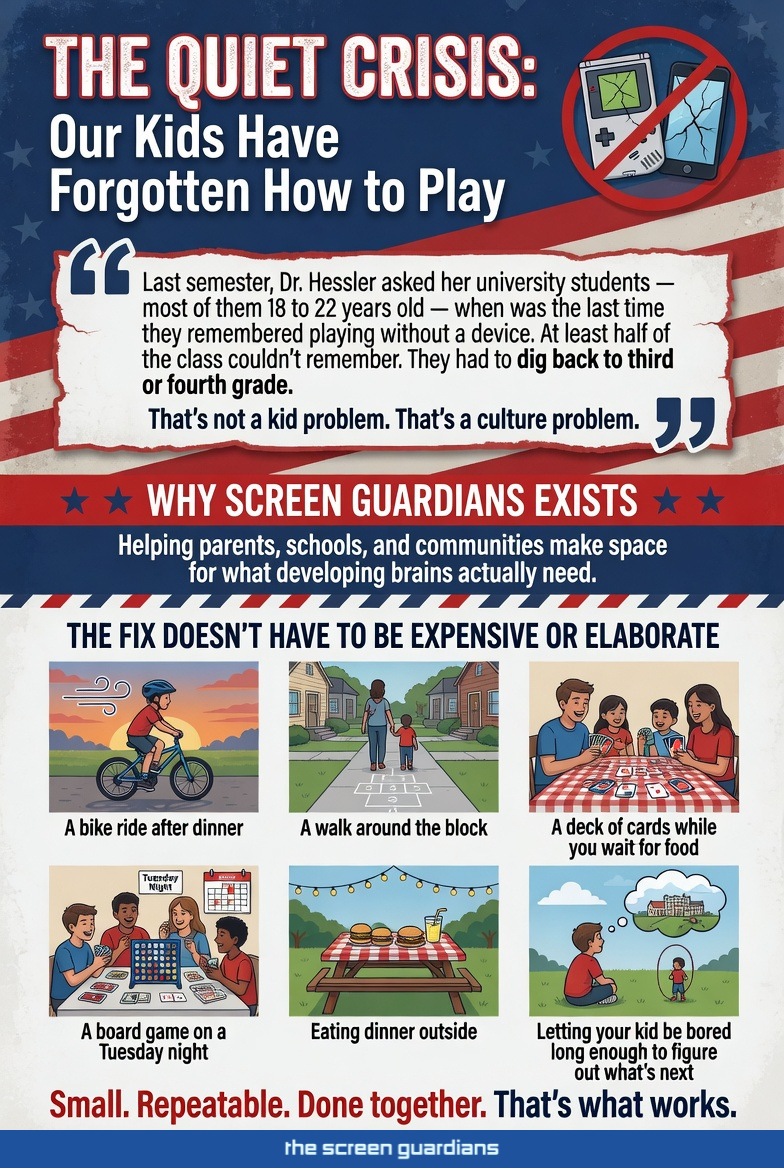
The fix doesn’t have to be expensive or elaborate:
- A bike ride after dinner
- A walk around the block
- A deck of cards at a restaurant while you wait for food
- A board game on a Tuesday night — Connect Four and Candy Land are still Dr. Hessler’s most-played office games, even with teenagers
- Eating dinner outside
- Letting your kid be bored long enough to figure out what’s next
Small. Repeatable. Done together. That’s what works.
Why Bell-to-Bell Phone Policies Aren’t Enough on Their Own
States across the country — including Kansas — are passing bell-to-bell phone-free school legislation. We support that. Dr. Hessler supports that. It’s a critical first step.
But a policy is not a curriculum. Removing devices from the school day creates space — and that space has to be filled with something. Recess. Unstructured play. Multisensory learning. Real conversations between students. The kind of human connection that COVID showed us we’d been quietly starving for.
Schools are uniquely positioned to give kids what their developing brains need: a six-to-eight-hour environment full of peers, eye contact, problem-solving, joy, and — yes — boredom. The Screen Guardians K–12 program was built to support exactly this work, giving teachers a once-a-week, 30 to 40 minute session that pairs the policy with the brain science behind it.
Because rules without understanding often breed rebellion. But when kids learn how technology affects their developing brain, they become more curious — not just more compliant.
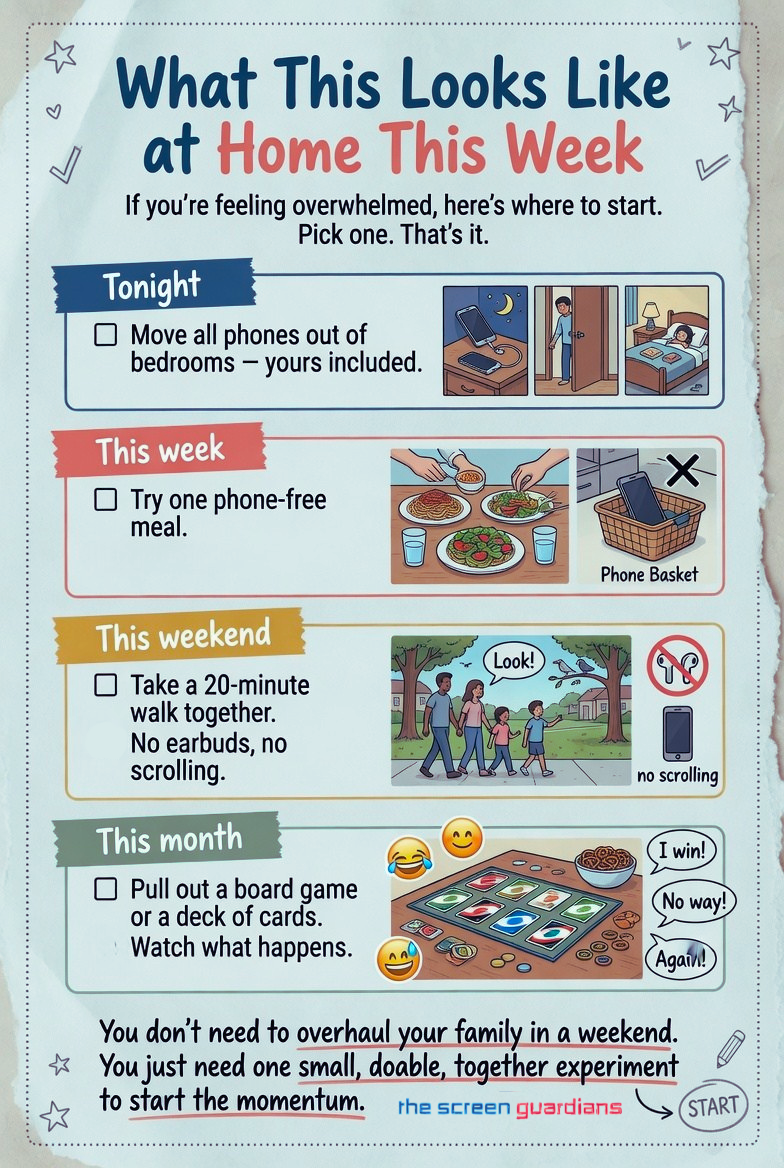
What This Looks Like at Home This Week
If you’re feeling overwhelmed, here’s where to start. Pick one. That’s it.
- Tonight: Move all phones out of bedrooms — yours included.
- This week: Try one phone-free meal. Just one.
- This weekend: Take a 20-minute walk together. No earbuds, no scrolling.
- This month: Pull out a board game or a deck of cards. Watch what happens.
You don’t need to overhaul your family in a weekend. You just need one small, doable, together experiment to start the momentum. For deeper research on why these small shifts matter so much for developing brains, the American Academy of Pediatrics has a strong library of family-facing resources.
Frequently Asked Questions
Q: What does “raising healthy kids in a digital age” actually mean if we’re not banning screens?
A: It means raising kids who can use technology intentionally instead of impulsively. The goal isn’t abstinence — it’s awareness, balance, and ownership. Kids who understand why their brain reacts to a phone are far more equipped than kids who are simply told to put it down.
Q: How do I get my kid to hand over the phone without a meltdown?
A: Start the conversation when everyone is calm — not in the middle of the moment. Talk about what you’ve noticed in your child’s mood when they come off devices, not the device itself. And remember to model what you’re asking for. You can’t ask a child to put down a phone that’s currently in your hand.
Q: Are bell-to-bell phone policies enough to fix the screen problem at school?
A: They’re a powerful first step, but no — not on their own. Removing phones creates space, but the space needs to be filled with play, multisensory learning, and real social interaction. Policies plus curriculum plus parent partnership is what creates lasting change.
Q: My kid is already deeply embedded with a phone. Is it too late?
A: It’s not too late. Start with one micro-experiment — phones out of bedrooms, phone-free meals, or phone-free car rides — and do it together as a family. Small, consistent shifts compound faster than you’d expect.
Q: What counts as “play” for a teenager?
A: Anything that’s joyful, low-pressure, multisensory, and ideally screen-free. Cards, hikes, cooking together, shooting hoops in the driveway, building something, even goofing off in the kitchen. It does not have to be organized or competitive to count.
You Don’t Have to Navigate This Alone
If this conversation hit home, you’ll love the full episode with Dr. Shreya Hessler on the Screen Guardians podcast. And if you want a calm, judgment-free place to land when the screen stress feels heavy, The Parent Portal is full of conversation starters, scripts, and short coaching videos for exactly these moments.
You’re already doing the hardest part. You’re paying attention. Pick one micro-experiment this week, do it together, and let us know how it goes.
Real tools. Real voices. Real support. Start where you are.