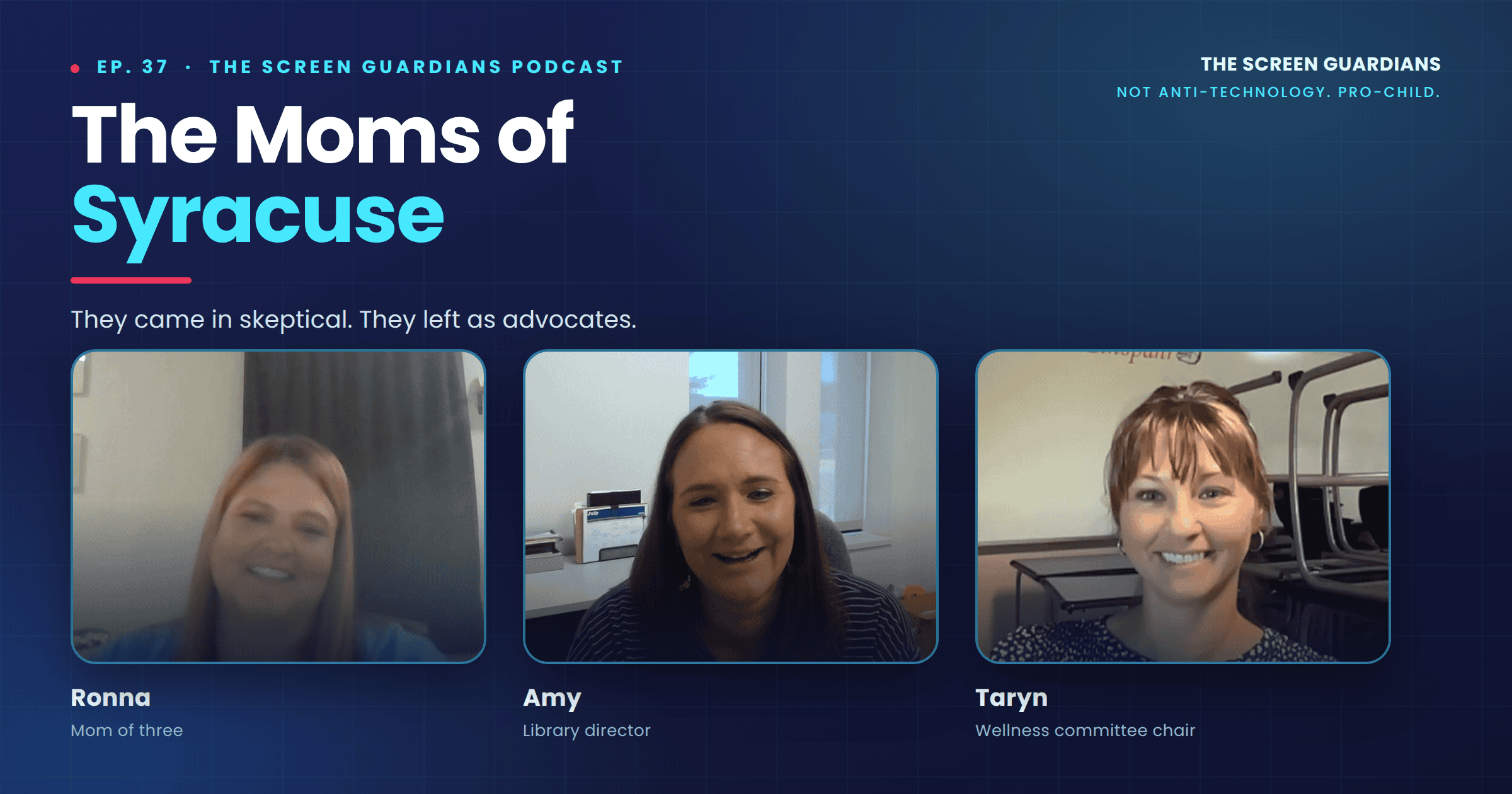
When a school announces a new program about screens, most parents brace for one of two things: a lecture, or a guilt trip. That was exactly the mood in Syracuse, Kansas, when digital wellness education in schools showed up on the calendar at USD 494. Three moms — Ronna, Amy, and Taryn — came to the first parent night with their arms crossed and their questions loaded.
Today, those same three women are some of the strongest advocates for digital health in their community. Two of them have testified in front of the Kansas State Board of Education. All three have changed the way technology works inside their own homes.
What flipped them wasn’t fear. It was education. In Episode 37 of The Screen Guardians Podcast, they sat down with host Katie and told the whole story — skepticism included. Here’s what they shared.
Table of Contents
They walked in expecting to be told technology is bad
Ronna is a stay-at-home mom of three. When her superintendent brought up The Screen Guardians in a committee meeting, her reaction was pretty typical.
“I was like, another, you know, technology’s bad.” — Ronna
Taryn — a mom of three and the chair of her district’s wellness committee — had a sharper concern, and an entirely fair one.
“My first impression of it was another company coming in to collect data on our students, because I feel like that’s a really popular thing at public schools. They mandate things, and really what they’re doing is collecting data.” — Taryn
She also wanted to know exactly what would be taught, and who would be teaching it. Amy, the director of the county library and a mom of two, came in more curious than critical — but she carried the same worry underneath.
“I was concerned that I was going to be shamed, or my kids were going to be shamed.” — Amy
None of that is unreasonable. Those are the questions engaged parents are supposed to ask. And honestly? Their pushback made our program better. More on that in a minute.
The brain science is what actually landed
For Ronna, the turning point came during the parent education event, when neurotherapist Susan explained what technology does to a developing brain.
“It just clicked, like how it makes it so addicting. Like why we can’t get off our phones, because they’re trained to make us stay on it. And especially, like, the kids — they’re on their games and they’re programmed to keep them wanting more.” — Ronna
That reframe matters more than any rule. It moves the conversation from my kid has no willpower to this product was engineered by a team of very smart people to hold my kid’s attention. Shame goes down. Agency goes up.
Ronna and her daughter went home that night and changed a lot of things. There was pushback. It was still worth it.
For Amy, the moment came from the other side of the presentation — Kevin, the ICAC detective who covers digital safety.
“Locks just keep the good guys out. Bad guys are going to find the ways to do that.” — Amy
Taryn’s came later, at the state board meeting, when she learned what a digital footprint really is — and that it starts long before a kid ever opens social media.
“It doesn’t matter what they’re logged into. Once they put their email, their name, it’s forever.” — Taryn
Syracuse’s pushback built the Parent Portal
Here’s the part we’re proudest of, and it isn’t ours. When we presented in Syracuse in January of 2026, parents pushed back. That pushback made our team stop and ask a better question: were we bringing parents alongside their kids, or just teaching kids and hoping it stuck at home?
So we built a whole parent-facing layer of the program — resources, scripts, and lessons that let families learn what their kids are learning, in real time. Taryn used it immediately.
“My kids are just as strong-willed as I am… I had to be confident to stand by what I was saying, but also give them a reason why. There’s a why to this. And the resources that you had on the parent portal gave me that confidence to do it.” — Taryn
Her kids had no idea she’d just read it that morning. They only knew that mom suddenly knew what she was talking about — the apps, the lingo, the reasons. That’s the whole point of a school-to-home bridge.
What actually changed inside three Syracuse homes
None of these families went device-free. What they did was smaller, steadier, and far more sustainable. Here’s what stuck:
- Phones sleep outside the bedroom. Taryn’s older two put their phones in her room at night — and it’s now their job to remember, not hers. Forget, and you lose 30 minutes the next day.
- Screens came out of routines that never needed them. Amy started with the small stuff: no tablet in the bathroom during showers, no devices on the drive to the optometrist.
- Family meal time is protected — for everyone. All devices go away, parents included.
- Car rides became conversations. Amy’s family plays “if you could live anywhere in the world, where would you live and why?” instead of handing back iPads.
- Screen time stopped being a reward or a punishment. Taryn deliberately keeps it out of the reward system.
- Kids learned the why, not just the rule. Every one of them credits this with reducing the fight.
Ronna noticed the difference in her daughter first.
“She’s not as doom and gloom and poor me… She’s happier. She’s back to hanging out with her friends. She’s back to loving sports.” — Ronna
Amy’s came at the dinner table, 45 minutes in, when the conversation had devolved into the kind of silliness only a family can produce.
“Just listening to him giggle like that at the table, it was like, wow, we have missed out… we need more of these moments, because life goes too fast.” — Amy
The hard part nobody warns you about: feeling left out
This is the honest tension none of them sugarcoated. When your kid has boundaries and their friends don’t, your kid feels it. Taryn’s middle child gets left out of group gaming. Ronna’s daughter has an hour limit while her friends have none.
“She’s like, ‘Mom, I need more time.’ And I’m like, no, you don’t… So she does feel left out. So it is hard as a parent for that. But I just keep reminding myself that this is the right way, I hope.” — Ronna
The antidote isn’t a stricter rule. It’s other families. When Taryn found out her seven-year-old’s friend lives in a device-free house, she could finally tell him, see, we’re not the only ones. When a mom in town texts Amy so her son isn’t the last to hear about the pool, that’s the village doing its job.
That’s collective action. And it’s the reason this works better as a community effort than a solo one. If you’re a school leader thinking about this, we broke down the practical side in 7 lessons for schools rolling out a digital wellness program.
Why digital wellness education in schools belongs in the school day
Taryn is the first to say she doesn’t want the school parenting her kids. She’s also the first to say this:
“At the end of the day, I wouldn’t know anything about digital wellness or digital health if it wasn’t for the school.” — Taryn
She borrowed a line from Kevin to explain it: you don’t just hand a kid a car and expect them to drive. You teach them. Then school and home reinforce the same thing, in the same language.
Amy, who sees the town’s kids from behind the library desk, made the case even plainer.
“We have to be realistic that not every parent is engaged, or willing to be engaged… And so this may be the only time these kids are hearing these messages… It doesn’t matter if they know what two plus two is, if they don’t know how to function without a screen in front of their face.” — Amy
That’s the case for digital wellness education in schools in one breath. It isn’t about banning anything. It’s about making sure every kid gets the instruction, not just the ones whose parents happen to have read the research. Major health organizations are landing in the same place — the American Academy of Pediatrics now runs a Center of Excellence on Social Media and Youth Mental Health devoted to exactly this question.
“I came in thinking… but today I believe…”
Katie closed the episode by asking each mom to finish that sentence. Their answers are the whole episode in miniature.
“I came into Screen Guardians thinking that screen time equals learning. But today I believe that parents matter, and we can change how our kids learn and explore the world. And it does start with us.” — Taryn
“I came into Screen Guardians thinking I’d feel guilt and shame, but today I believe I feel more empowered to help my kids — and that it’s not too late to make changes.” — Amy
“I came into Screen Guardians thinking that I would feel shame and guilt. But I feel seen, I guess. I feel heard.” — Ronna
Amy added one more line, borrowed from that morning’s Screen Guardians email: the culture isn’t my compass. It’s okay for your house to do things differently.
Listen to the full episode
There’s a lot more in the conversation than we could fit here — including Taryn on the warped version of reality kids absorb from YouTube and TikTok, Amy on why this generation of parents will bubble-wrap the park but hand over an unsupervised internet, and an honest exchange about why cursive, typing, and waiting three seconds before you answer someone are all digital wellness skills too.
Listen to Episode 37: The Moms of Syracuse wherever you get your podcasts.
Frequently asked questions
What is digital wellness education in schools?
It’s structured, age-appropriate instruction on how technology affects the developing brain, how to stay safe online, and how to build healthy digital habits. In The Screen Guardians K–12 program it’s taught once a week for 30–40 minutes by a student’s own teachers, with a parent companion sent home so families stay in the loop.
Is this an anti-technology program?
No. Not anti-technology, pro-child. The goal is intentional use, not removal. Kids who understand why an app is designed to hold their attention make better choices than kids who are simply told no.
Does the program collect data on students?
No. The Screen Guardians does not collect student data and does not sell information to third parties. It’s a fair question to ask of any program entering your child’s school — ask it every time.
My kids have had devices for years. Is it too late?
It isn’t. Every mom in this episode started from somewhere they wish they hadn’t — one describes her youngest as an iPad kid from day one. He now rarely asks for it. Start with one routine, explain the why, and build from there.
You’re not doing this alone
What Syracuse proves is that skepticism isn’t the opposite of buy-in — it’s often the beginning of it. Three moms asked hard questions, got real answers, and turned into the people other parents in their town now call. No fear tactics. No shame. Just information, and the confidence that comes with it.
If you want the same tools these moms used at home, the Parent Portal is where they live — videos, scripts for hard conversations, and a judgment-free place to land. If you’re at a school and wondering what this would look like in your building, take a look at the K–12 program.
And if you’re just starting? Start where you are. That’s exactly what Ronna, Amy, and Taryn did.