
It started because I asked our school a simple question:
Can I see a comprehensive list of every app, program and EdTech platform our kids are using?
The question led to something I didn’t expect.
Our school paused.
They realized this deserved a deeper look—and instead of getting defensive, they acted.
They dedicated professional development time to evaluating the technology being used across the school.
What are we using? Is it necessary? Is it effective? Are teachers actually using it? What does it cost? What data does it collect? How is that data protected?
And perhaps one of the most important questions:
What is this technology replacing?
I am incredibly proud of our school for being willing to ask these questions.
Because this is what being proactive about technology in schools looks like.
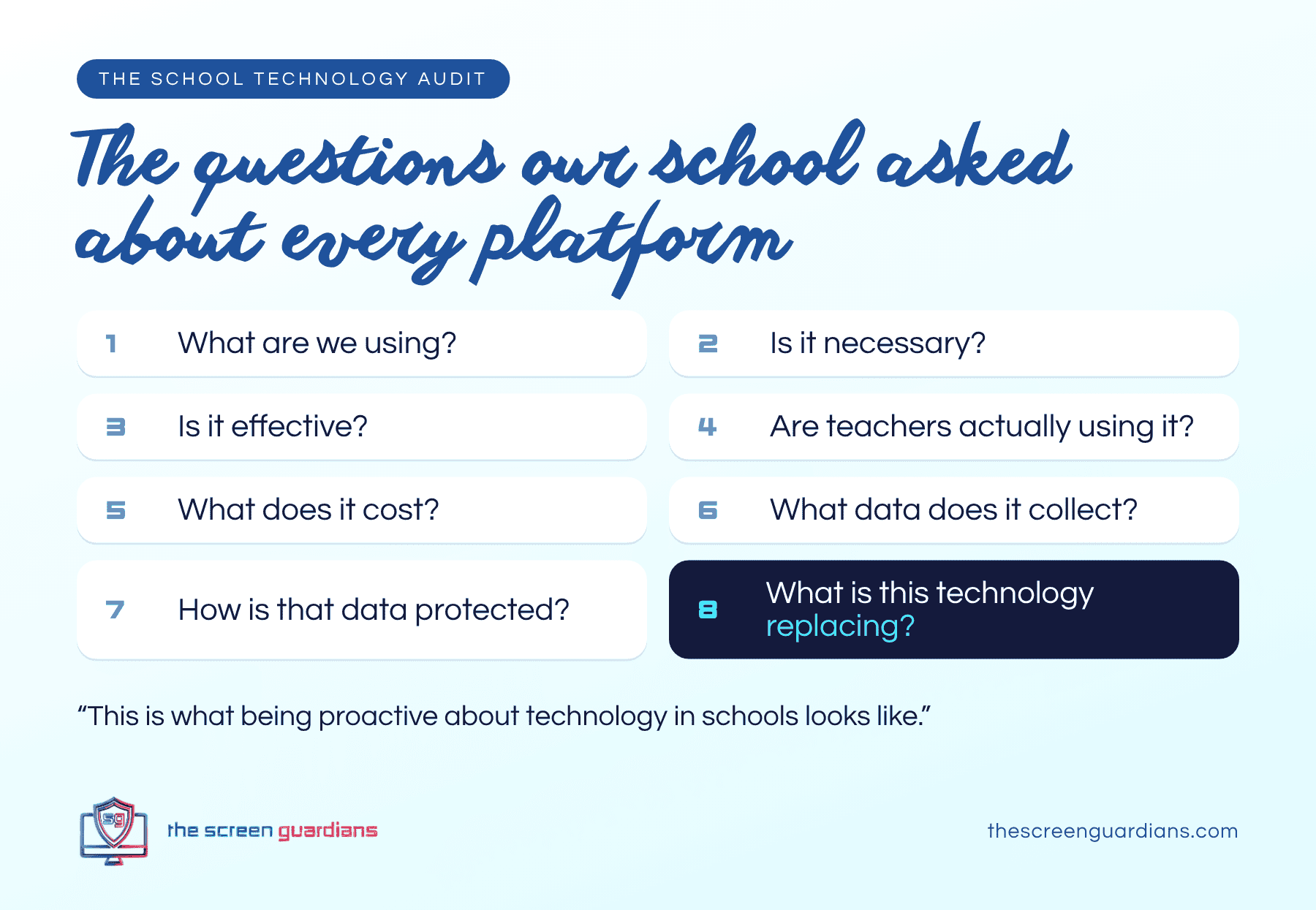
Table of Contents
Parents may have less visibility into technology in schools than they realize.
Many parents assume they personally approve every digital platform their child uses at school.
That’s not necessarily the case.
Under federal privacy laws, schools can, under certain circumstances, authorize EdTech providers to access or collect student information without obtaining individual parental consent for each platform.
For children under 13, COPPA allows schools in certain circumstances to consent on a parent’s behalf when information is collected for a school-authorized educational purpose—not for the company’s separate commercial purposes. FERPA also permits certain disclosures to outside providers without individual parental consent when specific requirements are met. [1][2]
These laws contain important protections.
But parents should understand this:
Your child may be interacting with technology and generating data at school without you personally reviewing and approving every individual platform first.
That’s one reason school oversight matters so much.
In fact, the U.S. Department of Education advises teachers to determine whether an application has been approved by their school or district before using it and warns that apps can introduce privacy and security vulnerabilities. [3]
“Educational” doesn’t automatically mean necessary.
Every platform should have to answer some basic questions.
What educational value does it provide?
What data does it collect?
How is that information protected?
What does it cost?
Is anyone actually using it?
And what are students getting in return?
Because there is another cost that doesn’t always show up on a school budget:
What is technology displacing?
If students are moving between apps, watching videos, completing gamified activities and navigating digital assignments, what aren’t they doing during that time?
Reading? Writing? Discussing ideas? Problem-solving? Interacting with a teacher? Working with classmates?
Or using the high-quality curriculum the school has already purchased?
This isn’t simply a philosophical question.
In September 2026, the American Psychological Association released a report examining children’s and adolescents’ learning with educational technology. Among its findings: measures like time spent, enjoyment, participation and completion can be mistaken for actual learning. The report also examines how attention-capturing design and the displacement of other activities can affect learning. [4]
In other words:
Engagement is not automatically learning.
Technology can absolutely enhance education.
But instead of asking only, Can we use this technology?
We should also be asking:
Does it improve learning enough to justify what it costs—in dollars, data, attention and instructional time?
We also need to understand the business behind the technology.
On a recent Screen Guardians podcast episode, Ben Gillenwater—the Family I.T. Guy—and I talked about the idea of separation time from marketing.
It has stuck with me.
Our children are growing up inside digital environments built by some of the largest companies in the world. Understanding the business models behind those environments should be part of digital literacy.
Take Google.
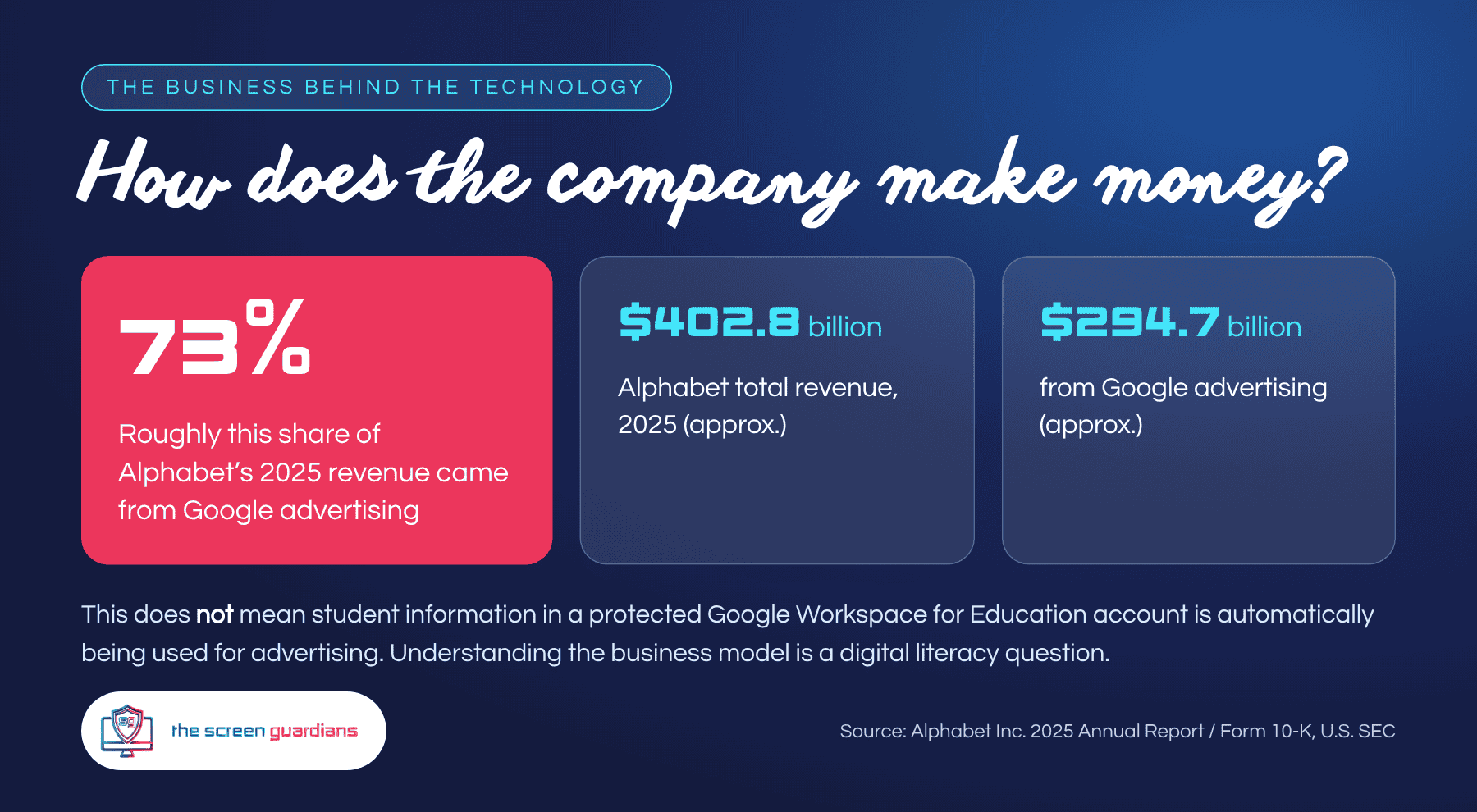
Google is part of Alphabet. According to Alphabet’s 2025 annual report filed with the Securities and Exchange Commission, Alphabet generated approximately $402.8 billion in revenue in 2025, with about $294.7 billion coming from Google advertising—roughly 73% of total revenue. [5]
That does not mean student information in a protected Google Workspace for Education account is automatically being used for advertising.
Google states that its education accounts include specific privacy protections. It also states that Gemini chats and uploaded files from qualifying school Workspace accounts are not reviewed by human reviewers or used to improve its generative AI models. [6]
Those distinctions matter.
But so does understanding the larger ecosystem our children are entering.
Who owns the technology? How does the company make money? What information is collected? Which protections apply to students? And what happens when children move outside the protected educational environment?
Those are digital literacy questions—not anti-technology questions.
And now we have AI.
Generative AI has enormous potential.
It can help teachers brainstorm, organize information, differentiate instruction and work more efficiently.
But it also creates an entirely new set of questions for schools.
Should teachers enter student names?
Student work?
Grades?
IEPs?
Behavior information?
Emails?
Other personally identifiable information?
Which AI platforms are approved—and under which accounts?
Our school decided to establish boundaries around the use of AI with student information and its integration into workflows involving sensitive student data.
Again, they didn’t wait for something to go wrong.
They paused. They asked questions. And they acted.
This is why I’m proud of our school.
I didn’t ask them to remove technology.
I didn’t demand that every Chromebook disappear.
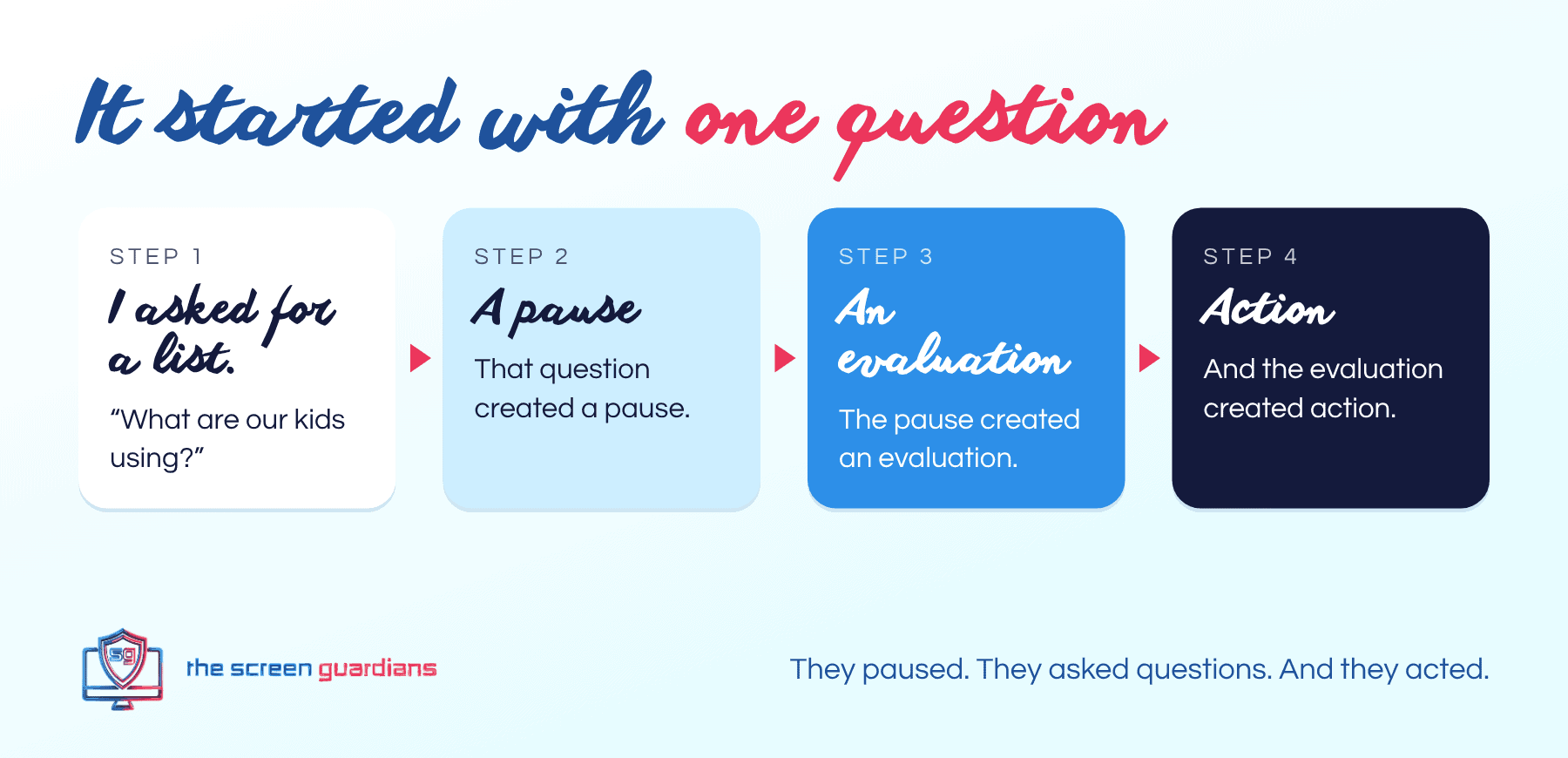
I asked for a list.
What are our kids using?
That question created a pause.
The pause created an evaluation.
And the evaluation created action.
Our administrators listened. Our teachers were included. And our school was willing to take a hard look at technology and ask whether every tool deserved its place in our children’s education.
That’s what I want more schools to do.
Because this isn’t about being anti-technology.
It’s about being pro-child development, pro-learning, pro-privacy and pro-intentionality.
Technology should earn its place in a classroom.
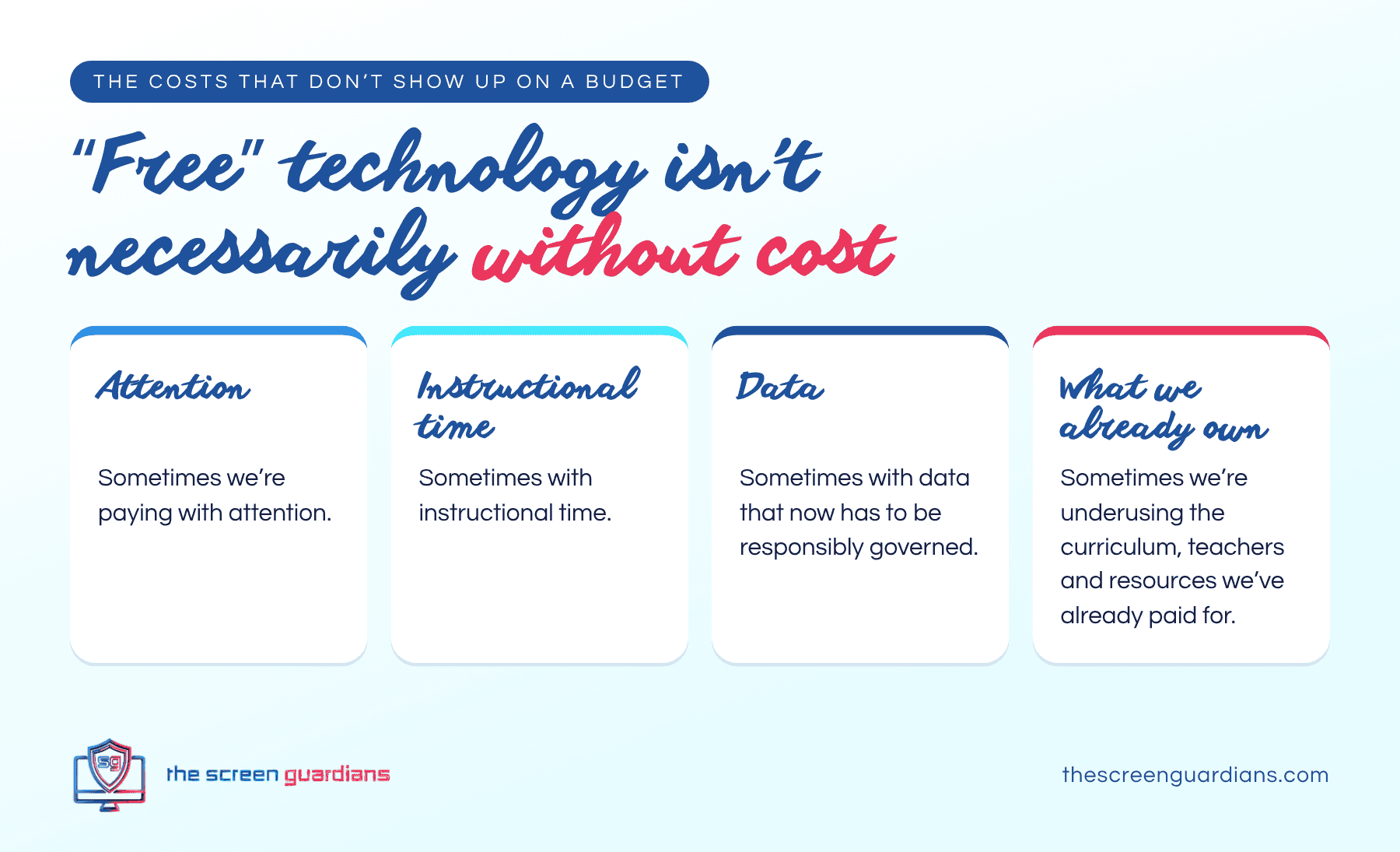
And “free” technology isn’t necessarily without cost.
Sometimes we’re paying with attention.
Sometimes with instructional time.
Sometimes with data that now has to be responsibly governed.
And sometimes we’re investing in technology while underusing the curriculum, teachers and resources we’ve already paid for.
Every school should do this.
I would love to see every school periodically conduct a comprehensive technology audit.
And I would love to see more parents simply start asking questions:
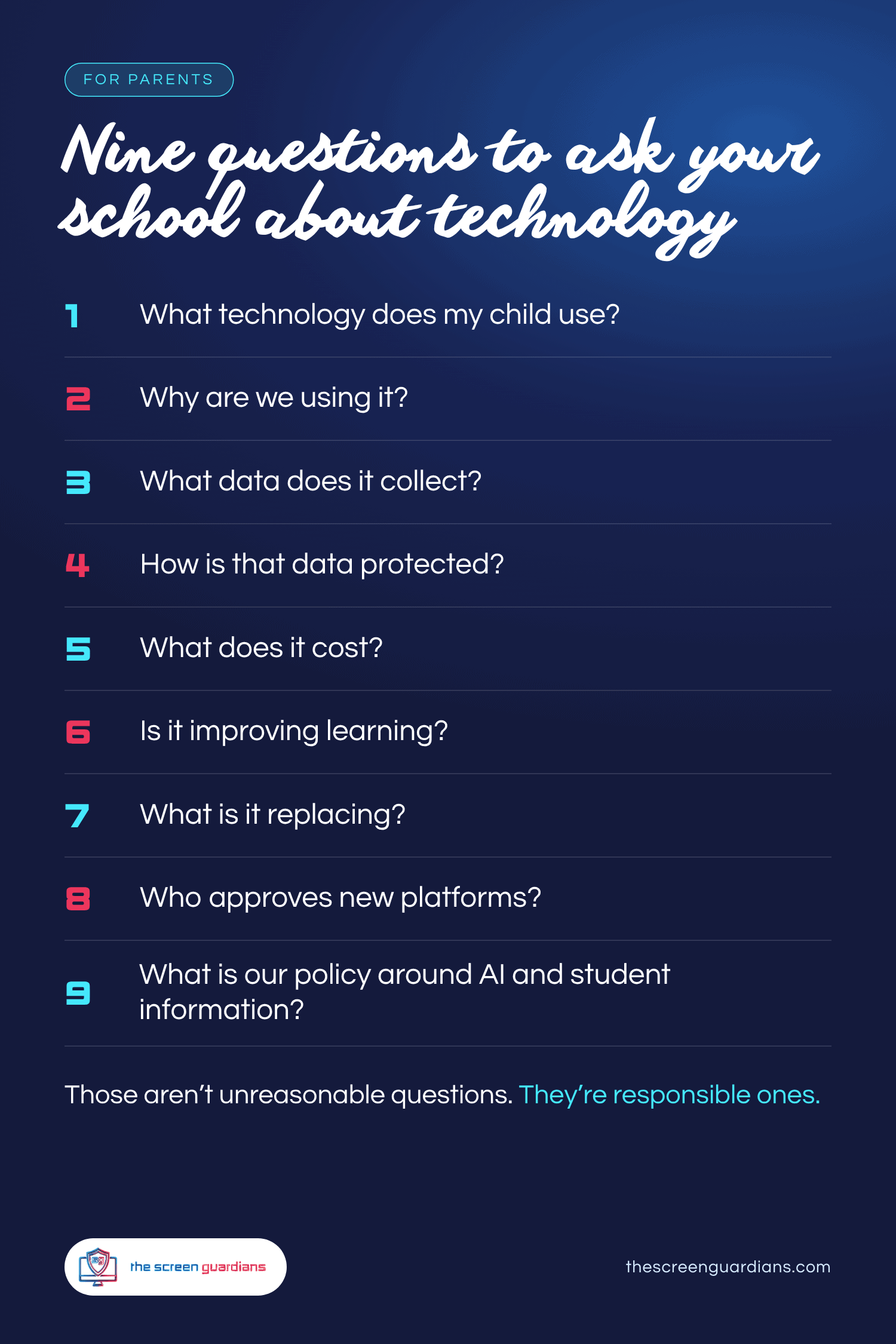
- What technology does my child use?
- Why are we using it?
- What data does it collect?
- How is that data protected?
- What does it cost?
- Is it improving learning?
- What is it replacing?
- Who approves new platforms?
- What is our policy around AI and student information?
Those aren’t unreasonable questions.
They’re responsible ones.
Our schools don’t need to have every answer.
But they should be willing to ask the questions.
I’m incredibly proud that ours was.
And sometimes, meaningful change starts with one parent being willing to ask the first question.
Want this in your school? See how The Screen Guardians works.
Sources & References
- Federal Trade Commission. Complying with COPPA: Frequently Asked Questions. https://www.ftc.gov/business-guidance/resources/complying-coppa-frequently-asked-questions
- U.S. Department of Education, Student Privacy Policy Office. FERPA Frequently Asked Questions, including guidance regarding outside providers and the school-official exception. https://studentprivacy.ed.gov/frequently-asked-questions
- U.S. Department of Education, Student Privacy Policy Office. Guidance on using online tools and applications in the classroom and FERPA compliance. https://studentprivacy.ed.gov/faq/i-want-use-online-tool-or-application-part-my-course-however-i-am-worried-it-violation-ferpa
- American Psychological Association. Children’s and Adolescents’ Learning with Educational Technology. September 2026. https://www.apa.org/pubs/reports/children-adolescent-learning-educational-technology
- Alphabet Inc. 2025 Annual Report/Form 10-K. U.S. Securities and Exchange Commission. https://www.sec.gov/Archives/edgar/data/1652044/000165204426000018/goog-20251231.htm
- Google. Gemini Apps with a Work or School Google Account — Education. Google Help. https://support.google.com/gemini/answer/14620100