“How much screen time is okay for my kid?” If you’ve ever stood in the kitchen at 5 p.m., tablet in one hand, dinner in the other, asking yourself that exact question — you’re not alone. Figuring out the right screen time by age is one of the most common (and most confusing) questions parents bring us at The Screen Guardians. The answer isn’t the same for a 4-year-old as it is for a 14-year-old — and that’s actually really good news.
This guide walks you through what’s healthy at every stage from toddlers through teens — grounded in brain science, not fear. You’ll also get our two most-requested parent tools: the Device Journey Roadmap and the Social Media Age Guide. No guilt. No judgment. Just real, age-appropriate guidance you can use tonight. And when you’re ready to zoom out, here’s a calm, honest way to decide about kids and technology.
Table of Contents
Why Screen Time by Age Matters (More Than the Number on the Clock)
Before we get into the stages, here’s the part most articles skip: your child’s brain is still under construction. The prefrontal cortex — the part of the brain responsible for impulse control, decision-making, and long-term thinking — doesn’t fully develop until the mid-twenties.
Meanwhile, every app, every game, and every “for you” feed is engineered to keep your child engaged. Dopamine. Dopamine. Dopamine. Each notification, each autoplay, each like delivers a small dopamine hit — and a developing brain can’t regulate that the way an adult brain can. Logic goes out the window. Impulse runs the show.
That’s why a blanket “two hours a day” rule doesn’t actually answer your question. The right approach to screen time by age looks different at every stage because the brain looks different at every stage. Same kid. Different needs. Different guardrails.
Screen Time by Age: A Brain-Science-Backed Guide
Here is what healthy looks like at each stage. These are starting points, not commandments — every family is different. Start where you are.
Ages 2–5: Build the Foundation
This is the stage where habits start. Little brains are wiring themselves through play, language, and real-world sensory experience — things screens cannot replicate.
- Time: No more than 1 hour per day of high-quality content (aligned with the American Academy of Pediatrics recommendations)
- How: Co-watch whenever possible. Talk about what you’re seeing together.
- What to avoid: Background TV during meals or play, fast-paced or ad-heavy content, screens as a soothing tool for big emotions
- What to prioritize: Outdoor play, books, pretend play, time with caregivers
This is also the age when the device journey can begin (but not required) — not with a tablet, but with a walkie talkie. More on that in a minute.
Ages 6–10: Set Clear Boundaries
School-age kids are ready for more autonomy — and more honest conversations about how screens work. They can also start to understand that the people who make these apps want them to keep watching.
- Time: 60 minutes of recreational screen time per day is a reasonable starting point (school work is separate)
- How: Family media agreement, screen-free zones (bedrooms, dinner table), screens off at least 30–60 minutes before bedtime
- What to avoid: Smartphones, social media, group chats, unsupervised online gaming with strangers
- What to introduce: Watches or a flip-style “kid phone” for communication when needed — not unrestricted internet access. But again less is best!
If you want a deeper walk-through, our post on how to limit screen time for kids breaks down the family media agreement step by step.
Ages 11–14: Shift From Time to Use
This is the stage where most parents start asking: Should I give my kid a phone? The honest answer is, “It depends on readiness — not age alone.” Tweens are deep in identity formation and peer sensitivity. Their brains are exquisitely tuned to feedback from peers, which means a single group-chat message can feel enormous.
- Time: Move from time limits to use agreements — when, where, and what apps and ideally not a smart phone with unlimited internet access. Bark phone is a great option.
- How: Devices charge outside the bedroom overnight. Phones away during family meals. No social media yet (more below).
- What to avoid: Open social media accounts, group chats without parent visibility, AI chatbots, sleepovers with unrestricted phone access
- What to prioritize: Honest conversations about online “tricky people,” group-chat dynamics, and what to do when something goes wrong
This is also when many families wonder whether their child is missing out by waiting. They’re not. Especially if they don’t have a smart phone. Kids who don’t have smartphones at this age are often the ones building the most confidence — here’s why kids without phones build the confidence you want them to have.
Ages 15–18: Coach Toward Self-Regulation
By high school, the goal is shifting. You’re no longer just controlling their screen time — you’re coaching them to manage it themselves before they leave for college, a job, or the military.
- Time: Self-regulation with parental check-ins; focus on quality, not just quantity
- How: Conversations about how screen use makes them feel — sleep, focus, mood, comparison
- What to avoid: Phones in bedrooms overnight (yes, even now), 24/7 access during the school day
- What to prioritize: Digital wellness habits they’ll carry into adulthood — screen breaks, social-media-free mornings, real-world friendships, activities in real life.
The Device Journey: When to Introduce Each Type of Device
One of the most-requested resources we hand parents is what we call the Device Journey Roadmap — a step-by-step map of which devices to introduce in which order. Because here’s the truth: the jump from “no device” to “smartphone” is enormous. There are smarter, calmer steps in between.
Here’s the order we recommend:
- Walkie Talkie — Pure communication. No internet, no apps. Encourages independence and play.
- Kid Watch — Call and text with approved contacts only. Location tracking for peace of mind. No photos, video, or internet (you may need to adjust the settings — these aren’t always the default).
- Landline (Home Phone) — Family-controlled communication. No constant access. A surprisingly powerful tool to bring back.
- Flip or “Dumb” Phone — Call and text only. No apps, internet, or social media (again, double-check the settings).
- Smartphone — Introduced based on readiness, not age alone. Start with controls and monitoring. No social media, AI chatbots, or addictive games. Out of bedrooms, away at school, and put away before bedtime.
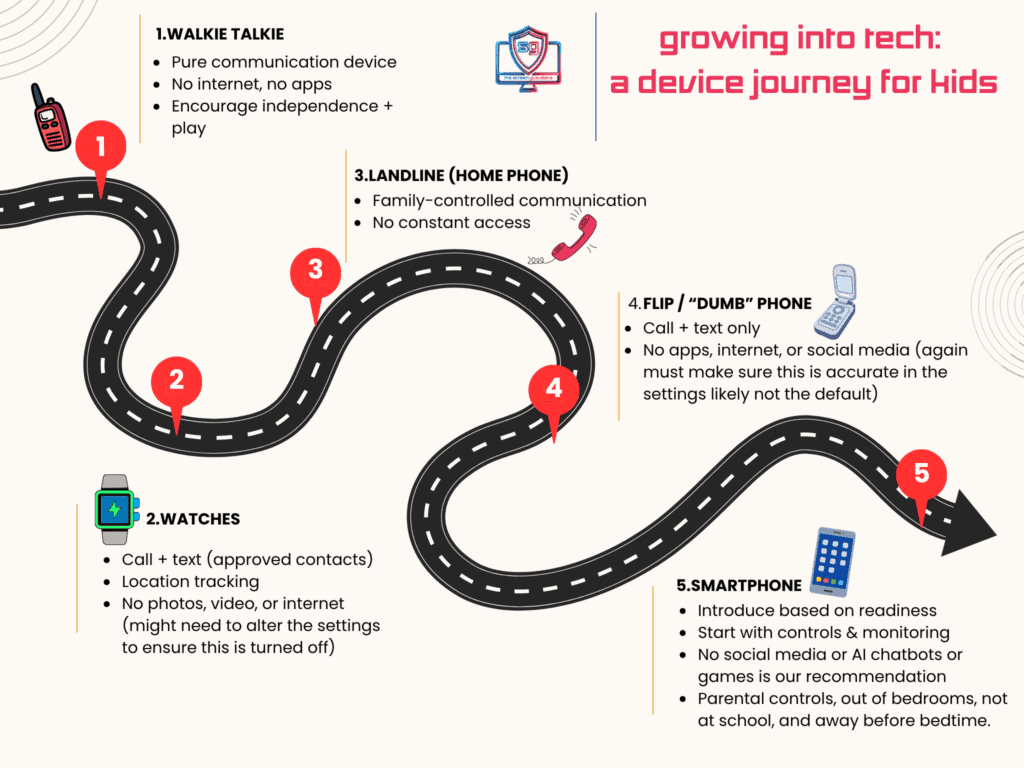
You can download the full, printable Device Journey Roadmap (with talking points for each stage) inside The Parent Portal.
When Should Kids Get Social Media? A Parent’s Guide to Timing
This question deserves its own section, because social media is in a different category than screen time, gaming, or even phone access. It’s not just time on a screen — it’s a developing brain meeting algorithms designed to monetize attention.
Here is what we recommend at The Screen Guardians:
- Under 13 — Not recommended. The brain is in critical development. Early exposure can interfere with attention, social, and emotional growth.
- Ages 13–15 — Still not recommended. Peer sensitivity and identity formation are at their peak. Social media at this stage amplifies pressure, comparison, and validation-seeking — and can intensify anxiety, self-esteem issues, and mood swings.
- Age 16 — Minimum acceptable, with strong guardrails. Increased maturity helps, but the risks don’t disappear. Limits, expectations, and regular breaks are non-negotiable.
- Age 18+ — Ideal. The brain is more developed. Even then, social media has been shown to impact well-being into adulthood — use with caution.
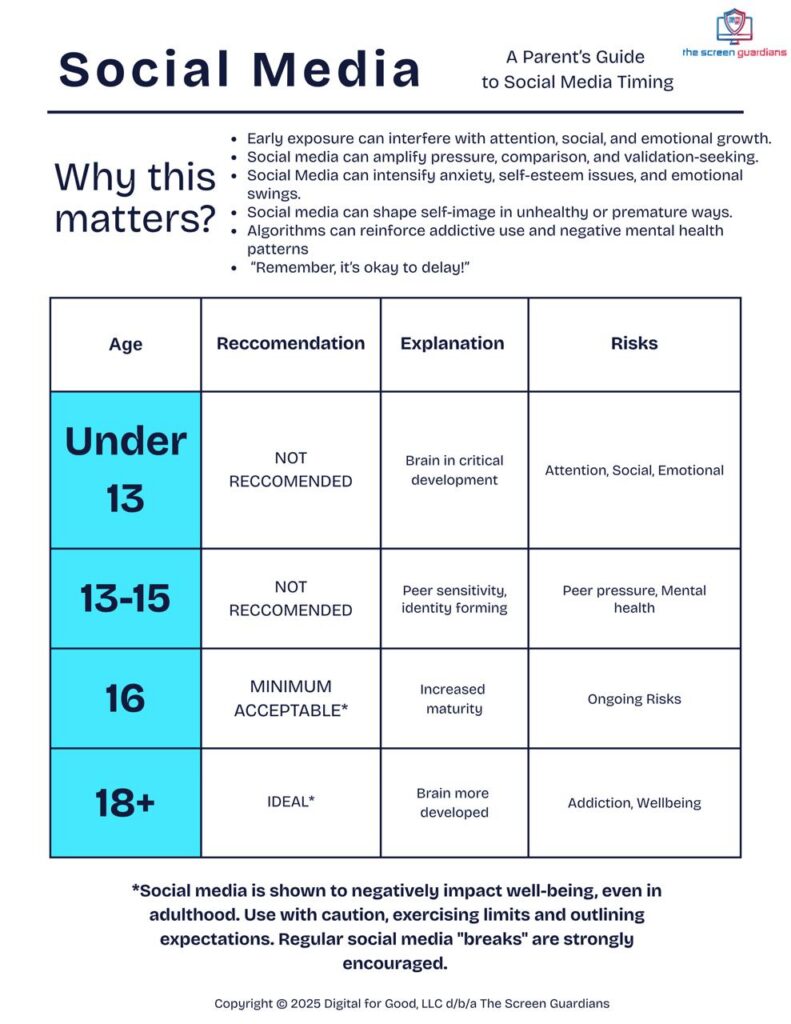
The short version: it’s okay to delay. If you’re feeling pressure to let your 11-year-old open an Instagram account because “everyone has one,” remember — early exposure shapes self-image in ways most adults are still working to undo. Waiting is not depriving. Waiting is protecting.
Red Flags to Watch For at Any Age
Regardless of which stage your child is in, watch for these signs that screen time is doing more harm than good:
- Sleep is suffering or bedtime is a battle
- Big emotional reactions when screens are turned off
- Withdrawal from offline activities they used to love
- Secrecy about what they’re watching or who they’re talking to
- Mood, anxiety, or self-esteem shifts that line up with screen use
None of these mean you’ve failed. They mean it’s time for a conversation — and maybe a reset. A dysregulated child doesn’t need more control. They need more connection.
You Don’t Have to Figure Out Screen Time by Age Alone
If you’ve gotten this far and you’re thinking, “Okay — but I want the printable version of all of this,” that’s exactly why The Parent Portal exists. Inside, you’ll find:
- The full Device Journey Roadmap (printable, with talking points for each step)
- The Social Media Age Guide you saw above
- The Recovery Plan — for when a digital mistake happens (because it will)
- Coaching videos, scripts for hard conversations, and a community of parents walking the same road
Real tools. Real voices. Real support. No judgment here.
If you want to start with something free, our free parent course is a great first step. Either way — you’ve already done the hardest part by showing up and reading this. Start where you are.
Frequently Asked Questions
Q: What is a healthy amount of screen time by age?
A: For kids 2–5, aim for no more than 1 hour per day of high-quality content. For ages 6–10, 60–90 minutes of recreational screen time is a reasonable starting point. For ages 11–14, shift from time limits to use agreements around when, where, and what apps. For ages 15–18, focus on coaching self-regulation rather than enforcing strict daily limits. Quality and context matter as much as the number on the clock.
Q: At what age should kids get a smartphone?
A: There’s no universal right answer, but most digital wellness experts — including The Screen Guardians — recommend waiting until at least age 13, and ideally later, with clear expectations and ongoing conversations. Before a smartphone, walk your child through earlier stages of the device journey: walkie talkies, kid watches, a landline, or a flip phone. Readiness matters more than age alone.
Q: When can my child get social media?
A: At The Screen Guardians, we recommend no social media under age 13, and ideally not before 16 — when increased maturity helps a child handle the pressure, comparison, and algorithmic design social media is built on. Even then, limits and regular breaks are strongly encouraged. Remember: it’s okay to delay.
Q: Is two hours of screen time per day too much for a 7-year-old?
A: It depends on what the two hours look like. Co-watching a documentary or video-calling grandparents is different than two hours of autoplaying short-form video. As a starting point, 60–90 minutes of recreational screen time is reasonable for ages 6–10 — but content quality, sleep, mood, and offline activity matter just as much as the total minutes.
Q: My kid is already on social media — is it too late?
A: It’s never too late. Start with a calm conversation, not a confiscation. Talk about how the apps are designed, how they make your child feel, and what healthy use could look like going forward. A Recovery Plan — available inside The Parent Portal — can help you reset together without shame. Education is the greatest form of protection.