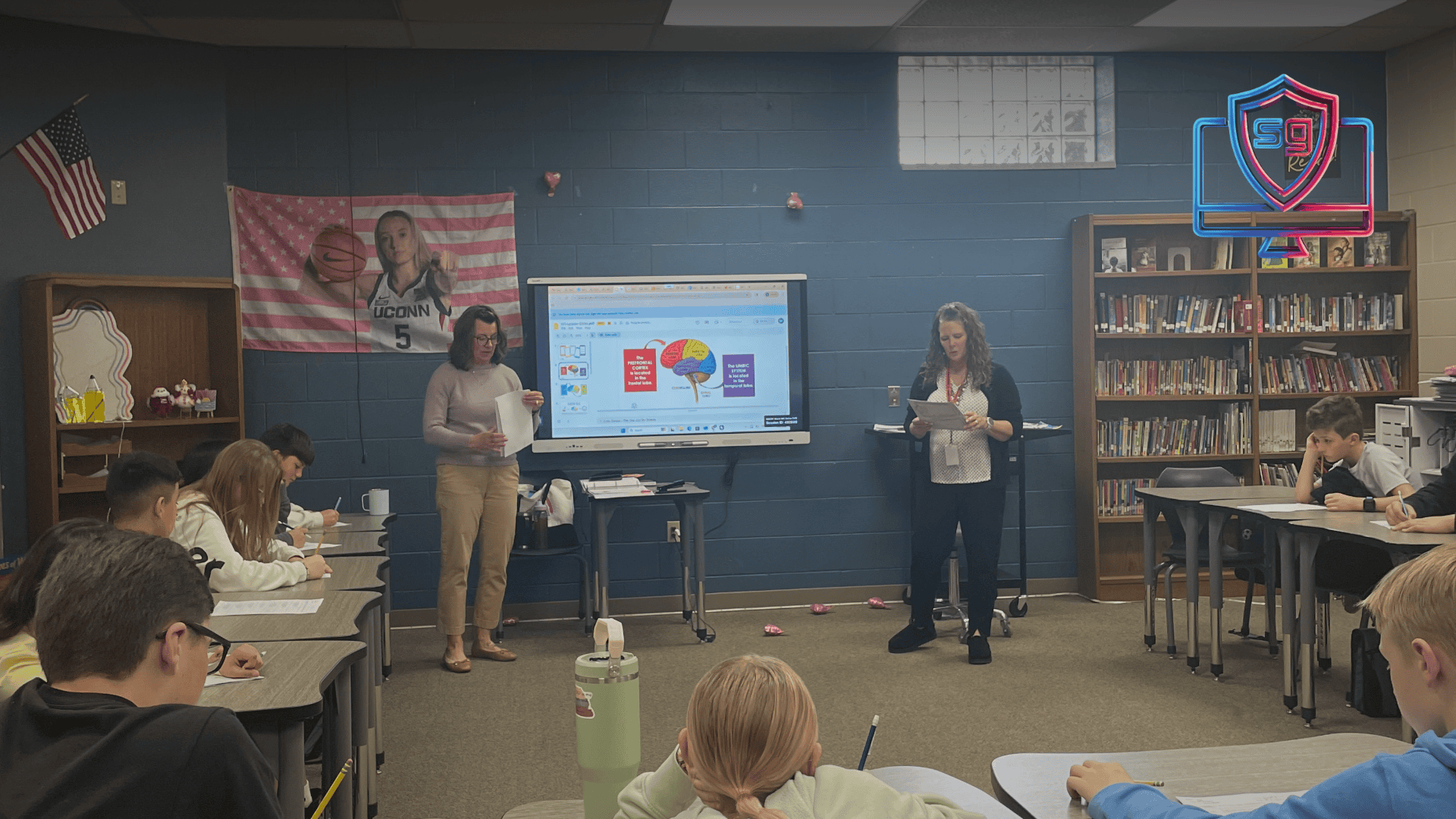
When a rural Kansas superintendent stood in front of the State Board of Education this spring, he wasn’t there to talk about test scores or budgets. He was there to talk about screens — and what happened when his entire district decided to do something about them.
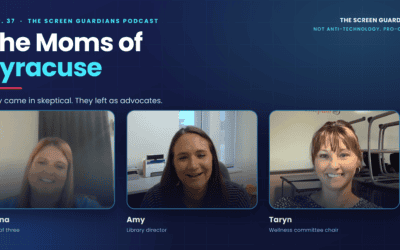
On our latest podcast episode, we shared a presentation given to the Kansas Department of Education State Board by the team from USD 494 in Syracuse, Kansas: Superintendent Paul Larkin, Elementary Principal Liz Plunkett, and parent Taryn Parks. They went first. They piloted The Screen Guardians program across every grade, K–12, and then they stood up and told the state what changed.
If you’re a principal, superintendent, counselor, or board member wondering whether digital wellness education is worth the effort — and how to actually roll it out without it blowing up in your face — this one is for you.
Here are the lessons Syracuse learned, in their own words.
Table of Contents
1. Skip the one-time assembly. Choose a real curriculum.
The first decision Syracuse made was the most important one. They said no to the assembly model.
“I was not interested in a one-time assembly,” Larkin told the board. “That’s not going to do us much good. We already have the awareness. We just need to really have the education portion.”
Awareness is not the same as education. A motivational speaker can move a gym full of kids for an afternoon. A structured, repeating curriculum actually changes how those kids think. Syracuse wanted something that ran all year, reached every classroom from kindergarten through the seniors, and built on itself week after week.
The takeaway for your district: if you want lasting change, look for a program that teaches — not one that performs.
2. Start with your teachers, not your students.
Before a single lesson reached a single kid, Syracuse spent an entire semester preparing the adults.
That first semester, the work was almost all professional development — teachers reviewing lessons together, talking through what’s age-appropriate for a kindergartner versus a sophomore, and getting comfortable with the material. The Screen Guardians team led that onboarding, teaching staff how the developing brain interacts with technology.
“This is why there’s this behavior I’m seeing in the classroom,” was the aha moment for teachers, Larkin’s team explained. When educators understand the brain science first, the classroom behavior they’ve been fighting suddenly makes sense — and they teach the lessons with conviction instead of obligation.
Principal Liz Plunkett went a step further: she and her school counselor taught the lessons themselves the first time through. “We wanted to really be in the weeds of it. We wanted to know what it looked like, how it felt, were the lessons really easy to use.”
Her verdict? Prep took 10 to 15 minutes a lesson. Then they just went and taught it.
3. Be radically transparent with your community.
This is the lesson Syracuse stressed the most — and the one most districts underestimate.
Larkin had seen digital safety conversations go sideways before. “We’d had some incidents where staff members talking about digital safety probably got a little age-inappropriate,” he admitted. There had been community backlash. So the rollout was built around one principle: don’t throw gas on the fire.
What that looked like in practice:
- A community launch event in January, open to every parent and kid, where The Screen Guardians team walked families through the brain science, the screen-time limits, and the digital safety lessons.
- Every channel covered — the local newspaper, Facebook, ClassDojo, flyers. (One parent, Taryn, first heard about it from a flyer in the newspaper.)
- Full access to the Parent Portal, so families could follow along with exactly what their kids were seeing in class. “It’s completely wide open, curriculum-wise,” Larkin said.
Transparency disarms the “what are you really teaching my kid” fear before it starts. When parents can see everything, suspicion has nowhere to grow.
4. Win the parents by teaching the kids.
Here’s the most surprising lesson from Syracuse: the most powerful way to reach parents wasn’t talking to parents. It was teaching their children.
“What we have found that has been the most powerful component to help parents understand is by teaching their kids,” Plunkett said. Kids go home using words like dopamine. They ask for a screen-free dinner. They announce they’re going outside because they hit their screen-time goal. And parents start to pay attention.
Taryn Parks lived this. She walked into the launch event skeptical — “I was like, oh, this is probably another organization trying to collect data on our students.” She left rethinking her whole household. Devices now charge overnight in her room, not her kids’ bedrooms. The family does puzzles and Legos and game nights. And her seven-year-old? He stopped asking for the iPad almost immediately.
“It’s never too late to make a positive change with my family,” she told the board.
The lesson: when the curriculum gives kids the language, the kids become the messengers. That’s how you reach the dinner table.
5. Make it easy on already-overwhelmed teachers.
No teacher wants one more thing on their plate. Syracuse solved this by choosing a turnkey program their staff could pull up and teach.
At the elementary level, homeroom teachers fold a short lesson into the day. At the junior high and high school, it lives in a 30-minute seminar period — one day a week, every week, taught by the homeroom teacher to a group of 12 to 15 students. No new prep curriculum to build from scratch. No specialist to hire.
“Our teachers have a lot on their plate,” Larkin said. “I really wanted a program the teachers could just pull the lessons up, review those, and carry them off with the kids.”
If a program adds workload, it won’t survive. If it removes friction, it sticks.
6. Pair education with fewer devices — not just more rules.
Syracuse didn’t stop at lessons. They changed the environment around the lessons.
Kindergarten and first grade use no tech at all. Textbooks are coming back into classrooms. Handwriting is taught every day, K–6. Phones are out of school dances. And the district is actively rethinking whether its high school one-to-one devices should even go home anymore.
“For a while we were kind of sold that all of these things are the magic fix for our kids,” Plunkett said. “A lot of us bought into that. But we know that’s not the case.” Her teachers worried students would feel cheated without the iPads. “They haven’t missed it at all.”
Education tells kids why. A thoughtful device environment makes the healthy choice the easy one. You need both.
7. Remember it’s collective action — nobody does this alone.
The quiet theme running through the entire Syracuse story is community. Shared language. Collective action.
When parents move together, the pressure lifts off the individual family. As one board member put it: get a group of parents to pledge not to give their kids a phone yet, and suddenly no child is “the only one.” They have friends in the same boat.
Larkin sees it in his own town now — adults putting phones in another room to play cards, families choosing a movie night where everyone actually watches the movie. “It feels like I’m going back to grandma’s house when I was a kid.”
That’s the whole idea. Education happens when kids feel safe, connected, and surrounded by adults who are aligned. “The more aligned we are as adults, the more supported our children become.”
What this means for your school
Syracuse isn’t a big district — about 500 students spread across the largest geographic county in Kansas. They didn’t have a huge budget or a tech department to spare. What they had was a leader willing to go first, teachers willing to learn alongside their students, and a community willing to be brought into the conversation honestly.
“If you believe in something strongly enough, you’ll find a way,” Larkin said.
You don’t have to navigate this alone — and neither do your teachers or your families. That’s exactly what The Screen Guardians program is built to do: give schools a structured, brain-science-based curriculum and bridge it straight to the home.
If you’re an educator or administrator wondering where to start, we’d love to walk you through it. Learn more about bringing The Screen Guardians to your district on our K–12 program page, or listen to the full Syracuse presentation on The Screen Guardians Podcast.
Because education is the greatest form of protection.