If you’ve ever tried to pry a tablet out of a six-year-old’s hands — or asked your teenager to put the phone away at dinner — you already know. The battle is real. And you’re not alone in wondering how to limit screen time for kids without turning your home into a war zone every single evening.
Here’s the good news: it doesn’t have to feel like a fight. When you understand why screens have such a powerful pull on your child’s developing brain — and pair that knowledge with a few practical strategies — everything shifts. Not overnight. But steadily.
This post will walk you through seven proven steps grounded in brain science, not fear. No guilt. No judgment. Just real tools you can start using today. It also helps to zoom out — here’s the bigger picture on kids and technology.
Table of Contents
Why Limiting Screen Time Feels So Hard
Before we get into the how, let’s talk about the why — because understanding this changes everything.
Your child’s brain is still under construction. The prefrontal cortex — the part responsible for impulse control, decision-making, and long-term thinking — doesn’t fully develop until the mid-twenties. Meanwhile, screens are designed by some of the smartest engineers in the world to do one thing: keep your child engaged.
Dopamine. Dopamine. Dopamine.
Every notification, every autoplay video, every like — it triggers a small dopamine hit in your child’s brain. And a developing brain can’t regulate that the way an adult brain can. Logic goes out the window. Impulse runs the show.
So when your kid melts down after you turn off the iPad? That’s not a character flaw. That’s brain chemistry. And knowing that gives you a completely different starting point for setting healthy boundaries.

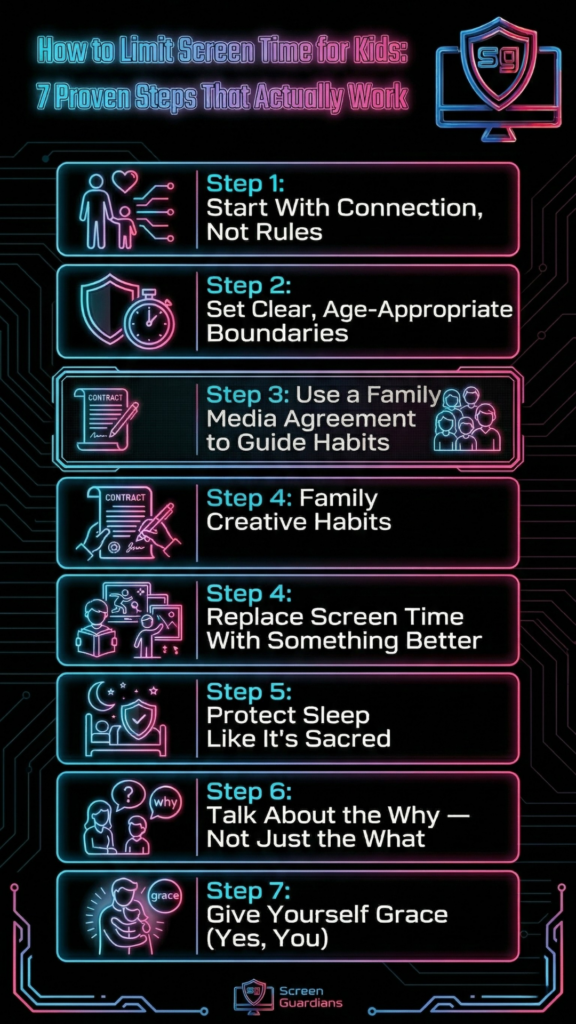
Step 1: Start With Connection, Not Rules
Here’s where most parents start: rules. Screen time limits. App timers. Parental controls.
And those tools have their place. But if you lead with rules alone, you’re likely to get pushback — especially from older kids and teens.
Instead, start with a conversation. A real one.
- Ask your child what they love about being online
- Listen without judgment
- Share what you’ve noticed — calmly, not critically
- Explain why you want to make changes (brain health, sleep, family time)
Connection first. Boundaries second. A dysregulated child doesn’t need more control — they need more connection. When kids feel heard, they’re far more willing to cooperate.
Step 2: Set Clear, Age-Appropriate Boundaries
Once you’ve built that foundation of connection, it’s time to set clear expectations. What works for a five-year-old won’t work for a thirteen-year-old — and that’s okay.
Here’s a simple framework:
- Ages 2–5: Limit recreational screen time to one hour per day of high-quality content. Co-watch whenever possible.
- Ages 6–10: Set daily time limits (60–90 minutes is a good starting point). Prioritize offline play, outdoor time, and creative activities.
- Ages 11–14: Shift from time limits to use agreements. Talk about which apps, when, and why. Include expectations around group chats and social media.
- Ages 15–18: Focus on self-regulation and digital wellness conversations. Help teens reflect on how screen use makes them feel.
The American Academy of Pediatrics offers research-backed guidelines that can serve as a helpful starting point. But remember — every family is different. Start where you are.
Step 3: Limit Screen Time for Kids Using a Family Media Agreement
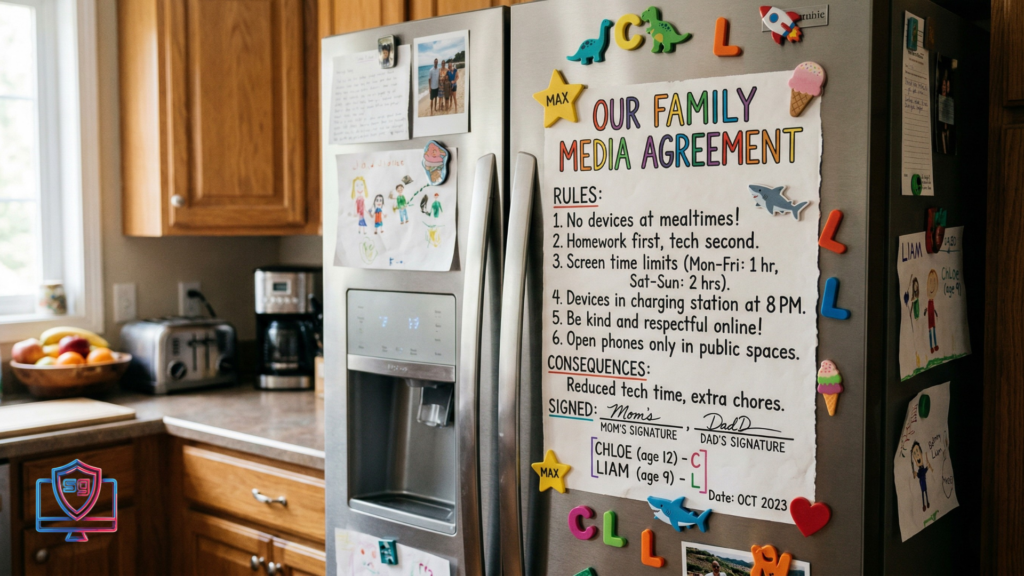
One of the most effective tools for managing screen time? A family media agreement. This isn’t a list of punishments — it’s a shared set of expectations that everyone in the house agrees to. Including you.
Here’s what to include:
- Screen-free zones (bedrooms, dinner table)
- Screen-free times (one hour before bed, mornings before school)
- Content guidelines (what apps and games are approved)
- Consequences for breaking the agreement (decided together, not imposed)
- A review date (revisit and adjust monthly)
Write it down. Post it somewhere visible. And here’s the most powerful part — follow it yourself. Kids are watching. When they see you put your phone in the basket at dinner, it speaks louder than any lecture.
Step 4: Replace Screen Time With Something Better
Taking something away without offering something in return rarely works — for kids or adults. If you want to limit screen time for kids effectively, fill that space with activities that meet the same needs screens are meeting.
Think about it: screens offer novelty, connection, entertainment, and a sense of control. So what else can?
- For novelty: New art supplies, science kits, cooking projects, outdoor exploration
- For connection: Family game nights, one-on-one time, playdates, team sports
- For entertainment: Audiobooks, podcasts, music, building projects
- For autonomy: Let kids choose their offline activities — ownership increases buy-in
You don’t need to fill every minute. Boredom is actually one of the most powerful catalysts for creativity. But having attractive alternatives ready — especially during the transition period — makes a real difference.
Step 5: Protect Sleep Like It’s Sacred
If there is one non-negotiable when it comes to screen time, make it this: no screens in the bedroom at night.
The blue light from devices suppresses melatonin production, making it harder for kids to fall asleep. But it’s not just the light. It’s the content. A late-night group chat, a scary video, a social media spiral — these activate the brain at the exact moment it should be winding down.
Here’s what works:
- All devices charge in a shared space overnight (a family charging station works great)
- Screens off at least 30–60 minutes before bedtime
- Replace the bedtime scroll with a book, a podcast, or a simple conversation about the day
Sleep is when the brain consolidates learning, processes emotions, and restores itself. Protecting it is one of the most impactful things you can do for your child’s mental and physical health.
Step 6: Talk About the Why — Not Just the What
Kids are smart. If you just say “because I said so,” you might get short-term compliance — but you won’t get long-term buy-in.
Instead, teach your kids about their own brains. You’d be surprised how much even a seven-year-old can understand when you explain it simply:
- “Your brain loves getting little rewards from the screen — that’s called dopamine. But too much makes your brain tired and cranky.”
- “The people who make these apps want you to keep watching. It’s designed that way.”
- “Your brain is still growing, and it needs breaks from screens to grow strong.”
When students — and kids at home — understand the system, shame decreases and agency increases. They stop feeling like screen time is something being done to them and start seeing it as something they can manage for themselves.
This is exactly what The Screen Guardians K–12 program teaches in schools across the country — and what you can reinforce at home.
Step 7: Give Yourself Grace (Yes, You)
Here’s the part nobody talks about enough. You’re going to mess this up sometimes. You’re going to hand them the iPad because you need 20 minutes of quiet. You’re going to scroll your own phone while telling them to put theirs away. You’re going to set a rule and then let it slide on a rainy Saturday.
That’s okay. That’s normal. That’s human.
Digital health is not about perfection. It’s about direction. It’s about small, steady shifts that add up over time. And it’s about being honest with your kids — modeling what it looks like to recognize a habit and work on it.
You don’t need to be a tech expert. You just need to be a connected, curious adult.
You Don’t Have to Figure This Out Alone: How to Limit Screen Time for Kids
If you’re reading this and thinking, “Okay, but I need more help” — that’s exactly why The Screen Guardians Parent Portal exists. It’s a calm, resource-rich space with coaching videos, conversation starters, scripts for hard conversations, and a community of parents walking the same path.
No judgment. Just support. Real tools. Real voices. Real support.
And if you want to start with something free, check out our free parent course — it’s a great first step.
Start where you are. You’ve already taken the first step by reading this.
Frequently Asked Questions
Q: How much screen time is too much for kids?
A: There’s no single magic number, but the American Academy of Pediatrics recommends no more than one hour per day for children ages 2–5 and consistent, age-appropriate limits for older kids. More important than the number is the quality of content and whether screen time is displacing sleep, physical activity, and face-to-face interaction.
Q: What’s the best way to limit screen time for kids without constant arguments?
A: Start with connection, not control. Have an honest conversation about why you’re making changes, involve your child in creating a family media agreement, and offer appealing offline alternatives. When kids understand the brain science behind screen design, they’re more likely to cooperate — and less likely to feel punished.
Q: Should I take my child’s phone away as punishment?
A: Using screens as a reward or punishment can actually increase the perceived value of screen time. Instead, focus on consistent boundaries and natural consequences outlined in your family agreement. If a serious digital incident occurs, The Screen Guardians’ Recovery Plan — available inside the Parent Portal — can help you navigate it together.
Q: At what age should kids get a smartphone?
A: There’s no universal right answer, but most digital wellness experts recommend waiting until at least age 13 — and even then, with parental oversight, clear expectations, and ongoing conversations. The question isn’t just “when” but “are they ready?” — and that depends on your child’s maturity, your family values, and the structures you have in place.
Q: Does limiting screen time really make a difference?
A: Yes. Research consistently links excessive screen time to sleep disruption, increased anxiety, decreased attention span, and lower academic performance in children. Reducing screen time — and replacing it with meaningful offline activities — supports better sleep, stronger relationships, and healthier brain development. Education is the greatest form of protection.