This conversation originally aired on the Get Curious Podcast, Ep. 10.
If you have ever stood in a school parking lot, watched your kid trudge to the car holding a Chromebook, and felt a quiet little knot in your stomach — you are not imagining it.
That feeling has a name. It is your nervous system telling you what the research is finally catching up to: edtech in schools rolled out faster than the brain science behind it. Test scores have dropped. Attention has fractured. Kids are coming home depleted from a school day spent staring at a screen. And the people making the decisions a decade ago were not villains — they simply did not have the information we have now.
This is the honest story of how we got here, what is actually happening in our kids’ brains, and the steady, doable next steps for families and schools. No fear. No shame. Just a clear path forward.
Table of Contents
How Edtech in Schools Started With Good Intentions
About ten years ago, devices began flooding classrooms across the country. Chromebooks. iPads. Adaptive math apps. Learning management systems for kindergarteners. Educational technology, or edtech, was sold as a solution — and from the outside, it looked like one.
Teachers could differentiate instruction faster. Students with learning differences could access tools their classmates were already using. Data could be tracked. Worksheets could go paperless. School boards across the country looked at the pitch decks and saw a future where every child would be reached, supported, and accelerated.
Many of the teachers and administrators championing edtech genuinely believed it would help kids. That matters. They were not negligent. They were responding to a real problem — overstretched classrooms, varied learning needs, and pressure to modernize — with the best information they had.
The missing piece was brain science. Specifically, how a developing brain responds to a screen designed by adults who study persuasion, dopamine, and attention for a living. That piece was not in the pitch deck.
What No One Told the Teachers About Brain Development
Here is something most parents are surprised to learn: teachers are not typically trained in neuroscience.
Think about that. We hand a developing human being to a teacher for eight hours a day, twelve years in a row, and that teacher has never been taught how the brain learns, what dopamine does, why a prefrontal cortex is not finished growing until the mid-twenties, or how persuasive design pulls attention away from the page in front of them.
That is not the teachers’ fault. It is a curriculum gap.
When teachers in our Screen Guardians pilot schools went through brain-based professional development, the response was almost always the same. Their eyes got wide. They started connecting dots they had been quietly noticing for years.
Why are these kids melting down when the iPad goes away?
Why does the apathy in my classroom feel different from ten years ago?
Why do my fifth graders struggle to hold a conversation?
Why is it so hard to compete with the screen?
The answer, in plain language, is dopamine. Devices light up the same reward centers in the brain that respond to gambling and other addictive behaviors. When kids are pulled off a device, their brains are not just bored — they are coming down. And when a teacher does not know that is happening, the behavior looks like a discipline problem instead of a brain in withdrawal.
The Data Nobody Wanted to See
Since edtech became standard in K–12 classrooms, the data has been telling a quieter, harder story.
Reading scores down. Math scores down. Comprehension down. Not in one district. Not in one state. Across the country. The U.S. Department of Education’s own reports on the National Assessment of Educational Progress show measurable declines in core academic skills over the last decade — the same decade devices became central to how kids learn.
Meanwhile, behavior referrals are up. Anxiety is up. The Surgeon General has issued a public advisory on youth mental health and social media. Teachers describe a kind of social flatness in their classrooms that did not exist before. Gen Z is now graduating into a workforce where employers openly say recent hires struggle to make eye contact, hold a conversation, or think through a problem without a screen.
This is not about catastrophe. It is about pattern recognition.
We introduced an unprecedented amount of screen time into the developmental window when kids are wiring up the brain they will use for the rest of their lives — and we did it before anyone could tell us what would happen. Now we are seeing what happens.
This Isn’t About Villainizing Anyone
I want to say this clearly, because it matters: Screen Guardians is not here to villainize big tech, the schools, the teachers, or the school boards. I have met the people on these boards. They have hearts of gold. Most of them got into education to serve kids, and they made the best decision they could with the information in front of them.
The harder question is the one underneath: who funded the early studies on screens and learning? Whose research are we relying on? When the same companies selling the devices are funding the studies that say the devices are fine, we are not getting the full picture.
That is not a conspiracy. That is a conflict of interest. And it is a fair thing to name.
The villain in this story is the gap — the gap between how fast technology moves and how slowly we, as a culture, develop the wisdom to use it well. That gap is closeable. It just requires us to stop pretending the rollout was neutral.
What Families Can Do Now
You do not need to fix the entire education system this weekend. You do need a clear, honest set of questions to ask, and a few small steps you can take that compound over time.
Start here:
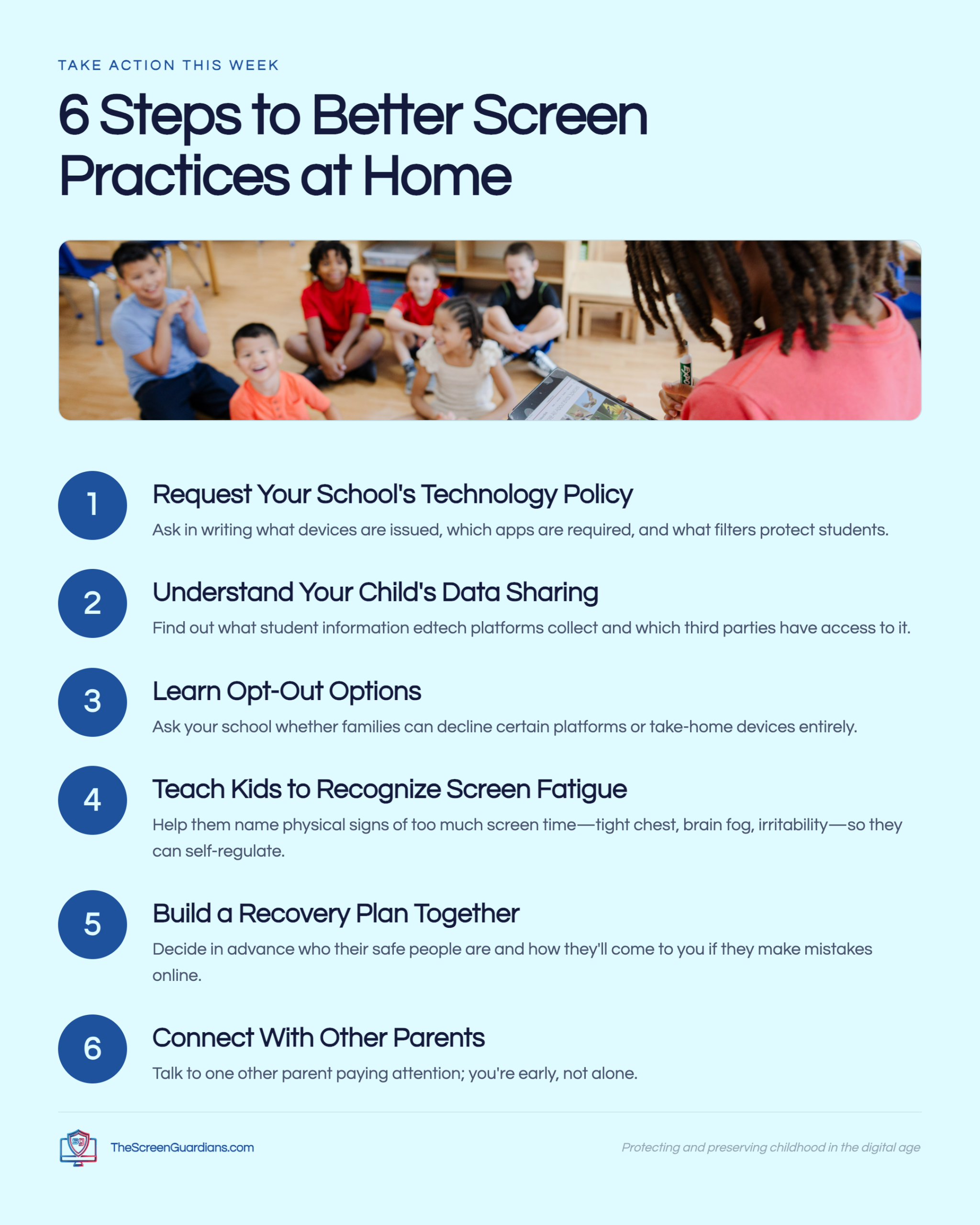
- Ask for your school’s technology policy in writing. What devices are issued? What apps are required? What filters are in place — and who tested them?
- Ask what student data is shared with third parties. Most edtech platforms collect data. You have the right to know what and with whom.
- Find out what opting out looks like. Some schools allow families to opt out of certain platforms or take-home devices entirely. The answer depends on the school, but you will never know if you do not ask.
- Teach your kids the “tell.” What does their body feel like when they have had too much screen time? Tight chest? Foggy brain? Cranky? Naming it is the first step in regulating it.
- Build a Recovery Plan together. Kids will make mistakes online. Who are their safe people when they do? What is the plan for coming to you instead of hiding? Decide this before they need it, not after.
- Find your people. Talking to one other parent who is also paying attention will change everything. You are not the only one who feels this way. You are early — not alone.
If you want a calm, step-by-step framework for any of these, the Parent Portal is built for exactly this.
What Schools Can Do Now
Schools have a harder job than families, but the path forward is similar — start with purpose and let the rest filter through it.
A clear mission statement is the most powerful tool a school has. Is the purpose of school to develop a human being — brain, body, and capacity for connection? Or is it to push information through kids quickly and measure how much they can repeat back? Once a school answers that honestly, every new piece of technology can be run through the same filter: Does this serve our mission, and can we prove it?
From there, the steady moves are these. Give families a real opt-out without stigmatizing the child who takes it. Invest in brain-science training for teachers so they understand what they are seeing in the classroom. Treat parent concerns as data, not pushback. And consider partnering with a digital health program — like our K–12 Program — that gives teachers, students, and parents shared language so kids are not getting one message at school and a different one at home.
When the adults are aligned, the kids exhale. That is the whole game.
Education Is the Greatest Form of Protection
You do not have to be anti-technology to be pro-child. You do not have to ban every screen to protect your kid’s brain. You do not have to have it all figured out by Friday.
You just have to stay curious, stay connected, and keep choosing education over fear.
Screen Guardians exists to walk that road with you. If something in this post made you exhale, made you a little angry, or made you feel less alone — that is your signal. Join the newsletter and we will keep showing up in your inbox with the steady, research-grounded support you came here for. No alarm bells. Just real tools, real voices, and a path you can actually walk.
Frequently Asked Questions
Q: Is edtech in schools actually causing learning declines?
A: The honest answer is: the timing lines up, and the pattern is consistent across the country. Test scores have declined in the same decade devices became central to K–12 learning. We are not saying edtech is the only factor — but it is a factor we ignored for too long, and it deserves a serious second look.
Q: Are you against all technology in classrooms?
A: No. Screen Guardians is not anti-technology. We are pro-child. Some edtech tools are genuinely helpful, especially for students with specific learning needs. The problem is unfiltered, all-day, every-grade screen exposure with no brain-science framework underneath it.
Q: Can my child opt out of school-issued devices?
A: It depends on your school and district, but in many places — yes, partially or fully. There is a growing movement of organizations providing pre-drafted opt-out letters and templates for parents. Start by asking your principal for the written technology policy and what alternatives exist for assignments.
Q: What is a Recovery Plan, and how do I build one with my child?
A: A Recovery Plan is a simple, pre-agreed plan for what your child will do when they make a mistake online — and they will. It names their safe people, the steps to come to you, and the grace they can expect when they do. Building it before a mistake removes the shame and shortens the recovery time. We walk families through it inside the Parent Portal.
Q: I feel behind. Is it too late to start paying attention to this?
A: It is not too late. Kids are remarkably adaptable, and so are families. Start with one conversation, one question to the school, or one small change at home. That is how every healthy digital family I know got started — one steady step at a time.