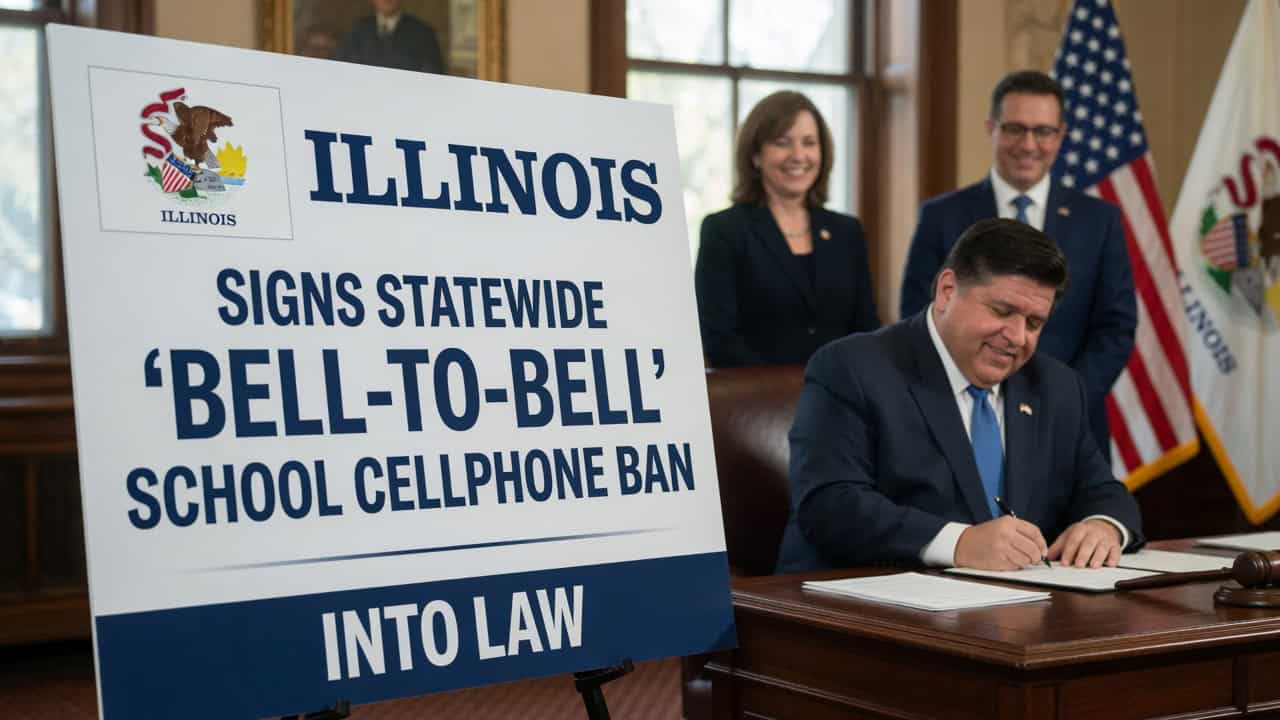
Illinois has become the latest state to make its public schools phone-free. On July 28, 2026, Gov. JB Pritzker signed SB 2427 into law, requiring “bell-to-bell” restrictions on student cellphone use in Illinois public schools beginning with the 2027–2028 school year.
The Illinois school phone ban prohibits students from using wireless communication devices — cellphones, smartwatches, tablets, and gaming devices — from the first bell to dismissal. School-issued devices used for learning are exempt.
Key details at a glance:
- Signed: July 28, 2026, by Gov. JB Pritzker (SB 2427)
- Takes effect: the 2027–2028 school year
- Scope: bell-to-bell for grades K–8, including class, lunch, and passing periods
- High schools: districts may decide whether older students can use phones during lunch or passing periods
- State guidance: the Illinois State Board of Education will release a template policy on September 1, 2026
Table of Contents
What the Law Requires
Under the new law, K–8 students will be restricted from phone use for the entire school day. High schools are given more flexibility: individual districts can choose whether to let older students access their phones during lunch or between classes.
To help districts prepare, the Illinois State Board of Education plans to publish a model policy on September 1, 2026, giving school communities more than a year to hold discussions and adopt their own rules before the 2027–2028 start date.
The law also limits how schools can respond to violations. Districts cannot fine, suspend, or expel a student solely for using a device, unless the use involves gross misconduct. Districts are required to review their policies every three years in consultation with teachers, administrators, parents, and community members.
Who Is Exempt
The law builds in several exceptions. Students may use a device when it is needed for:
- A medical reason
- An Individualized Education Plan (IEP) or 504 plan
- Language translation for English learners
- Case-by-case situations for students who are caregivers
Emergencies are also accounted for, and school-issued technology used for instruction remains permitted.
Why Lawmakers Acted
Supporters framed the measure as a way to protect classroom focus. “We want to make sure that every hour of school time can have the greatest possible positive impact,” Pritzker said.
State Sen. Cristina Castro, the bill’s lead sponsor, pointed to the flexibility built in for older students. “You have a lot of students who do dual (high school and college) credit,” Castro said, noting the law gives high schoolers “a little bit more responsibility.”
Illinois Joins a National Wave
Illinois is far from alone. By mid-2026, more than 30 states had enacted some form of restriction on cellphone use in K–12 schools, according to a policy tracker maintained by Ballotpedia. Roughly 35 states now ban or limit classroom phone use, with additional states requiring or encouraging districts to set their own rules.
Several of those measures are landing around the same time as Illinois’. California districts were required to limit or prohibit student smartphone use by July 1, 2026. Michigan’s policy requirement begins in the 2026–27 school year, New Jersey districts are adopting rules restricting non-academic device use, and Indiana has moved on its own classroom restrictions. Phone-free school, once an outlier, is quickly becoming the national norm.
Context: A school phone Ban Removes the Device, Not the Habit
For digital wellness educators, the policy shift is a welcome step — with a caveat.
A bell-to-bell policy solves the classroom distraction, but it doesn’t teach students why the boundary matters or what happens the moment the phone comes back after dismissal. That gap between rule and understanding is where organizations like The Screen Guardians focus, teaching students how their developing brains respond to technology so healthy habits hold beyond the school walls.
For families wondering how to mirror the change at home, The Screen Guardians has a companion guide: Phone-Free Schools Are Here: How to Make the Same Shift Feel Doable at Home. For deeper support, the Parent Portal offers calm, practical tools — no fear required.
Frequently Asked Questions
Q: When does the Illinois school cellphone ban take effect?
A: SB 2427 was signed on July 28, 2026, and applies beginning with the 2027–2028 school year. The Illinois State Board of Education plans to release a template policy on September 1, 2026.
Q: Does the ban apply for the entire school day?
A: For K–8 students, yes — including class, lunch, and passing periods. High schools may decide whether older students can use phones during lunch or between classes.
Q: What are the exceptions?
A: The law allows device use for medical needs, IEP or 504 plans, translation for English learners, student caregivers, and emergencies. School-issued devices for learning are also exempt.
Q: How many other states have similar laws?
A: By mid-2026, more than 30 states had enacted some form of K–12 cellphone restriction, with roughly 35 banning or limiting classroom use, according to Ballotpedia.