Three behavioral support counselors. Eighteen hundred students. That’s the math at one Texas high school, and it isn’t unusual.
So when a company offers a tool that can listen to every student at once and flag the ones in crisis, of course schools say yes. More than 200 schools across 19 states now use AI chatbots for student mental health support, and one Texas principal credits the software with catching a student minutes before the Friday bus pulled out.
That story is real, and we are so grateful that student is safe. But it holds a tension every school should sit with. The same tool that caught the red flag was also the place a struggling kid went to process something they hadn’t said out loud to a single adult in the building. Technology can help keep kids safe. It should never replace the people who keep them safe.
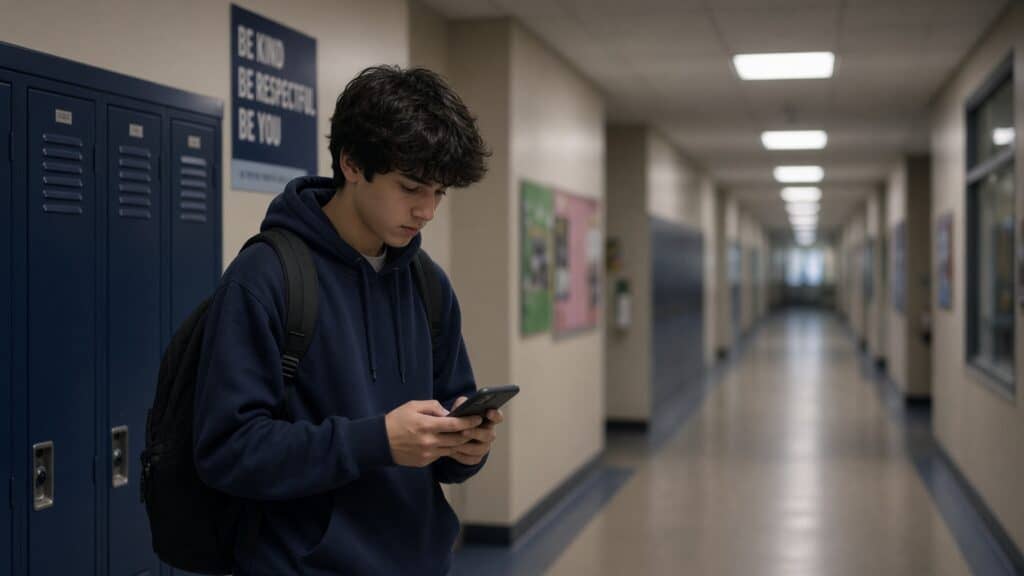
Table of Contents
What’s actually happening in schools right now
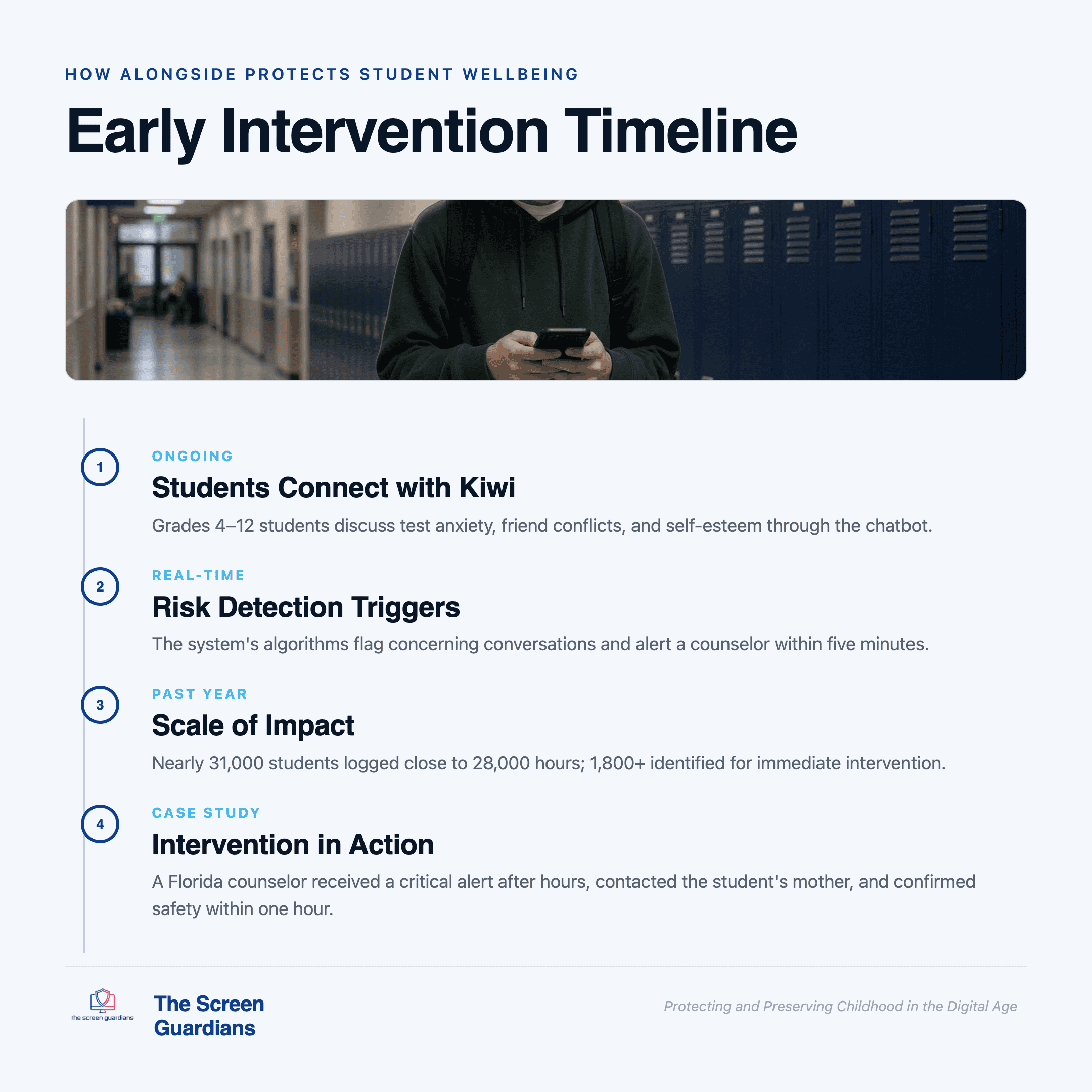
The platform is called Alongside. Its chatbot, Kiwi, is built for students in grades four through twelve and talks with them about ordinary hard things: test anxiety, friend conflicts, self-esteem. If a conversation trips the system’s risk detection, a counselor gets an alert with the chat log within five minutes.
In the past year, nearly 31,000 students used it, logging close to 28,000 hours. The company says the platform identified more than 1,800 students who needed immediate intervention. In Florida, a middle school counselor got a critical alert late one evening, called for a wellness check, and reached the student’s mother while she was out grocery shopping. The student was found safe within the hour.
The Texas principal’s summary was blunt: “We actually saved a kid.” He also says the platform has saved each of his counselors about three weeks of work a year, and that students keep surfacing who were never on anyone’s radar.
Source: EdSource, “Schools recruit AI chatbots as counselor shortage persists,” September 10, 2026
Nobody here made a bad call. A principal with 1,800 kids and three counselors isn’t choosing technology over people. He’s choosing coverage over nothing. That’s not a school problem. That’s a system problem.
Why a kid tells a chatbot before telling a person
The Florida counselor said the quiet part plainly: her students want to be heard, but they are not going to walk up to an adult and announce that they’re having harmful thoughts.
Agent Andy Herrera, Senior Special Agent with the Kansas Bureau of Investigation and part of The Screen Guardians expert team, has been saying a version of this for years. His core insight is about how silence gets built: fear turns into shame, shame turns into silence, and silence is what predators count on.
It’s the same machinery here, pointed at a different kind of harm. A kid who is scared of what he’s thinking gets ashamed of thinking it. Then he says nothing. A chatbot lowers the price of telling, because there’s no face on the other side. Nobody flinches. Nobody gets disappointed in him. Nobody calls his mom unless the system decides to.
We understand why that feels easier. But easier isn’t the same as good for them. When a child learns to pour hard feelings into a chatbot, it can quietly become the first place they go, and people become the harder place. Every private conversation with a machine is one they didn’t practice having with a person.
“The goal isn’t that they tell you. The goal is that they tell somebody instead of nobody.” — Agent Andy Herrera
That’s why Andy’s advice matters more now than ever. The somebody needs to be a person. AI isn’t where kids should turn for advice, especially about their emotions, and we say that directly to students in our program. A school tool that flags a crisis did something good here. The goal is still a child who walks into a counselor’s office on their own, before any alert is needed.
Where AI chatbots for student mental health fall short
This is where the story gets more complicated than either side wants it to be.
Common Sense Media’s Youth AI Safety Institute and the Stanford Medicine Brainstorm Lab ran a risk assessment on AI mental health apps and rated most consumer-facing tools, including ChatGPT, Gemini, and the wellness app Wysa, as unacceptable risk for children. A common failure: they didn’t notify a guardian when a child was in crisis. Alongside, the school-based tool, was rated low risk by comparison, largely because it’s built to alert an adult rather than hold the conversation on its own.
Even so, the honest limits are worth naming:
- Alongside’s own clinical director says the system can misread context. One example she gave: confusing “shooting hoops” with something far worse.
- It struggles to detect signs of psychosis.
- A Northwestern University pilot in Texas and New Mexico found about 76% of high-risk students reported no suicidal ideation after three months. But across the full student sample, there was no measurable effect on depression, anxiety, or loneliness.
- RAND researchers found roughly 1 in 5 adolescents already use AI chatbots for mental health advice. A school-provided bot doesn’t replace that. It gets added to it.
- A California family’s lawsuit against OpenAI, filed after their 16-year-old’s death, is still pending in court.
Common Sense Media’s Robbie Torney made the point that matters most for schools: even a detection system that works well is missing the overlapping protection of a real human network around a child — family, teachers, coaches, support staff — the people who close the gap when one adult misses a sign.
Put simply: it’s a smoke detector, not a fire department. Smoke detectors save lives. Nobody installs one and cancels the fire department.
AI isn’t bad. How we use it, and how much we lean on it, is what matters. So when a school looks at any technology that touches students’ emotional lives, we’d suggest one question: which direction does it move the child?
Toward people: Does it strengthen human connection, build real skills, and move the child toward trusted adults?
Or away from them: Does it invite emotional dependence, encourage more and more personal disclosure, and slowly replace human connection?
A tool that flags a crisis and hands the child to a counselor is moving in the right direction. A tool that becomes the place a child goes every time they feel sad is not, even when it’s kind, and even when it’s always available. Especially then.
The part software can’t do: three trusted adults
Every one of Agent Herrera’s videos inside our Parent Portal ends with one small action a parent can take that night. His first one is the cheapest intervention in this entire article, and it costs a school nothing.
Help every child name three trusted adults.
Three, not one. One might be out of town. One might be the problem. One might be the person a kid can actually get the words out in front of. Teachers, coaches, a bus driver, a grandparent, a counselor, a neighbor. Specific people with specific names.
Then two more from Herrera:
Give amnesty in advance. “You will not be punished for telling me the truth.” Say it before anything happens, not after.
Set the secret rule. “Anyone who asks you to keep a secret from me is a person you should tell me about.”
An alert tells a counselor that a student is in trouble. A trusted adult is the reason a student speaks up in the first place, and the person still there the following week, and the week after that.

What a school can put in place this year
If your district is looking at this technology, or already using it, here’s the work that surrounds it:
- Treat the chatbot as detection, not care. Write down who responds, how fast, and what happens in the first 24 hours.
- Teach the skill the tool assumes kids already have. Students need to know what a trusted adult is, how to actually go to one, and that AI is not where we go for advice about our feelings.
- Tell families before launch, not after. Cover what’s stored, who reads a flagged chat, and how to opt out.
- Name three trusted adults in every classroom. By name, out loud, written down.
- Give amnesty in advance, as a stated school norm.
- Account for the other chatbots. Students aren’t only using the school’s tool.
- Have a recovery plan ready, so the adults aren’t improvising on the worst day.
That’s the half almost nobody is funding. A phone policy doesn’t cover it. Neither does an app.
Get the one-page school brief
The seven things a school can put in place this year, on one printable page. Built to hand to a principal, a counselor, or your school board. Free, no strings.
No spam. Unsubscribe anytime.
You’re in.
Your one-page brief is ready below. Print it, forward it, bring it to your next meeting.
Download the brief (PDF)
You don't have to navigate screen time alone.
Real tools. Real voices. Real support — delivered to your inbox. Pick what you'd like to hear about.
You're in. 🎉
Check your inbox to confirm — your first email is on its way.