For years, the conversation about kids and technology in schools has been about what to take away: phones in pouches, apps blocked on the network, bell-to-bell bans. Those guardrails matter. But a phone policy doesn’t teach a single student how to spot a manipulative message, protect their personal information, or ask for help when something goes wrong online.
That gap is why states are stepping in. Florida, Georgia, Tennessee, North Carolina, Mississippi and, as of this summer, Pennsylvania have written social media literacy and internet safety instruction into law. For principals and superintendents, the question is no longer whether students need this. It’s what your state requires, and how to teach it well. (If your school just went phone-free, start with what schools should teach after the phone ban.)
On November 16, I was one of 23 people who testified to the Kansas Legislature’s Special Committee on Protecting Children from Online Harm. Nurses, a police detective, a KBI agent and child advocates all testified, and nearly every one of us named education as part of the solution. Here’s where the laws stand, what they ask of schools, and what it takes to actually change student behavior.
What Social Media Literacy Laws Have in Common
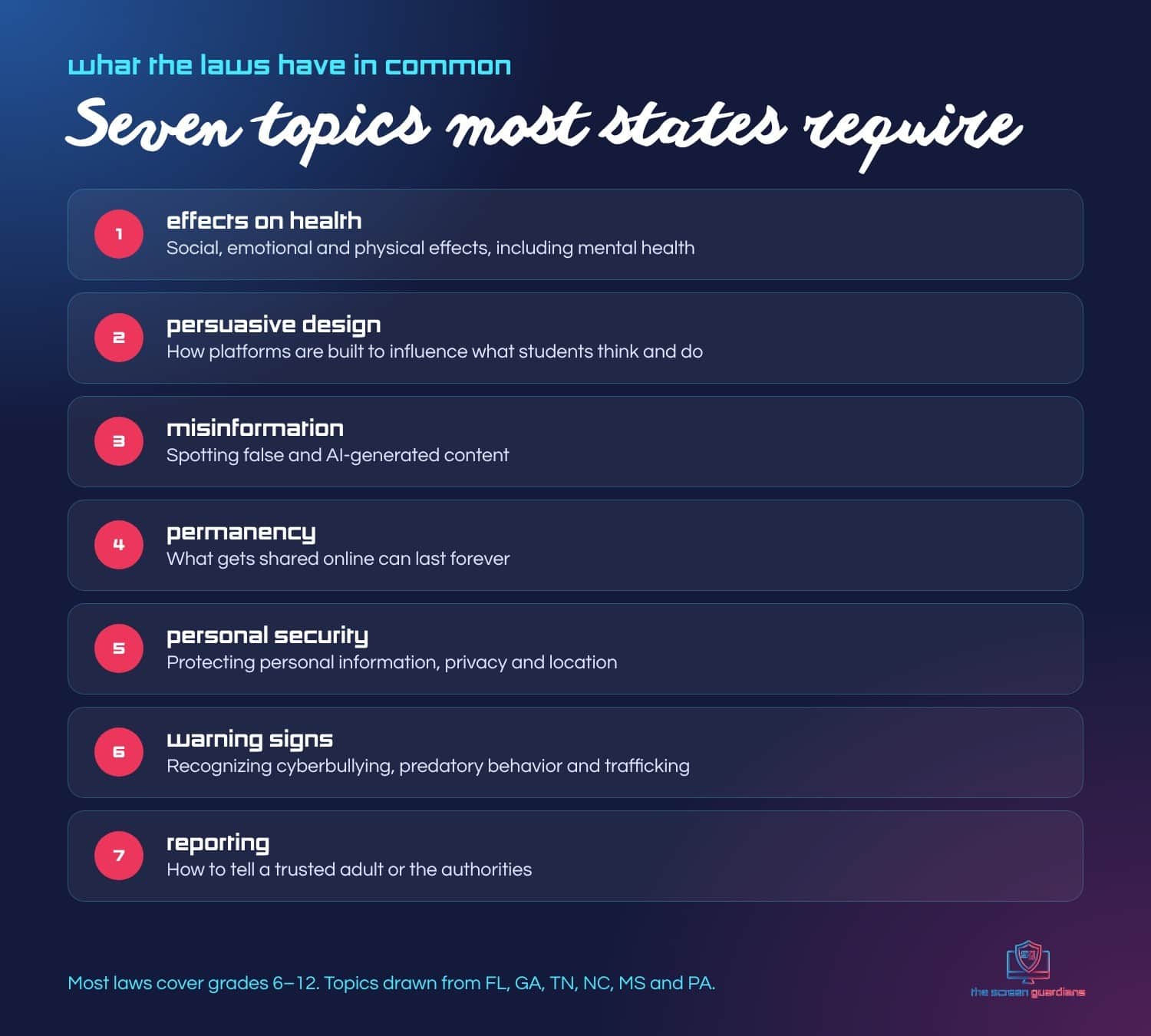
Read these laws side by side and the same topics show up again and again. Many follow the Teen Social Media and Internet Safety Act model policy, so the required lessons tend to cover:
- The social, emotional and physical effects of social media, including on mental health
- How social media is designed to influence what students think and do
- Misinformation and disinformation (Tennessee adds AI-generated misinformation)
- The permanency of what students share online
- Protecting personal information, privacy and location
- Recognizing cyberbullying, predatory behavior and human trafficking
- How to report suspicious behavior to a trusted adult or the authorities
Most of these requirements start in middle school and run through grade 12. North Carolina is the exception: its instruction happens once in elementary school, once in middle school and twice in high school.
State-by-State Guide to Social Media Literacy Requirements
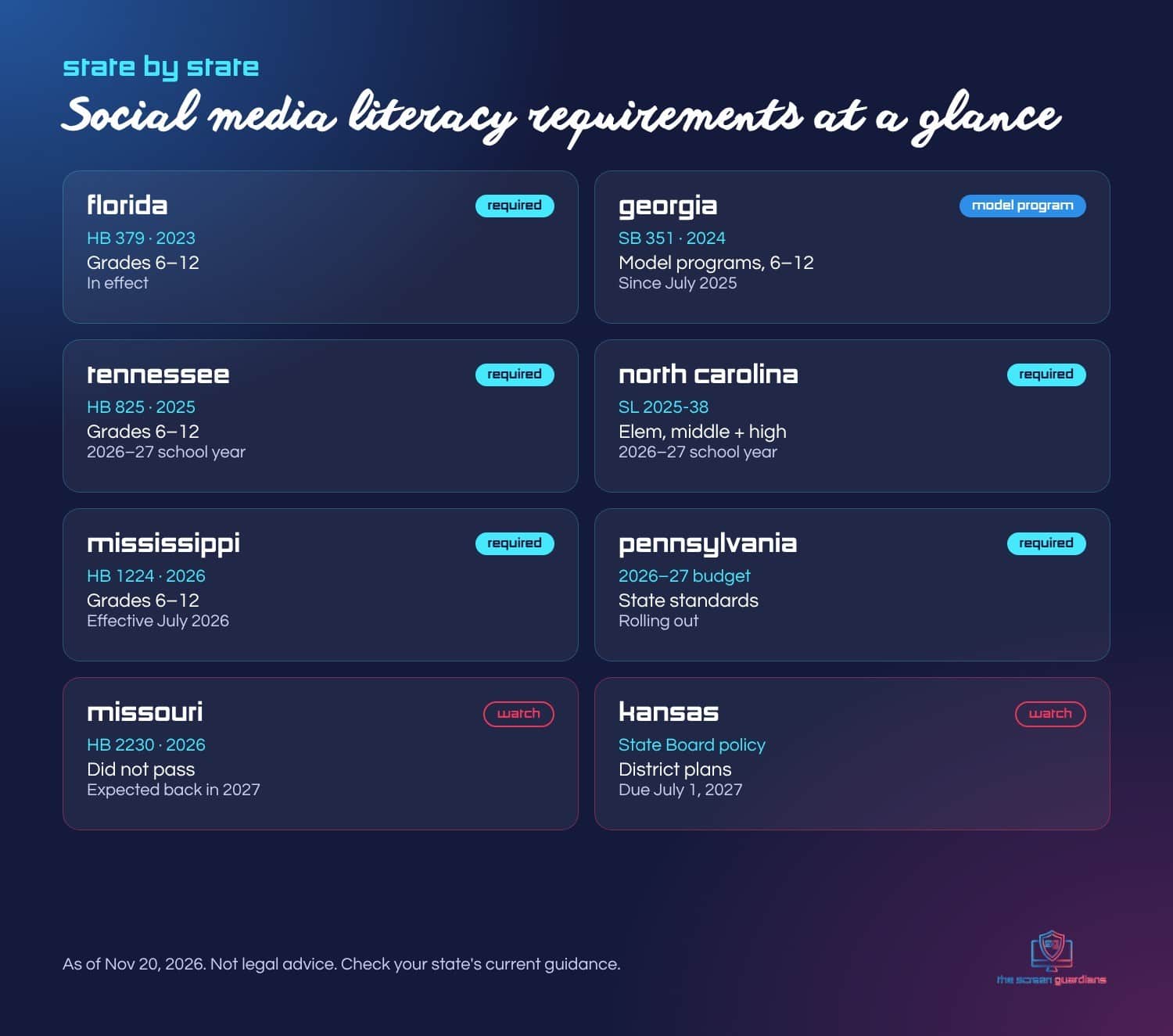
Here’s where things stand as of November 20, 2026. These laws change quickly, so check your state’s own guidance before you build a plan. This is a summary for school leaders, not legal advice.
| State | Law | Status | Grades | What it asks of schools | Timing |
|---|---|---|---|---|---|
| Florida | HB 379 (2023) | Signed May 9, 2023 | 6–12 | Instruction on the social, emotional and physical effects of social media | In effect |
| Georgia | SB 351 (2024) | Law; O.C.G.A. § 20-2-149 | 6–12 | State develops model online safety programs; local boards may add them to instruction | Effective July 1, 2025 |
| Tennessee | Teen Social Media and Internet Safety Act (HB 825, 2025) | Law; state guidance issued | 6–12 | Required topics taught using TDOE guidance; parents may opt out | 2026–27 school year |
| North Carolina | HB 959, Session Law 2025-38 | Signed July 1, 2025 | Once in elementary, once in middle, twice in high school | Instruction on social media and its effects on health added to the standard course of study | 2026–27 school year |
| Mississippi | HB 1224 (2026), Keeping Kids Safe Online Act | Signed April 8, 2026 | 6–12 | State creates social media safety courses; parents may opt out | Effective July 1, 2026 |
| Pennsylvania | HB 2176, enacted in the 2026–27 budget | Enacted July 2026 | Set through state academic standards | Standards include social media effects and safe use; social media literacy programming for students and teachers | Rolling out |
| Missouri | HB 2230 (2026) | Did not pass the Senate | — | No requirement yet; expected to return in 2027 | — |
| Kansas | State Board Instructional Technology Policy | No law; board policy adopted Nov 2026 | By grade level or grade band | District plans must build digital citizenship skills, with education for educators and families | Plans due July 1, 2027 |
What This Means for Your School
I hope these laws make digital safety education an expectation instead of an afterthought. States like Tennessee, North Carolina and Pennsylvania are saying out loud that kids need to be taught, not just restricted.
I also worry they’ll focus only on predators, when technology harms kids in quieter ways too: lost sleep, anxiety, fragmented attention, struggles with friendships, less creativity and critical thinking. And most of these laws start in sixth grade and hand districts guidance instead of a program.
So read the requirements as a floor, not a ceiling. A list of required topics isn’t a plan. Students need lessons that are sequenced, age-appropriate and revisited as they grow, starting well before sixth grade.
Checking the Box vs. Changing Behavior
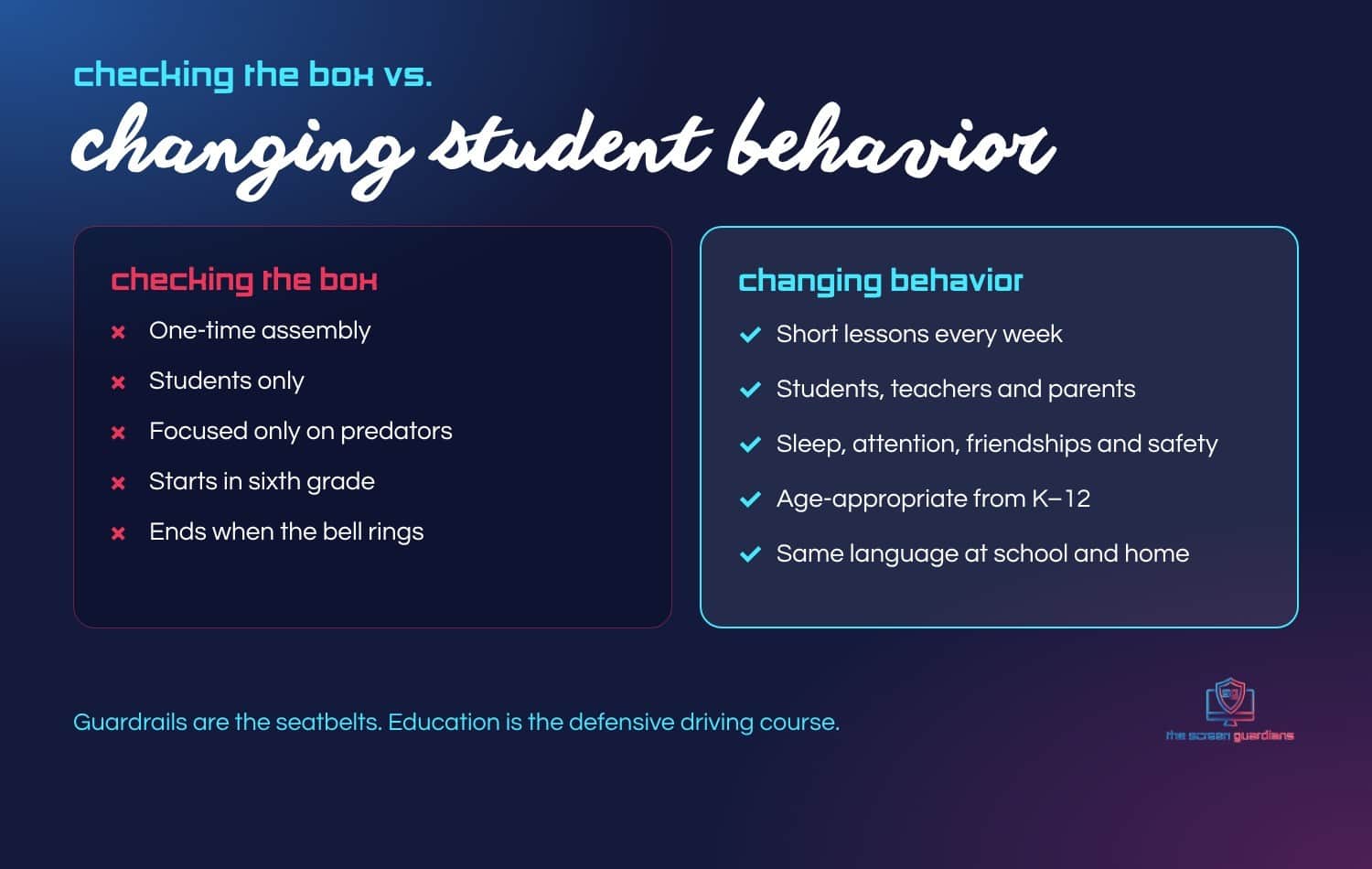
Checking the box is a one-time assembly. Real change comes from ongoing education that keeps building, so it sticks.
We gave kids devices the way we’d hand over car keys without teaching the rules of the road. Guardrails are the speed limits, and parental controls are the seatbelts and airbags. Kids still need to learn to drive. Really, they need a defensive driving course.
Behavior changes when the whole community learns together: students, teachers and parents, using the same language.
How to Choose a Social Media Literacy Curriculum
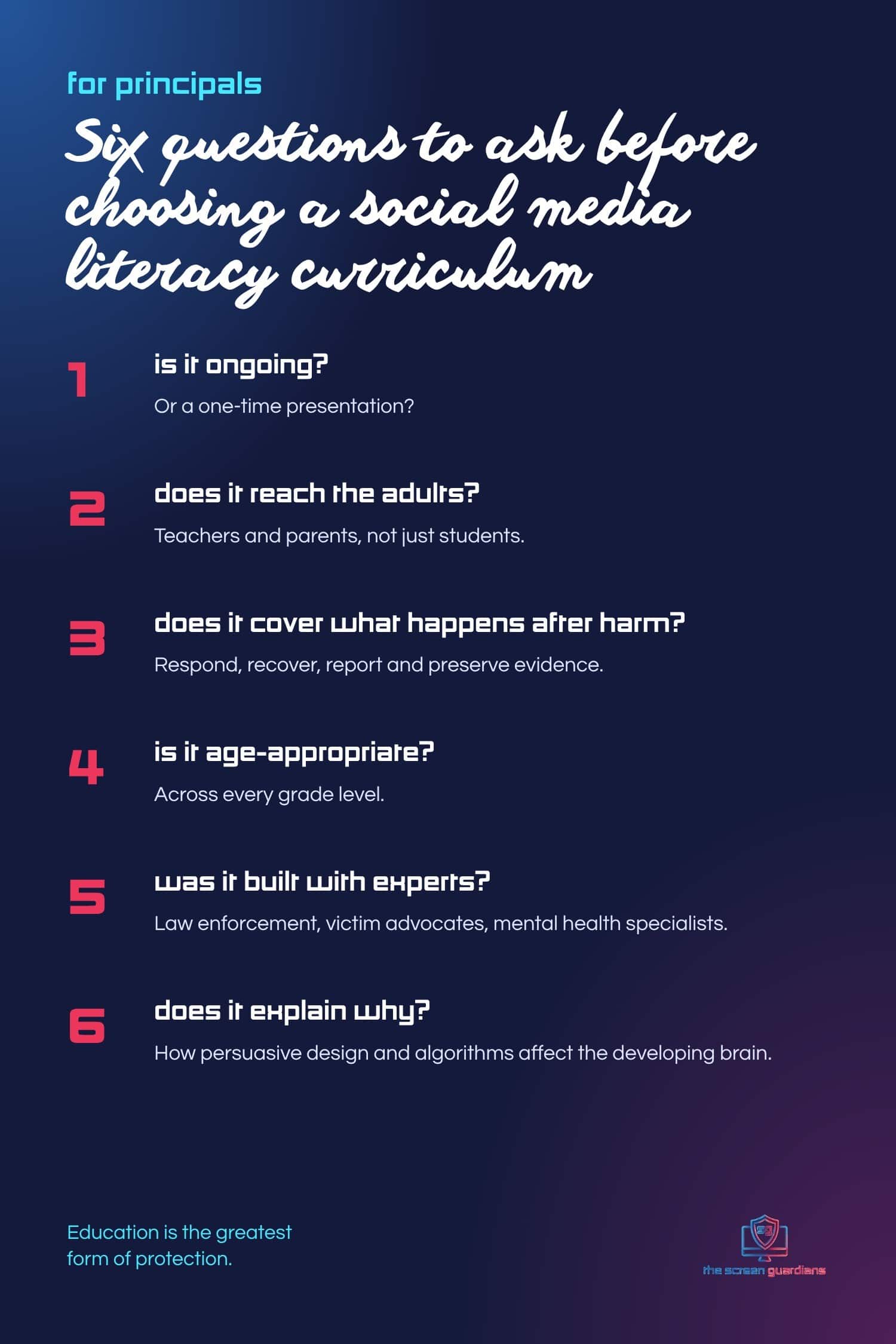
When you’re choosing a social media literacy curriculum or internet safety curriculum to meet one of these laws, ask:
- Is it ongoing, or a one-time presentation?
- Does it educate teachers and parents, not just students?
- Does it teach what to do after harm happens, including how to respond, recover, report and preserve evidence?
- Is it age-appropriate across grade levels?
- Was it built with experts like law enforcement, victim advocates and mental health specialists?
- Does it explain why: how persuasive design and algorithms affect the developing brain?
How to Meet the Requirement Without Overloading Teachers
Teachers are already stretched. Meeting a social media literacy law doesn’t have to mean another unit stacked on top of everything else. What works:
- Short weekly lessons instead of a single long unit, so the learning keeps building
- Ready-to-teach materials, so teachers aren’t writing lessons from scratch
- Family communication built in, so parents hear the same language at home
- Education for teachers too, because teachers often can’t tell when a student is talking with a bad actor, and they need to know where to turn
I’d point to schools that educate the whole school community at once: every student, every teacher and their parents. Schools using that approach tell us their communities have changed. USD 494 has been a great partner, and we presented together to a packed room at the KASB convention this month.
If Your State Hasn’t Passed a Law Yet
Kansas has no law requiring this instruction yet. But on November 9, the Kansas State Board of Education adopted a new Instructional Technology Policy (KSDE news release), and it puts education at the center.
Every district’s plan must cover “methods for developing students’ digital citizenship skills by grade level or grade band” while promoting online and personal safety and student well-being, “with corresponding education and support for educators and families” (Section III.B.3). The policy also defines digital citizenship to include understanding “how technology use and design, including persuasive design and algorithms, affect attention,” recognizing “manipulative or unsafe digital interactions,” and knowing “how and where to seek help when harm occurs” (Section II.5).
Commissioner Steel said the parent education piece was added because of the 150-plus signatures on our open letter from Kansas parents, educators and students. Districts have until July 1, 2027 to submit their plans to KSDE. (Here is what the Kansas school technology policy means for your district.)
The legislative committee is weighing options, including an App Store Accountability Act. What lawmakers needed to hear is that educating children isn’t enough on its own. Parents are overwhelmed, parental controls are hard to use and change without warning, and when something happens, the adults don’t know where to turn or how to preserve evidence. Kids, families and communities need both: accountability and education.
In Missouri, HB 2230 died in the Senate last session, and we expect it to come back in 2027. (For the federal picture, see where kids online safety law stands.)
Leading schools aren’t waiting. Restrictions like age verification matter, but kids find workarounds and predators will always find a way online. Guardrails are necessary, and they aren’t enough on their own. The tide is turning: people in positions of power now see that education matters.
Who’s Going to Teach It?
The question was never whether kids need this. It’s who’s going to teach it, and with what?
The Screen Guardians is a K–12 digital health and safety program built with law enforcement, victim advocates and mental health specialists. Classroom teachers teach short weekly lessons, teachers get the training to recognize warning signs, and a Parent Companion brings the same language home. It’s built to help schools meet these requirements and go beyond them. Want this in your school? See how The Screen Guardians works →
Education is the greatest form of protection.
Frequently Asked Questions
Which states require social media literacy instruction in schools?
As of November 2026, Florida, Tennessee, North Carolina, Mississippi and Pennsylvania require social media or internet safety instruction, and Georgia has the state develop model programs that districts may use. Kansas has no law, but its State Board’s new Instructional Technology Policy requires district plans to build digital citizenship skills. Missouri’s 2026 bill did not pass.
What grades do social media literacy laws cover?
Most apply to grades 6 through 12. North Carolina requires instruction once in elementary school, once in middle school and twice in high school. The habits these laws target start earlier, so many schools begin age-appropriate lessons in the elementary grades.
What should a social media literacy curriculum cover?
Most state requirements include the effects of social media on mental and physical health, how platforms influence behavior, misinformation, the permanency of posts, protecting personal information, recognizing cyberbullying, predatory behavior and trafficking, and how to report suspicious behavior. Strong programs also teach what to do after harm happens.
Is a one-time assembly enough to meet these requirements?
It may check the box, but it rarely changes behavior. Ongoing, age-appropriate lessons that also educate teachers and parents give students a shared language and skills that build over time.
Does Kansas require social media or internet safety lessons?
Not by law yet. The Kansas State Board of Education’s Instructional Technology Policy, adopted in November 2026, requires each district’s plan to develop students’ digital citizenship skills by grade level or grade band, with education and support for educators and families. Plans are due to KSDE by July 1, 2027.
Last updated November 20, 2026. This guide summarizes state laws and policies for school leaders and is not legal advice. Check your state department of education for current requirements.