The headline you saw is real. Now let’s translate it.
On May 20, 2026, the U.S. Department of Health and Human Services and the Office of the Surgeon General issued a formal advisory classifying youth screen time as an “urgent public health concern.” If you saw the headlines and felt your stomach drop — you’re not overreacting. You’re paying attention.
Here’s what we want you to know first: you are not alone in this, and you are not behind. The 2026 Surgeon General advisory on screen time isn’t a verdict on your parenting. It’s federal cover for what so many of you have already been feeling in your gut. Today, the guidance caught up to you.
At The Screen Guardians, we’ve been saying it for years: screens are shaping our kids’ brains, sleep, mood, and learning — and parents need real tools, not more fear. So let’s walk through what the advisory actually says, what it means for your family, and what to do this week.
Table of Contents
What the 2026 Surgeon General Advisory on Screen Time Says
The advisory establishes the first federal age-by-age screen time guidance for U.S. families. It cites cognitive and emotional development, sleep, physical health, education, and mental health as primary impact areas — and notes that the average American teen now exceeds four hours of digital entertainment per day.
Here are the new federal guidelines at a glance:
- Under 18 months: Zero screen time.
- 18 months to 6 years: Less than one hour per day.
- 6 to 18 years: A maximum of two hours of digital entertainment per day.
A few things worth naming. The two-hour ceiling refers to digital entertainment — not schoolwork on a Chromebook, not a FaceTime with Grandma. The advisory was issued through HHS leadership; the administration has not yet confirmed a sitting Surgeon General. And like every advisory before it, this is guidance — not a law. But the message is clear: the federal government is now naming what families have been living with for years.
Why This Matters for Your Family’s Digital Health
Numbers on a page are easy to skim past. So let’s say it plainly.
Children’s brains are still under construction. The prefrontal cortex — the part responsible for impulse control, judgment, and long-term thinking — is one of the last regions to fully develop. When kids spend hours inside dopamine-driven feeds, their brains are learning to expect that pace, that reward, that intensity. Sleep gets disrupted. Mood gets harder to regulate. Attention gets fragmented.
This isn’t fear talking. This is how their wiring works.
And here’s the part the headlines often miss: the answer isn’t shame. The answer isn’t a tech ban. The answer is education. When kids understand why their brain responds to a notification, a streak, a like — they stop seeing the rules as punishment and start seeing them as protection.
Rules without understanding often breed rebellion. But when kids learn how technology affects their brain, they become more curious — not just compliant.
2026 Surgeon General advisory screen time: What Parents Actually Need to Do This Week
You don’t need to overhaul your family in 48 hours. You need a calm starting place. Try these five steps.
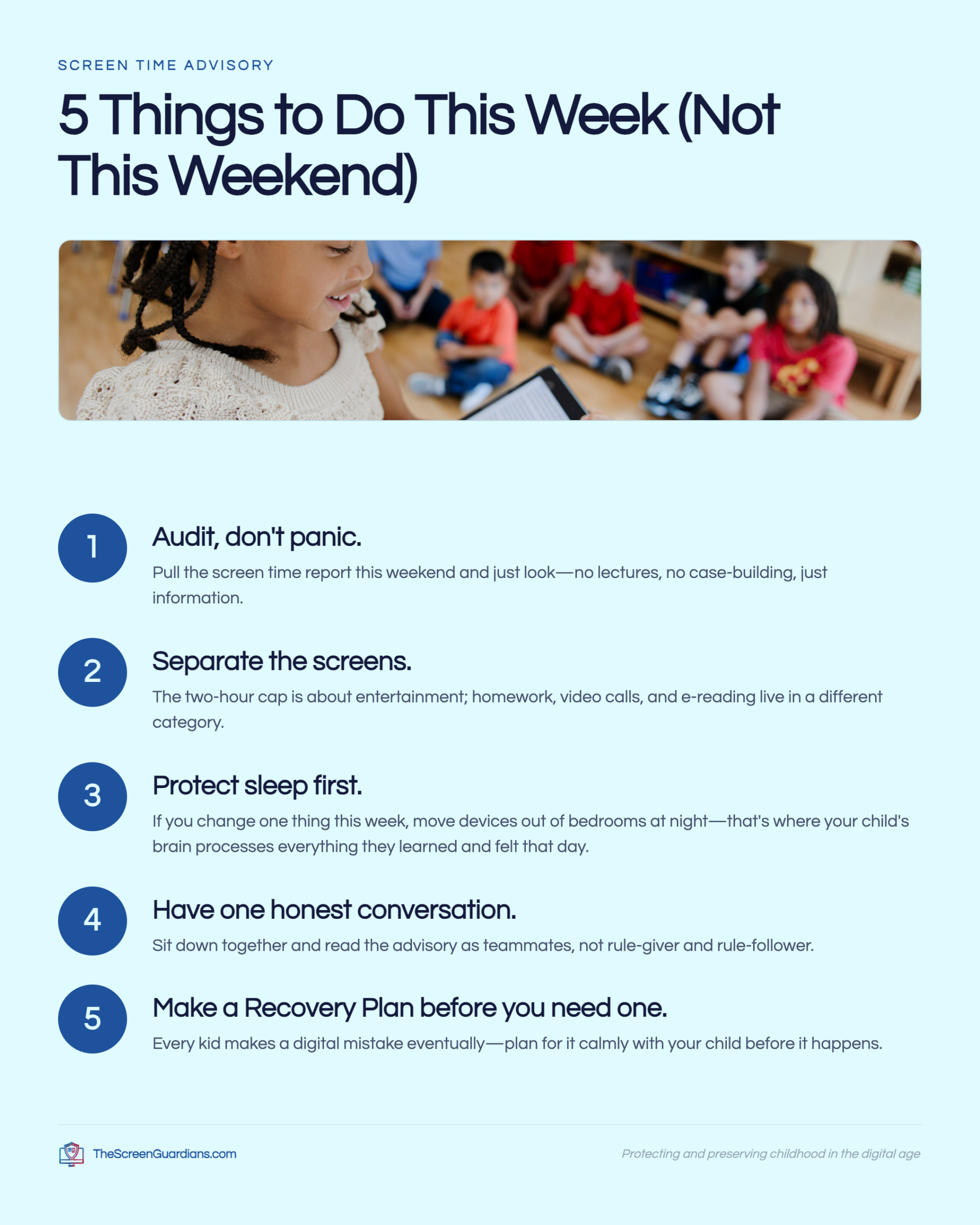
1. Audit, don’t panic.
Look at the screen time report on your child’s device this weekend. Just look. No lectures, no punishment. You’re gathering information, not building a case.
2. Separate the screens.
The advisory’s two-hour cap is about entertainment. Homework, video calls with family, and reading a book on a Kindle are different categories. Knowing the difference helps you set fair limits without sounding arbitrary.
3. Protect sleep first.
If you change only one thing this week, get devices out of bedrooms at night. Sleep is where your child’s brain processes everything they learned, felt, and saw that day. Protect it fiercely.
4. Have one honest conversation.
Sit down with your child and read the advisory together. Use words like, “The government just put out new guidance, and I want us to talk about it as a family.” That sentence alone changes the dynamic from rule-giver to teammate.
5. Make a Recovery Plan before you need one.
Every kid makes a digital mistake eventually. A group chat goes sideways. A photo gets shared. An app gets downloaded behind your back. Planning for that before it happens — calmly, with your child — is one of the most powerful things you can do.
For Schools and Educators
If you’re a teacher, principal, or curriculum director reading this — you’ve just been handed the federal cover you’ve been waiting for. The advisory makes the case for a structured, school-day digital health curriculum that aligns home and classroom on the same language.
That’s exactly what The Screen Guardians K–12 Program is built to do. Taught once a week, 30 to 40 minutes per session, by your own teachers. Grounded in brain science. Paired with a Parent Companion so families aren’t left out of the conversation. Learn more about bringing the program to your school.
You’re Not Doing This Alone
The 2026 Surgeon General advisory on screen time is a turning point. It’s also a beginning. The headlines will fade in a week. Your kid’s relationship with their phone will not.
That’s why The Screen Guardians exists. Not to add to the noise. Not to shame anyone. To walk alongside the parents and educators who are doing the hard work — with research, real tools, and a steady hand.
If today’s news rattled you, take a breath. Then take one step.
The Parent Portal is where you’ll find the Recovery Plan, conversation scripts for hard talks, and a calm, judgment-free space to land. The Free Parent Course is a great starting point if you’re brand new here. And our weekly newsletter will keep you steady as this conversation keeps evolving.
You don’t have to navigate screen time alone. We’re in it with you.
Not anti-technology. Pro-child.