A morning at the Starbucks that changed my perspective
I walked into a Starbucks in an affluent Kansas City neighborhood at 8 a.m. on a Thursday morning with my coffee order and a business meeting on my mind.
What I saw stopped me cold.
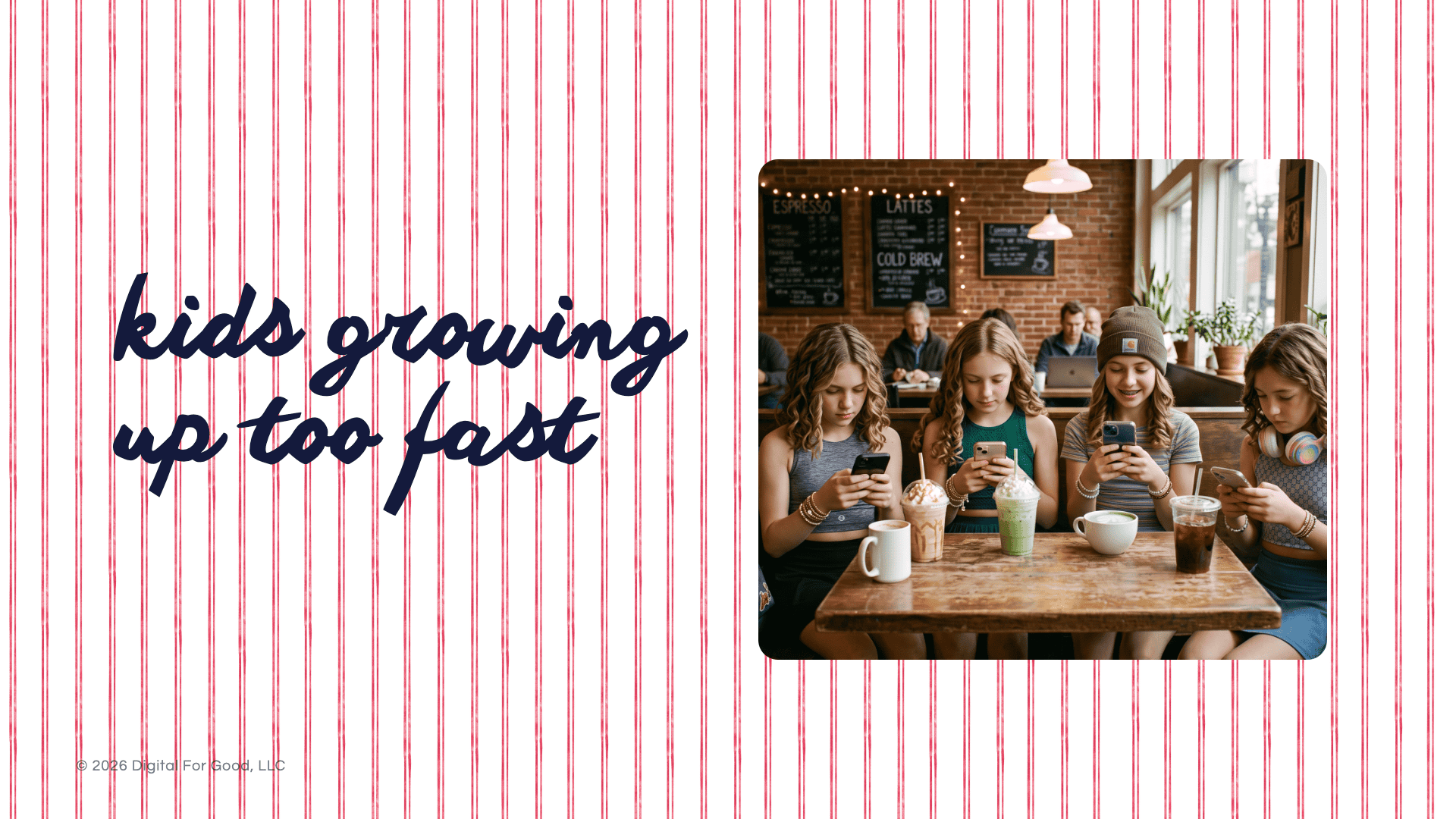
The place was packed with young girls—11, 12, maybe 13 years old—and they didn’t look like the kids I remember from that age. Not even close. They looked like kids growing up too fast.
They were dressed in perfectly curated athleisure: designer crop tops, brand-name athletic skirts, impeccably curled hair, stacked bracelets that probably cost more than my morning coffee. Each one had an iPhone in hand. Each one was holding a $6+ beverage like it was a status symbol, not a drink.
But it wasn’t the clothes that got me. It was the presence.
These girls moved and carried themselves with a sophistication and self-awareness that felt distinctly adolescent—maybe 17 or 18. They weren’t giggling or being silly. They weren’t talking about homework or crushes or the things I’d expect to hear from a sixth or seventh grader. They were hyper-conscious of how they looked, how they sat, who was watching. They were performing.
And someone—some very skilled marketer, some algorithm designer, some brand strategist—had taught them to do exactly this.
Table of Contents
The Architects of Kids Growing Up Too Fast
Here’s what bothered me most: these girls didn’t get here by accident.
This is the result of intentional, sophisticated marketing aimed directly at preteen and early teen girls. We’re talking about TikTok trends, Instagram aesthetics, YouTube fashion hauls, influencer culture, brand collaborations designed specifically to make young girls feel like they need to look like miniature adults to belong.
And it’s working.
The person marketing luxury coffee to 12-year-olds? Killing it. The brand selling athleisure designed to make kids look older? Genius, from a business perspective. The algorithm serving perfectly curated lifestyle content to young girls who are still figuring out who they are? It’s operating exactly as intended.
But here’s the part that kept me up: These companies know what they’re doing. They know they’re targeting kids in a critical developmental window. They know that girls this age are hypersensitive to peer approval, brand status, and visual self-presentation. They know that their brains—still under construction—are wired for dopamine-seeking behavior, impulse, and the constant comparison that social media demands.
And they’re exploiting it.
The Neuroscience of Childhood Cut Short
I teach brain development for a living. I know that the prefrontal cortex—the part of the brain responsible for impulse control, decision-making, and long-term consequences—isn’t fully developed until the mid-20s. I know that dopamine loops are powerful, especially in young people. I know that algorithms are deliberately designed to keep kids scrolling, comparing, consuming.
But knowing it intellectually is different from seeing it.
Seeing a room full of 11-year-old girls who have internalized the values of adult consumer culture—the performance, the perfectionism, the brand loyalty, the appearance-first mindset—was jarring in a way that hit different.
These aren’t the product of bad parenting. These aren’t kids who woke up and decided to abandon childhood. These are young girls who’ve been systematically taught that their value is tied to how they look, what they wear, what they own, and how carefully they curate their image. They’ve been taught this by the most powerful marketing machine in human history.
And they’ve learned the lesson well.
The Innocence We’ve Lost
I think about my own kids. My almost-15-year-old navigates a world that my generation couldn’t have imagined. But at least there’s some distance there—by 15, you’re supposed to be thinking about independence, image, peer approval. That’s developmentally normal.
But 11? 12? That’s supposed to be the age of silly jokes, mismatched socks, playing with friends without documenting it, not caring what your hair looks like because you’re too busy having fun.
What I saw at that Starbucks wasn’t fun. It was work.
These girls were working to look a certain way. Working to maintain an image. Working to fit into a version of girlhood that’s been sold to them as aspirational, attainable, and necessary.
That’s not childhood. That’s performance. And it starts way too young.
What Now?
Here’s what I want to be clear about: This isn’t about blaming kids. These girls aren’t failing. They’re succeeding at exactly what they’ve been taught to do. They’re following the rules of a game they didn’t design.
The problem is the game itself.
The problem is that our media ecosystem, our marketing industry, and our social platforms have decided that childhood is a market segment to be monetized, not a stage of life to be protected. The problem is that we’ve created an environment where an 11-year-old feels the need to perform adulthood before she’s had a chance to be a kid.
And the problem is that we’re all—parents, educators, policymakers—acting like this is normal.
It’s not.
What We Can Do About Kids Growing Up Too Fast
Here’s what I know: Education is the greatest form of protection.
When kids understand how marketing works, when they can name the algorithm, when they recognize persuasive design for what it is—their agency increases. Shame decreases. They start making choices instead of just following impulses.
When parents and kids have a shared language for talking about social media, brand culture, and the pressure to perform—those conversations become possible. Real conversations. The kind where a kid can say, “I know why I feel like I need to look this way,” instead of just acting like it’s normal.
When schools teach digital literacy and brain science alongside their traditional curriculum—kids get permission to question the stories they’ve been told about who they’re supposed to be.
None of this is easy. But it’s necessary.
Because somewhere in that Starbucks, underneath the perfect hair and the designer crop tops and the curated aesthetic, there are still 11-year-old girls who want to play, to be silly, to figure out who they are without an audience watching and judging.
They just need someone to tell them that’s okay.
They need adults who understand the system. Who can name it. Who can walk alongside them and say: You don’t have to perform your way into belonging. You’re already enough.
That’s what protecting childhood looks like today.
It’s not about banning phones or demonizing social media. It’s about giving kids—and parents—the tools to navigate this world with eyes wide open.
Because childhood is too short, and too precious, to sell it all away by the time they’re in middle school.
You’re Not Alone
You’re not alone in noticing this shift. If you’re seeing it in your own community—kids growing up too fast, the pressure to perform, the constant comparison—you’re not imagining it. It’s real. And it’s worth talking about.
Start a conversation with your kids about what they see online. Ask them what they notice about how kids their age present themselves. Help them understand the difference between who they are and who they’re trying to be.
Because the answer to “What happened to childhood?” isn’t resignation. It’s connection, education, and the steady presence of adults who still remember what it felt like to just be a kid.
Ready to dive deeper? The Parent Portal is built for moments like these—when you need to understand your kid’s digital world and have the tools to guide them through it. Join us here.