Screen Guardians Podcast 42 — What to Do If Your Child Is Targeted Online, with KBI Senior Special Agent Andy Herrera
Every parent I know carries a version of the same fear: the day your kid walks up and says, “Something happened online.” What do you do first? What do you say? What should you absolutely not do? If your child is targeted online, those first few minutes matter more than almost anything else, and most of us have never been told what to do with them.
So I asked someone who knows. On this episode of The Screen Guardians Podcast, I sat down with Senior Special Agent Andy Herrera of the Kansas Bureau of Investigation’s Northeast Child Victims Unit. Andy investigates internet crimes against children across 35 Kansas counties. He has also recorded online safety videos for our school lessons and our Parent Portal, and I am so grateful the KBI stands with us in this work.
A quick note before you read on: this conversation covers online exploitation of children, including sextortion and self-harm. It’s an important conversation, and it’s a heavy one. Take care of yourself as you read.
Table of Contents
Meet Agent Andy Herrera
Andy’s career started on patrol with the Lawrence Police Department. From there he worked fraud and identity theft, major violent crimes, and eight years on the KBI’s Crime Scene Response Team. He joined the KBI in 2015 and moved to the Child Victims Unit full time in January 2024, where much of the work is now internet crimes.
When I asked why he chose this work, he didn’t hesitate. “I felt like I could be the voice for those child victims,” he told me. “I knew that this was my calling because I really do have a passion to protect our children.”
What I appreciate most about Andy is how he talks about all of this. He doesn’t lead with fear. He leads with calm, clear steps. That’s exactly what parents need from someone who sees this up close.

What Law Enforcement Is Seeing Right Now
Without going into specific cases, Andy described what his unit sees most: inappropriate content, online enticement, sexting, sextortion, and cyberbullying. He also named a growing concern, which is the AI element showing up in more investigations.
Two things he said stayed with me.
No community is immune
“I don’t think there’s really any community that’s specifically safe or immune,” Andy said. His team works cases in small towns and in Topeka, Kansas City, and Lawrence. These crimes don’t discriminate by zip code, school, or how “good” a neighborhood is.
It’s not the app. It’s who’s on the other side.
I asked which platform worries him most. He wouldn’t name one. Any platform with a chat feature can be a door in, so his advice is to assume someone could find a way to reach a child on any of them. He also sees parents who did everything right, every setting and every limit, and something still happened. He tells those parents plainly: it’s not your fault.
His framing for the conversation at home is one I’ve already borrowed in my own house:
“You’re not saying you don’t trust your child. You just don’t trust who’s on the other side of that screen.”
Senior Special Agent Andy Herrera, KBI

How Sextortion of Teen Boys Escalates So Fast
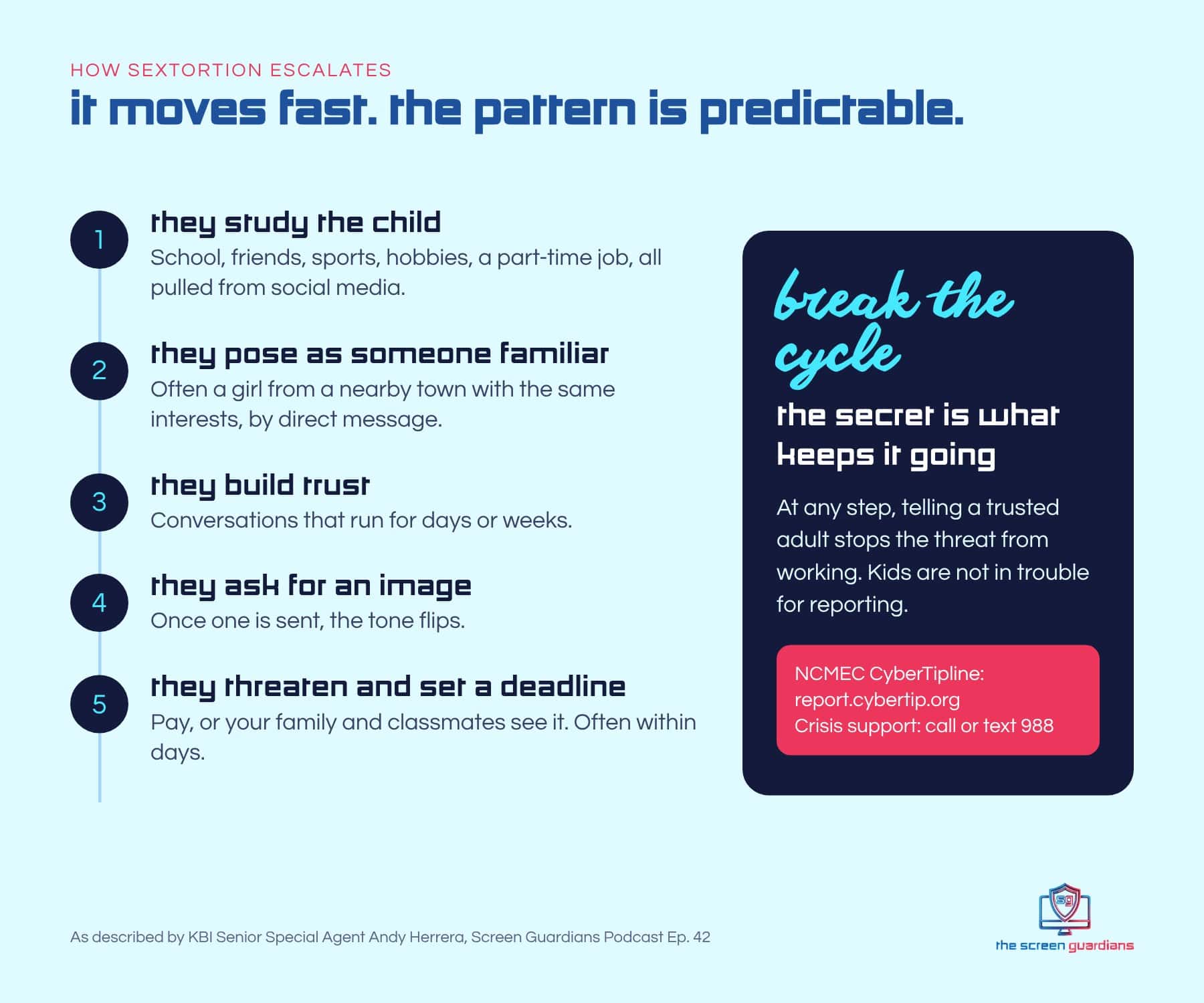
There’s a stigma that only girls are targeted. Andy was clear that this is not the case. Teen boys are just as vulnerable, and the pattern he described is chillingly methodical:
- They study the child. The offender looks through social media to learn the boy’s school, friends, sports, hobbies, even his part-time job.
- They pose as someone familiar. Often a girl from a nearby community with the same interests, reaching out by direct message.
- They build trust. Conversations can run for days or weeks.
- They ask for an image. Once one is sent, the tone flips.
- They threaten and set a deadline. Your family, friends, and teachers will see this unless you pay. Andy described demands like $250 and deadlines like two days.
“That’s where the element of the self-harm comes into play,” Andy said. In one recent case, the offender was overseas and the boy had said he was going to hurt himself. Andy’s team identified the family quickly, called the father to say his son was not in any trouble, and put a safety plan and counseling in place. The goal was the child’s safety first.
Andy also wants kids to hear the hopeful part: most teens recognize the red flag and refuse these requests, and it is always okay to report.
If you or your child are struggling or thinking about self-harm, call or text 988 to reach the 988 Suicide & Crisis Lifeline any time.
AI-generated images are a growing piece
Andy shared a case where an offender pulled ordinary photos of a teen girl from a family friend’s Facebook and manipulated them into nude images. The mother and daughter had no idea. If an explicit image of a minor is circulating, or someone is threatening to share one, NCMEC’s free Take It Down tool can help remove it from participating platforms.
Why Kids Stay Silent
Andy listed the reasons kids hold back: they’re afraid of losing their phone or online access, they think their parents can’t help, they worry their parents won’t understand, and it’s an awkward conversation to start. I’d add shame. “I made a mistake. I was curious. I went too far down the path.”
Here’s what I believe with my whole heart: the secret is what keeps the cycle going. If we can eliminate the secret, we can stop grooming, exploitation, and sextortion earlier in the process. When I said that on the episode, Andy’s answer was simple. “Exactly. Spot on.”
So what can we say now, before anything happens? Andy’s words: “If something happens, you could come to me and talk to me about it. I’m not going to get mad at you. We just want to make sure you’re safe.” At our house, we talk about “tricky people” with the littles, and I tell my older kids what I’m afraid of and why. Not perfect kids, not perfect parents. Just kids who know they can come to us.
Education Breaks the Cycle of Secrecy
Here’s what I want every family and every school to hear: education is how we break the cycle of secrecy. Offenders count on silence. Shame keeps a child quiet, and the quiet gives the harm room to grow. When kids and parents both understand how this works, the secret loses its power.
For kids: knowing the pattern makes it safe to speak up
When kids understand how grooming and sextortion work (the flattery, the pressure, the threats, the deadlines), they can name it for what it is. A child who knows “this is a trick, and it’s not my fault” is far more likely to tell someone than to carry it alone. That’s why our lessons teach kids the pattern before they ever need it, and why Andy wants every child to have more than one trusted adult they can go to.
For parents: keep the conversation open
Open communication isn’t one big talk. It’s a hundred small ones. Ask about the games and apps they use. Tell them what you’re worried about and why. And say the words out loud before anything happens: “If something goes wrong online, you can come to me. You won’t be in trouble. I’ll help you.” The secret is what keeps the cycle going. Every time we make it safe to talk, we break it a little more.
What to Do If Your Child Is Targeted Online: 4 Steps
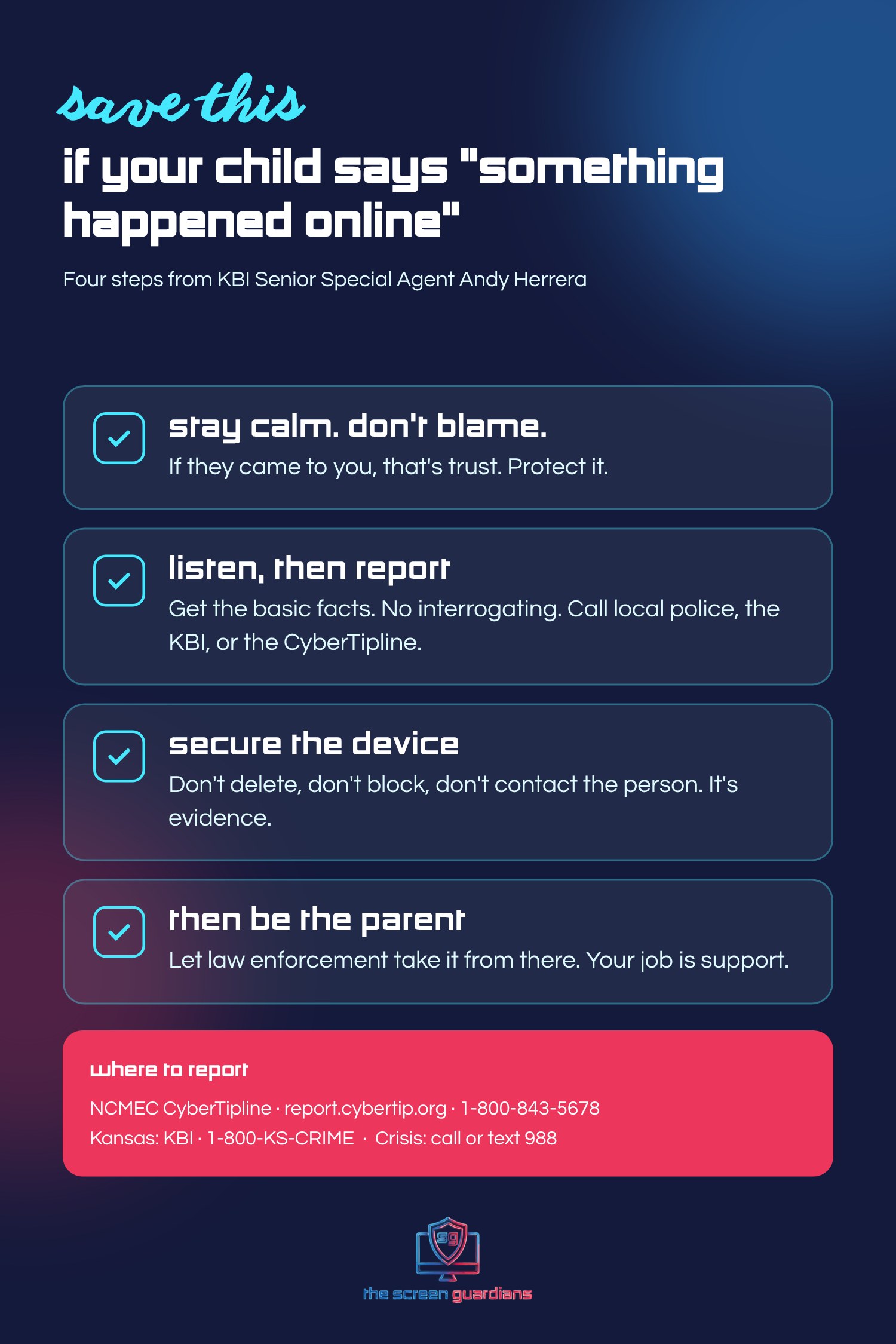
This is the part every parent wants. I’ve had parents call me and say, “I forgot. What do I do?” So save this section. Here is Andy’s guidance, in order:
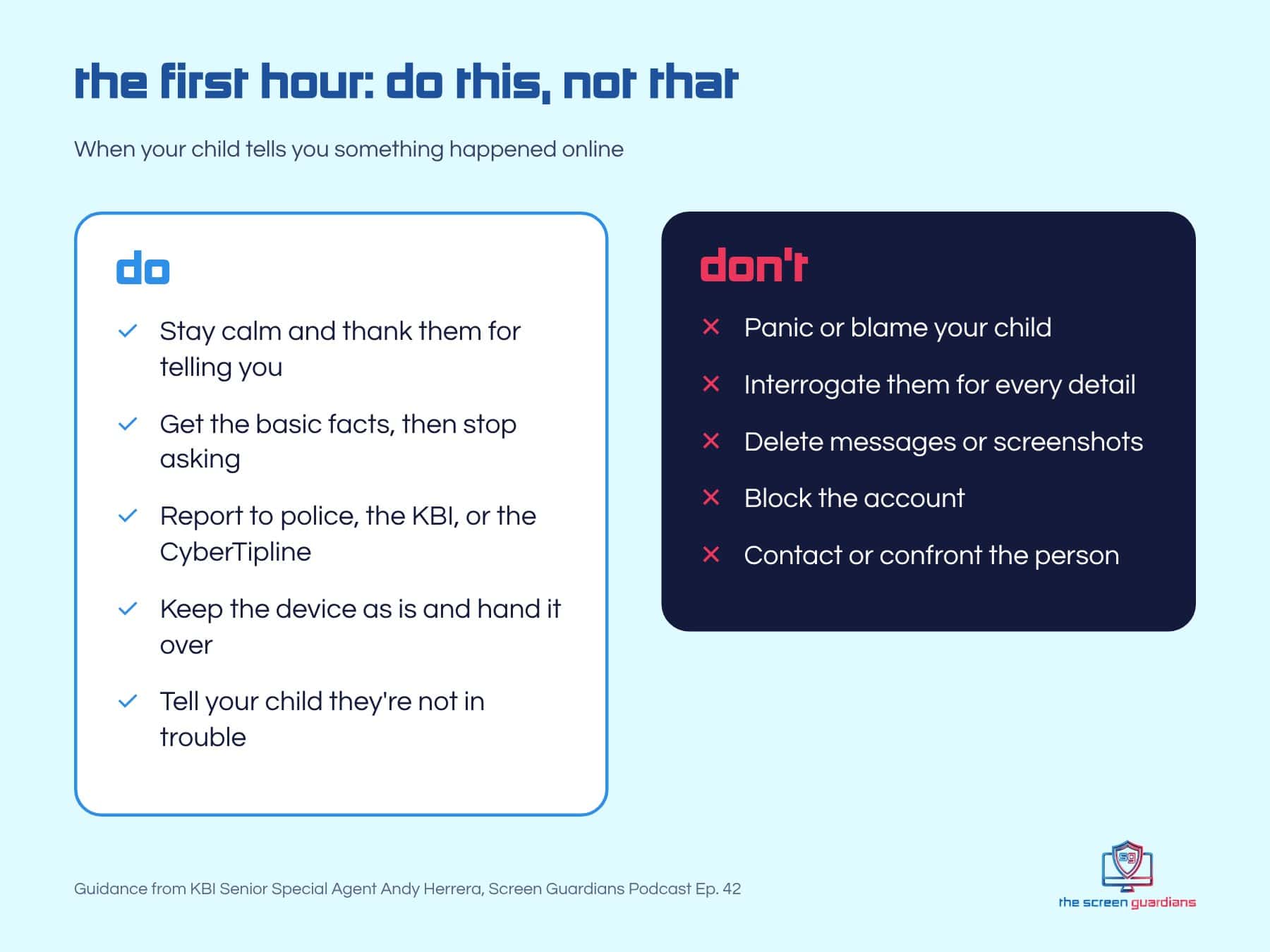
- Stay calm and don’t blame your child. “The biggest thing is don’t panic and don’t immediately blame your child.” If they came to you, that’s trust. Protect it.
- Listen, get the basic facts, and report. You don’t need to interview your child. Report to your local law enforcement, the KBI at 1-800-KS-CRIME if you’re in Kansas, or the NCMEC CyberTipline at 1-800-843-5678. Trained professionals conduct forensic interviews so your child doesn’t have to tell the story over and over.
- Secure the device. Don’t delete messages, don’t block the account, and don’t contact the person. Keep everything as it is and contact law enforcement quickly, because that device likely holds evidence.
- Then be the parent. “Once you’ve reported it, just be supportive for your child. Let law enforcement take it from there.” Investigations can take a long time, and victim advocates and counseling are part of the process.
If your child is targeted online, it can feel like you have to fix it all yourself, right now. You don’t. Your one job after you report is the one you already know how to do: love your kid through it.
Pause, Check, Choose: Teaching Kids to Pump the Brakes
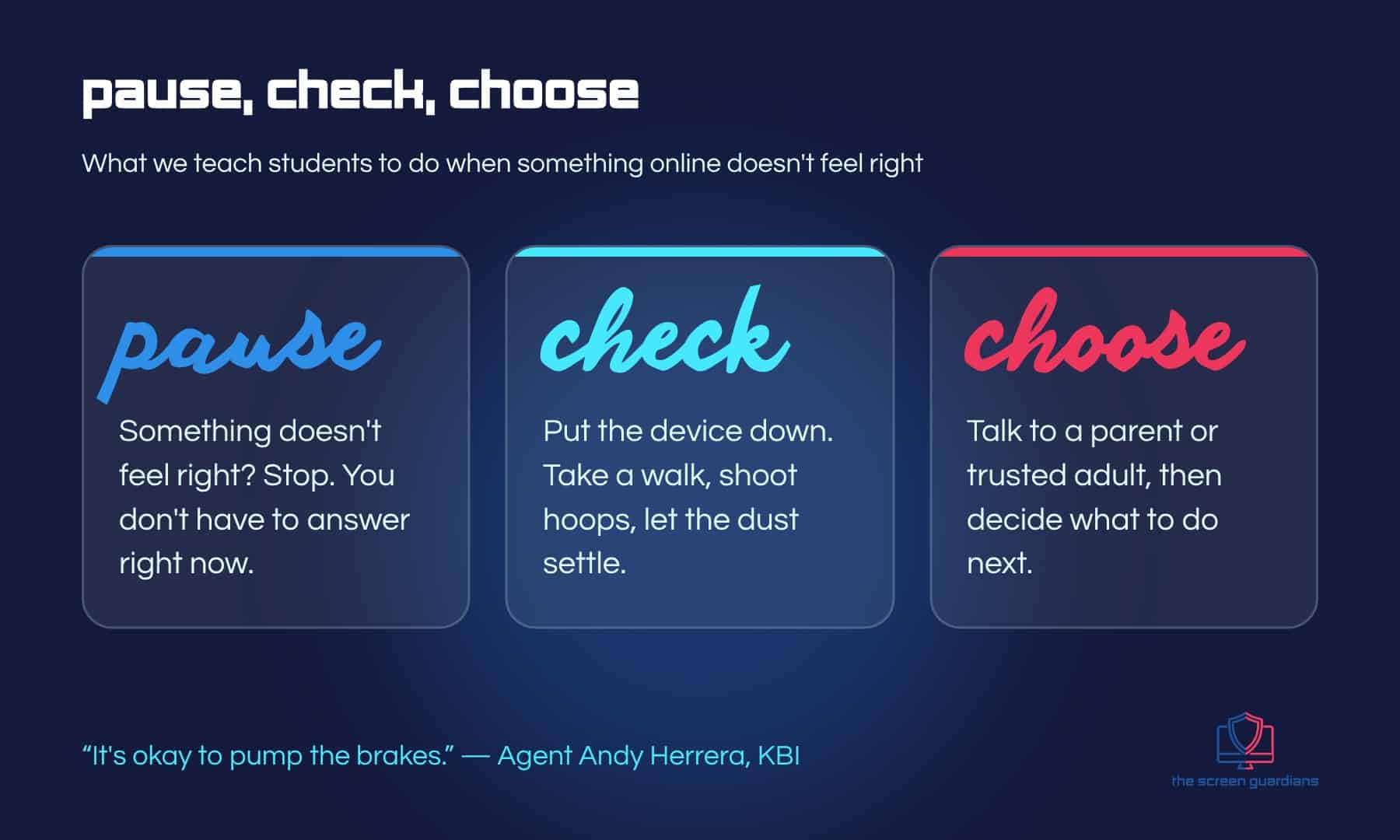
In our program, we teach students to Pause, Check, Choose when something online doesn’t feel right. I asked Andy where that pause makes the biggest difference. His answer: kids feel enormous pressure to make snap decisions online. They don’t have to. That space to stop is the skill that matters most when a child is targeted online.
“It’s okay to pump the brakes. You don’t have to act on impulse.”
Senior Special Agent Andy Herrera, KBI
His advice to kids is practical: put the device down, go for a walk, listen to music, shoot some baskets, let the dust settle. Then talk to a parent or another trusted adult, like an aunt, uncle, cousin, teacher, school counselor, or coach. And the rule he repeats in every school he visits: “If something doesn’t feel right, it’s probably not right.”
Always take a break, and get outside. The intensity of the moment is powerful. A threatening message, a deadline, a request that feels urgent: it’s all designed to make a child react before they can think. The pause breaks that intensity. Stepping away, even for a walk around the block, gives the thinking part of the brain time to catch up, so kids can think critically about what’s really happening and who they should tell.
What This Means for Schools
Teachers and counselors are on the front line with our kids. As Andy put it, they spend seven or eight hours a day with students and they know their behavior. When an outgoing child suddenly withdraws, “there’s a reason for that.” He wants educators to trust their instincts, pull that student aside, and check in.
Kids also need to hear this more than once, and from more than one voice. “I think that we can never hear this enough,” Andy said. And when a KBI agent shows up in a classroom lesson, kids see law enforcement as helpers, not just characters on TV.
That’s why Andy’s videos live inside The Screen Guardians. Our online safety module, our school response guidelines developed with KBI input, and the Parent Companion that carries the same language home all work toward one goal: if a child is targeted online, they know exactly what to do and who to tell. We can’t expect kids to recognize a risk nobody ever taught them about. Andy said it best: if we get ahead of it on the front end, we eliminate cases before they start.
What Gives Andy Hope
I closed by asking what gives him hope. Education, first. When parents and kids are on the same page about guardrails, “I consider that a huge win.” Then accountability for the people who prey on children, and the advocates who walk families through the hardest season of their lives. “Our children should be able to be safe online,” he said.
And his one thing for parents to remember? “Have that communication, have that trust, and just take care of yourselves.” Listen to the full episode on Spotify or on The Screen Guardians Podcast page, and if you missed it, catch our last episode on whether your daughter is ready for social media.
Frequently Asked Questions
What should I do first if my child is targeted online?
Stay calm and don’t blame your child. Listen and get the basic facts without interrogating, report it to local law enforcement or the NCMEC CyberTipline, and secure the device without deleting anything. After you report, focus on supporting your child.
Should I delete the messages or block the account?
No. Agent Herrera advises leaving the device exactly as it is, not deleting messages, not blocking the account, and not contacting the person. The device likely holds evidence, so contact law enforcement as soon as possible and let them preserve it.
Who do I report online exploitation or sextortion to?
Report to your local police, the NCMEC CyberTipline at report.cybertip.org or 1-800-843-5678, or, in Kansas, the KBI at 1-800-KS-CRIME. If a child is in immediate danger or talking about self-harm, call 911 or call or text 988.
Can an explicit image of my child be taken down?
Often, yes. NCMEC’s free Take It Down service helps remove or block intimate images taken before age 18 from participating platforms, without anyone having to send the image itself.
How can schools help before a child is targeted online?
Schools can teach students to recognize red flags and pause before acting, train teachers and counselors to notice behavior changes, and keep parents on the same page. The Screen Guardians builds this into weekly lessons, school response guidelines, and a Parent Companion after every lesson.
Bring This Conversation to Your School
Andy’s guidance is part of The Screen Guardians, a K–12 digital health and safety program taught once a week by students’ own teachers, with a Parent Companion that brings the same language home. Want this in your school? See how The Screen Guardians works.
Want to go deeper at home? Hear more from Agent Herrera in the Parent Portal, with videos, guides, and scripts for the hard conversations.
Education is the greatest form of protection.