If you’ve ever found yourself yelling “put the phone down!” while simultaneously scrolling your own device, you’re not alone. Intentional parenting in a digital world is one of the biggest challenges families face today — and most of us are figuring it out as we go.
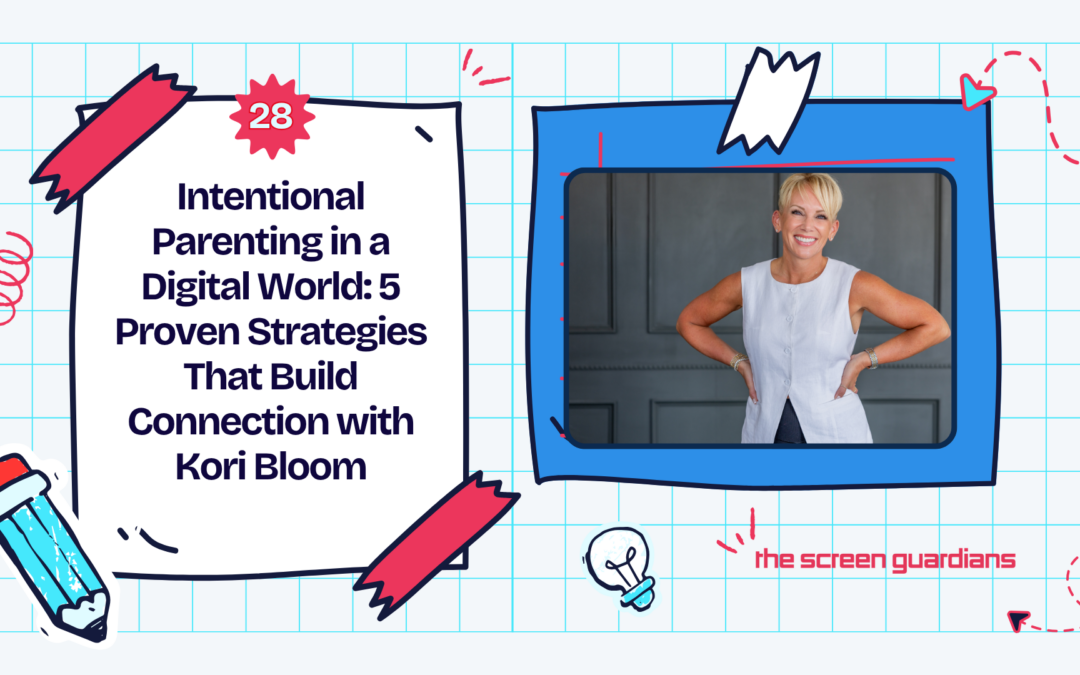
On a recent episode of The Screen Guardians Podcast, host Katie Longhauser sat down with Kori Bloom — founder of Conscious Not Crazy, author of The Business of Parenting, and a mom of two teenagers — to talk about what it really looks like to lead yourself first as a parent, communicate without fear, and stay connected to your kids in a world full of devices.
This conversation was packed with practical wisdom. Here are the biggest takeaways every parent needs to hear.
Table of Contents
Why So Many Parents Get Stuck in Reactive Mode
Before we can talk about intentional parenting in a digital world, we have to name what most of us default to: reactive parenting. That’s the yelling, the snatching devices away mid-game, the “because I said so” moments we regret later.
Kori explained it this way: technology doesn’t just impact our kids — it impacts us. We live in an age of immediacy. We’re answering emails, managing schedules, juggling work and home, and running on fumes. When we’re overwhelmed, we stop being conscious. We go on autopilot.
And that autopilot? It’s often wired from how we were raised. Many of today’s parents grew up in a “children should be seen and not heard” era. We weren’t taught to manage big emotions — so when our kids trigger us, our brains default to the only patterns they know.
The good news? Neuroplasticity is real. You can rewire those patterns. It takes time, but every conscious pause is a new pathway being built in your brain. Think of it like sledding down a hill — you’re creating a brand new trail, one run at a time.
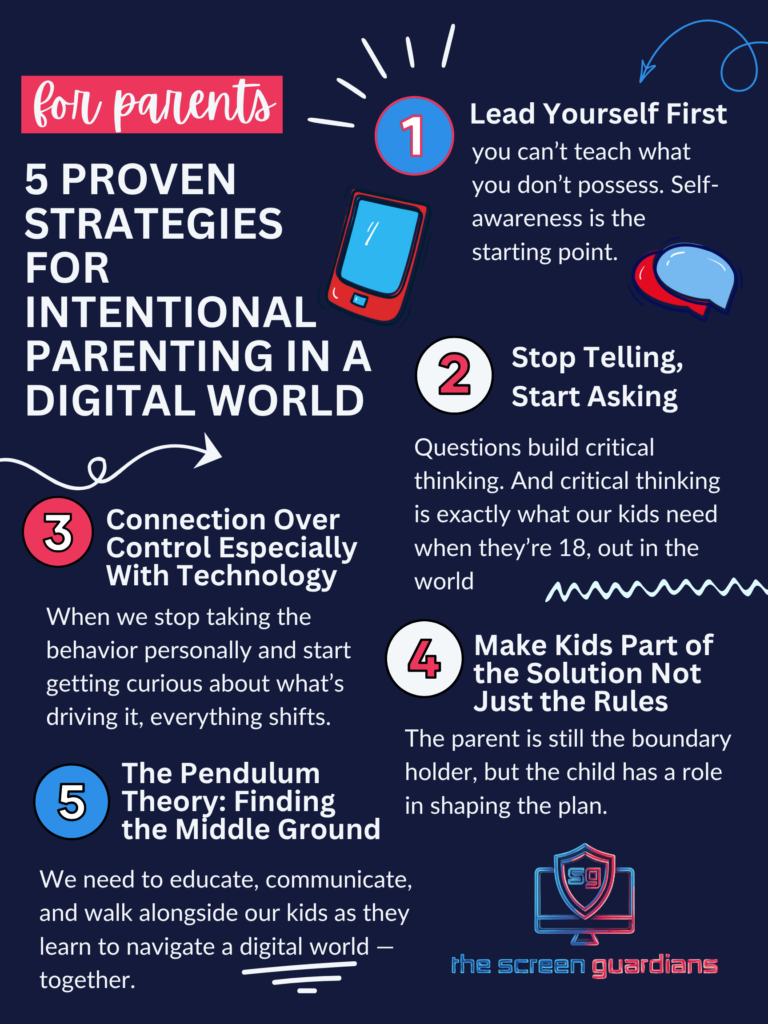
1 – Lead Yourself First — The Foundation of Intentional Parenting in a Digital World
Kori’s core message is one every parent needs to sit with: you can’t teach what you don’t possess.
She shared that early in her parenting journey, she was laser-focused on fixing her kids — getting them to comply, to behave, to stop doing the things that were driving her crazy. But the real shift happened when she realized the guide was the one who needed new tools.
Self-awareness is the starting point. That means asking yourself honest questions in the heat of the moment:
- Why am I feeling this way right now?
- What’s the actual goal here — connection or compliance?
- Is my reaction proportional to what just happened?
- Am I responding… or reacting?
This isn’t about being a perfect parent. Kori is the first to say she still dips a toe back into autopilot sometimes. But when you’ve done the work, it feels off when you slip — and that awareness is the win.
2 – Stop Telling, Start Asking: The Communication Shift That Changes Everything
When Katie asked Kori for the one thing parents should stop doing today, her answer was instant: “Stop telling. Start asking.”
Here’s why this matters so much for families navigating technology together. When we tell kids what to do — put the phone down, stop playing that game, get off social media — their defenses go up. They shut down or push back. We get locked in a power struggle where nobody wins.
But when we ask questions, something different happens in their brain. They have to think to answer. Their guard comes down. Critical thinking kicks in. And we get real information about what’s going on beneath the surface.
Try these instead of commands:
- “What do you notice about how you feel after being on your phone for a while?”
- “Do you ever feel grumpier or more frustrated after gaming versus playing outside?”
- “What do you think would be a fair amount of screen time on school nights?”
- “If someone online asked you for personal information, what would you do?”
Questions build critical thinking. And critical thinking is exactly what our kids need when they’re 18, out in the world, and making decisions without us standing over their shoulder.
3 – Connection Over Control — Especially With Technology
One of the most powerful moments in this conversation was Kori’s reminder: a child’s behavior is not about you.
When your teen rolls their eyes. When your eight-year-old melts down because you set a screen time limit. When your kid says “I hate you” because you took the iPad away. None of that is personal. It’s the tip of the iceberg — and there’s always something bigger going on underneath.
Kori uses the iceberg analogy to stay grounded. The behavior you see? That’s just the 10% above water. Below the surface is stress, fear, overwhelm, hormones, peer pressure, or exhaustion. When we stop taking the behavior personally and start getting curious about what’s driving it, everything shifts.
Her advice for staying connected:
- Be curious, not furious. Approach mistakes with wonder, not punishment.
- Don’t personalize the attitude. Their bad moment isn’t your failure.
- Have fun together. Sometimes a water fight in the kitchen does more for your relationship than a lecture ever could.
- Share your own struggles. Tell your kids about your own screen habits. Be honest about what you’re working on too.
As Kori put it: connection over compliance — every time. Because when your kids feel connected to you, they’re far more likely to come to you when something scary or confusing happens online.
4 – Make Kids Part of the Solution — Not Just the Rules
Here’s where this conversation connects directly to the tools families can use at home. Kori strongly believes that kids need voice and choice — even when it comes to digital boundaries.
Instead of handing down a set of device rules and expecting buy-in, sit around the kitchen table together. Kori calls these “essential agreements” — guidelines the whole family creates together. The parent is still the boundary holder, but the child has a role in shaping the plan.
What this might look like:
- “We’ve noticed screens are becoming a problem. We think we need some guidelines. What do you think would be fair?”
- “Would you rather have screen time in the morning or after homework?”
- “What’s one rule you think our family should have around phones at dinner?”
When kids help create the boundaries, they’re more invested in following them. They develop ownership. And they practice the exact decision-making skills they’ll need as they grow.
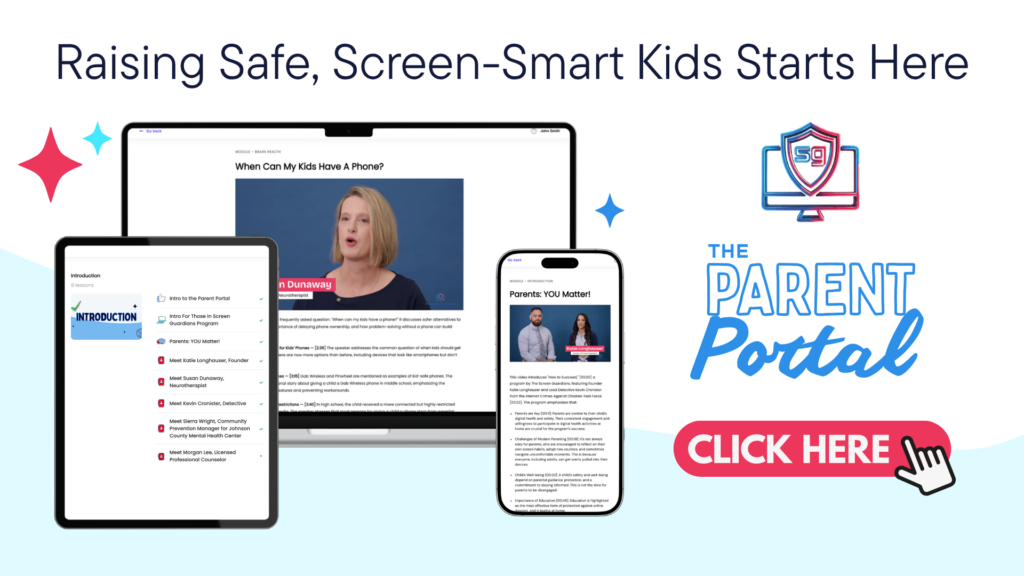
This is also where tools like The Screen Guardians Parent Portal come in. Inside the portal, families can access device guidelines, a recovery plan for digital mistakes, conversation starters, and short video lessons — all designed to help you navigate these conversations with confidence, not fear.
Kori reviewed the Parent Portal herself and shared something that stuck with us: the first step is the hardest, but once you’re in, you just want to keep learning. She called it the information she wished she’d had 15 years ago.
5 – The Pendulum Theory: Finding the Middle Ground
Kori closed with what she calls “the pendulum theory” — and it perfectly captures why so many parents swing between extremes with technology.
Many of today’s parents were raised in an authoritarian, “do as I say” generation. We were resourceful and autonomous, yes — but we also suppressed a lot of emotion. Now, as parents, we’ve swung to the other extreme: helicopter parenting. We over-save, over-protect, and over-manage our kids to spare them the pain we felt.
The sweet spot is in the middle. Feelings are valid — but they’re indicators, not dictators. Boundaries make kids feel safe. Mistakes are how they learn. And when we let them experience natural consequences with our support (not our shame), we raise resilient, capable humans.
This applies directly to screens. We don’t need to ban all technology. And we don’t need to hand over unlimited access. We need to educate, communicate, and walk alongside our kids as they learn to navigate a digital world — together.
Your Next Step as a Parent
If this conversation resonated with you, here’s what we’d encourage: take one small step today. Ask one question instead of giving one command. Sit with your child and start a conversation about screens — with curiosity, not fear. Create a moment of connection.
Because intentional parenting in a digital world doesn’t require perfection. It requires presence. And you’re already here — which means you’re already doing it.
Want more support? Explore The Parent Portal for short, practical video lessons on everything from screen time boundaries to online safety conversations. Or subscribe to our newsletter for weekly tips delivered straight to your inbox.
And if you haven’t yet, listen to the full podcast episode with Kori Bloom — it’s one you’ll want to share with every parent you know.
You can also connect with Kori at koribloom.com and find her book, The Business of Parenting, on Amazon.
Frequently Asked Questions
Q: What does intentional parenting in a digital world actually look like?
A: Intentional parenting in a digital world means being conscious and present in how you guide your kids through technology — not reactive or fear-based. It looks like asking questions instead of giving commands, creating device boundaries together as a family, and staying connected so your child feels safe coming to you when something goes wrong online.
Q: How do I talk to my kids about screen time without starting a fight?
A: Start with curiosity, not correction. Ask questions like “What do you notice about how you feel after being on your phone?” instead of “You’re on that thing too much.” When kids feel heard and involved in creating guidelines rather than just following rules, conversations become collaborative instead of combative.
Q: Is it too late to change how I parent around technology if my kids are already teenagers?
A: It’s never too late. Kori Bloom, who has a 15- and 17-year-old, says you can sit down with your teens at any age and open a conversation about technology. Start where you are. Share your own struggles with screens. Be honest. The relationship you build through those conversations matters more than getting it perfect from the start.
Q: What’s the difference between reactive and intentional parenting?
A: Reactive parenting is driven by emotion — yelling, punishing, or controlling in the heat of the moment. Intentional parenting means pausing, getting curious about what’s really going on below the surface, and responding with a clear goal in mind — usually connection and teaching rather than compliance.
Q: How can The Screen Guardians help my family?
A: The Screen Guardians offers a Parent Portal with short video lessons, device guidelines, a recovery plan for digital mistakes, and conversation starters — all designed to help families navigate technology together. There’s also a free parent course and a weekly podcast with expert guests. You don’t have to figure this out alone.