When you think about your own childhood, you may remember the sound of gravel crunching under bike tires. You remember unscheduled afternoons, neighbors who knew your names, and long, meandering conversations on porches or in backyards until the streetlights clicked on.
It was messy and imperfect, but it felt real. Rooted. Rhythmic.
Now, as a parent, I look at my children navigating childhood in a world of infinite content—where everything is immediate, curated, loud. I ache sometimes for what their nervous systems never had a chance to know: long stretches of boredom, slow social cues, the space to feel without being interrupted by a ping.
And if I’m being honest, that ache can begin to feel like fear.
Because raising emotionally well kids is hard enough in any generation. But raising them in the age of algorithms—where personalized feeds and dopamine loops shape their inner world—can feel overwhelming, disorienting, even quietly heartbreaking.
Understanding emotional regulation for kids is essential in today’s digital age.
Table of Contents
The Childhood grief we rarely talk about
I want to name something first, before we try to fix or fight anything.
There is real grief in parenting right now—grief for the childhood we knew, grief for the pressures our kids carry, and grief for the ways connection has changed.
Many of us are raising our children in a reality that didn’t exist when we were growing up. We don’t have a lived model for how to guide kids through endless scrolls or AR filters or YouTubers whispering messages into their earbuds.
So of course we feel unsure.
Of course we doubt ourselves.
Of course we feel pulled between protecting them… and preparing them.
This grief isn’t a weakness. It’s love, in disguise.
What kids are missing (and can’t always name)
Today’s constant connectivity can feel like presence—but, in truth, it often replaces essential kinds of interaction.
- Face-to-face communication that teaches them timing, tone, and empathy.
- Stillness that allows for emotional processing.
- Bodily rhythm—movement, rest, and play—that calms the nervous system.
- Real-time feedback that helps them understand the impact of their words and actions.
These are developmental necessities, not luxuries.
The tricky part is, modern tech gives our kids immediate stimulation and emotional surges—but dulls the subtle cues they need to learn how to regulate those feelings.
It might look like misbehavior. But more often than not? It’s dysregulation.
They’re not bad… they’re overwhelmed.
And they’re trying to cope with tools that weren’t designed with their wellbeing in mind.
Screens aren’t evil—but they are powerful
I want to be clear: this is not a blog about villainizing technology. I don’t believe in fear-based parenting, and I certainly don’t believe in shame.
Tech is here to stay. In many ways, it’s beautiful—connecting us to people, ideas, and experiences our kids wouldn’t otherwise have access to.
But it’s a powerful tool. One that has to be used on purpose. With context. With safety. With care.
Because without guidance, screens become the loudest voice in the room—teaching our kids who they should be, how they should feel, and where their worth is measured.
And often, that voice is monetized, manipulative, or completely misaligned with your family values.
Which is why our kids don’t just need rules—they need resilience.
They need inner strength, awareness, and emotional vocabulary.
They need our presence more than our paranoia.
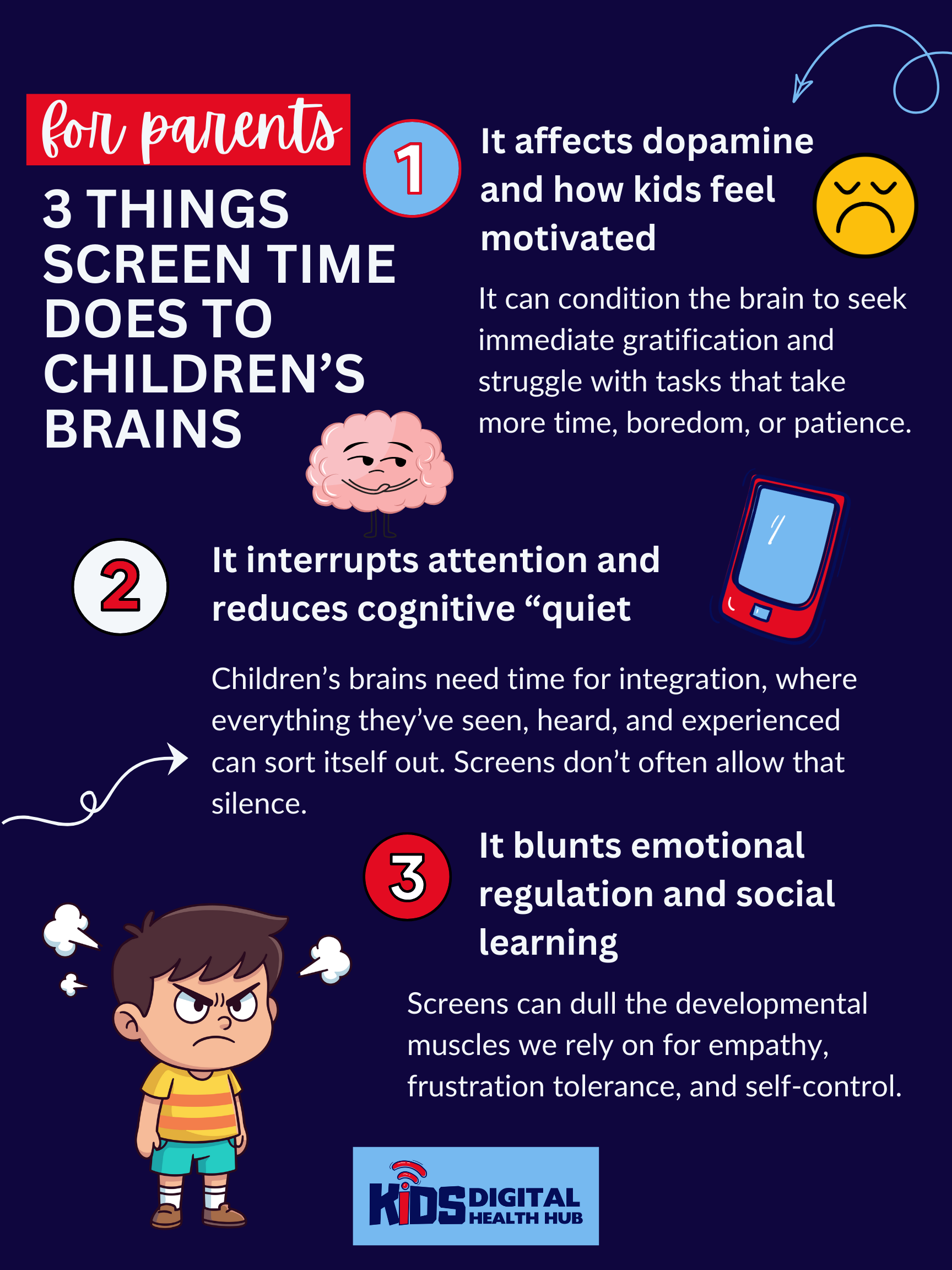
3 Things screen time does to children’s brains
The short answer is: screen time doesn’t just entertain our kids—it shapes them.
The longer answer is more nuanced.
As a nurse, digital wellness educator, and mom, I’ve sat with this question many times. Not from a place of fear, but from deep curiosity—what is actually happening in our children’s brains when they’re scrolling, streaming, swiping?
The truth is, screens are not inherently “bad or good.” But they are powerful, especially for developing brains that are still learning how to self-regulate, focus, process emotion, and relate to others.
1. It affects dopamine—and how kids feel motivated
Screen-based activities (like video games, short-form videos, and social media likes) often trigger surges of dopamine, the brain’s “feel-good” chemical. This isn’t dangerous on its own—it’s the same chemical released when we laugh, play, or learn something new.
But when most of a child’s dopamine comes from fast, digital inputs, it can condition the brain to seek immediate gratification and struggle with tasks that take more time, boredom, or patience—like reading, problem-solving, or simply being still.
You might see it show up as:
- “I’m bored” after just a few minutes offline
- Difficulty following through on schoolwork
- Tuning out or melting down during low-stimulus activities
2. It interrupts attention and reduces cognitive “quiet”
Children’s brains need time for integration, where everything they’ve seen, heard, and experienced can sort itself out. Screens don’t often allow that silence.
Instead, they split attention across visuals, sounds, comments, and scrolling content—all designed to keep them engaged. But constant switching between inputs disrupts working memory and makes it harder for the brain to hold focus or regulate emotion.
What this can look like over time:
- Trouble completing multi-step instructions
- Struggling to retain what they learned in class
- Feeling “wired but tired” after screen-heavy days
3. It blunts emotional regulation and social learning
One of the hardest truths: screens can dull the developmental muscles we rely on for empathy, frustration tolerance, and self-control.
Children learn emotional regulation through real-life co-regulation—the back-and-forth of facial expressions, tone of voice, body language, and response timing. Screens remove many of these cues, which means kids can lag in recognizing how others feel—or what to do with the emotions rising inside of them.
If you’ve noticed:
- More outbursts after long screen sessions
- Less patience for siblings, peers, or problem-solving
- Difficulty reading emotional situations in real life
…this may be part of the reason.
Here’s the hopeful part
Children’s brains are incredibly adaptable.
This means we’re not powerless. And they’re not ruined.
With intentional tech boundaries, rhythmic offline time, healthy modeling, and supportive conversations, kids can (and do) develop balanced, emotionally strong, and connected lives—even in a high-tech world.
You don’t have to go tech-free.
You just need to go tech-aware.
Connection over control
This is where the Parent Portal comes in.
It’s not a course full of rules. It’s not another checklist for Already-Too-Tired parents.
It’s a place built with calm, clarity, and emotional intelligence at the center.
Inside the Parent Portal, you’ll find:
- Gentle tools to guide conversations around empathy, impulse control, and mood
- Scripts for tough topics—so you know what to say when the moment comes
- Family check-in sheets designed to help your child reflect and talk honestly
- Brain-based education that helps you understand why certain behaviors happen online
- Co-regulation strategies that build trust, not tug-of-war
You won’t find judgment here.
Just research-backed resources grounded in lived experience—as caregivers, educators, and people who know what it’s like to raise kids in a modern world.
We can still raise grounded, emotionally healthy kids—even now
If you’ve been holding onto guilt, frustration, or fear—take a deep breath with me for a moment.
You haven’t missed the moment.
You aren’t too late.
And your kids don’t need you to be perfect.
They just need you to be present.
With steady hands.
With open eyes.
With the willingness to turn toward instead of away.
The world is noisy—but our connection can be louder.
And from that place… they’ll learn how to come back to themselves.
Let’s build that safety together.
👉 Learn more about the Parent Portal and how it can support your family in raising emotionally well kids, one conversation at a time.