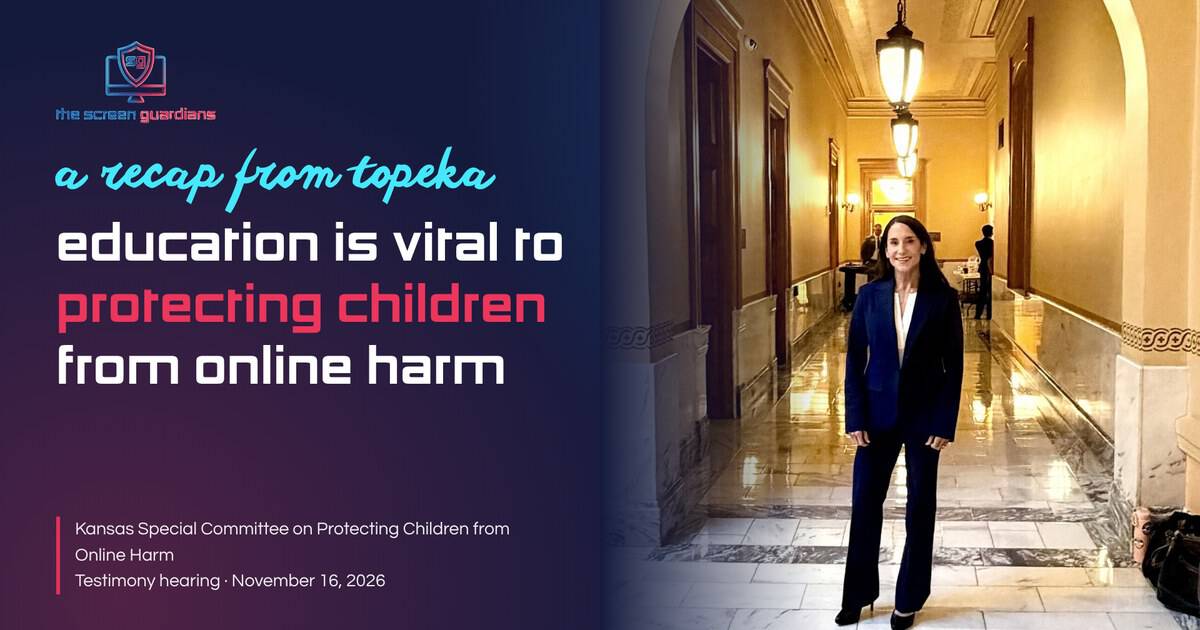
A recap from Topeka: the Kansas Special Committee on Protecting Children from Online Harm, November 16, 2026
By Susan Dunaway, LCPC, Chief Neuroscience Officer, The Screen Guardians
On Monday, November 16, Katie Longhauser, founder of The Screen Guardians, joined 22 others in giving testimony to the Kansas Special Committee on Protecting Children from Online Harm. I was privileged to be in the audience to support her and listen to the others giving testimony.
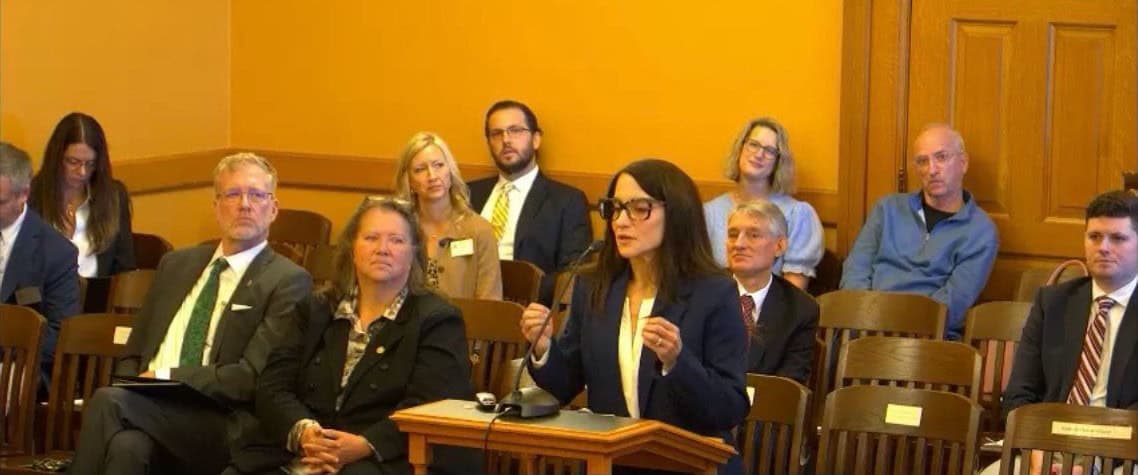
Many of them were talking about their experiences helping children who had been victims of crimes. One through line stood out: whether it was from a nurse, a police detective, a KBI agent, or one of the many child advocates, each mentioned education as one of the solutions to this heinous problem.
Table of Contents
One Solution Kept Coming Up: Education
Children need to be taught what we call The Predator Playbook (how to spot “Tricky People” for the littles). Predators are banding together, sharing tips and tricks that are known to catch more victims in the wide net they cast. It is not okay that these criminals have more information and community networking than we do! Think about that for a moment.
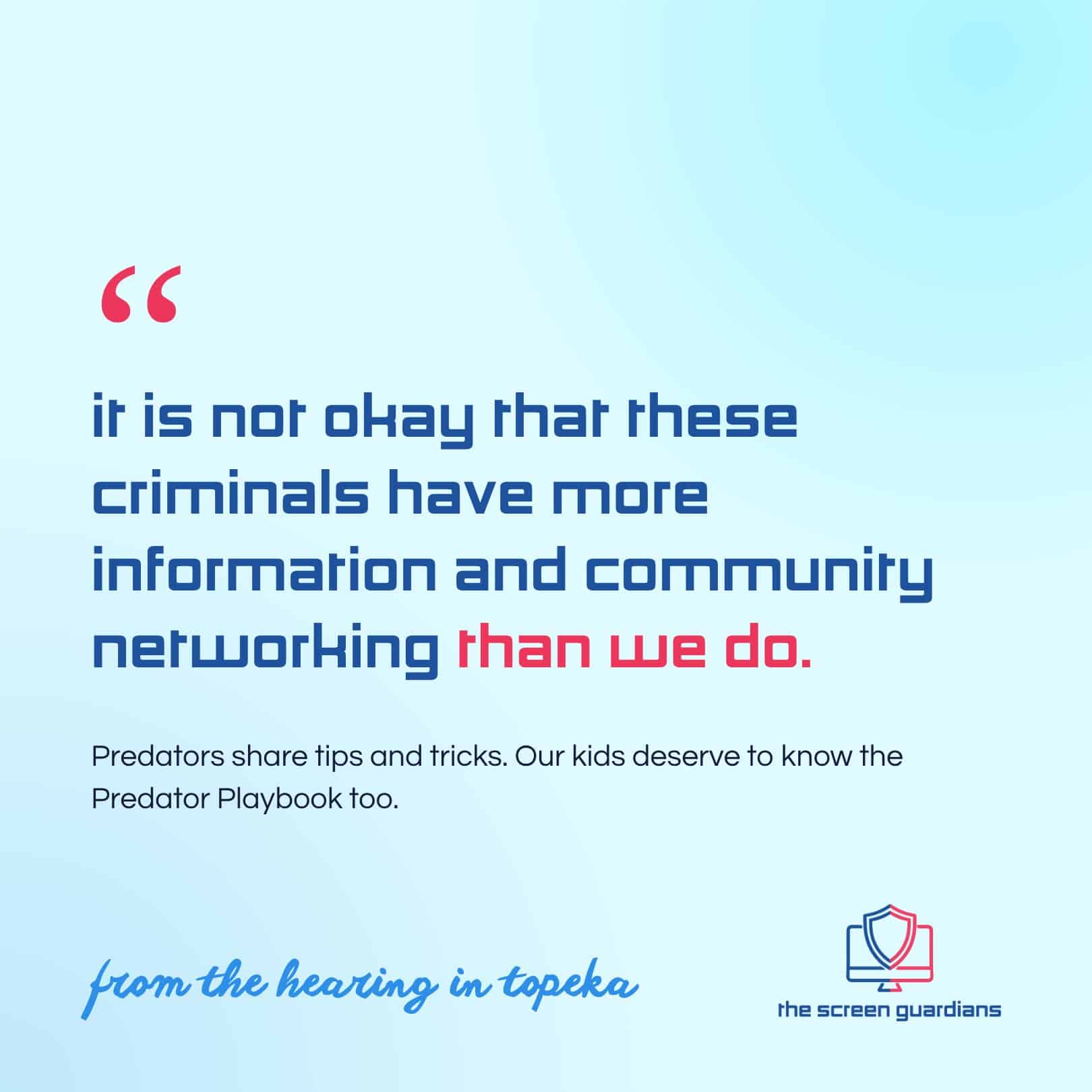
Those testifying wanted to educate the children, but testimony after testimony also mentioned educating the adults who support children. Parents are overwhelmed. Parental controls created by the apps or the devices are difficult to use, not intuitive, and can change without warning. Teachers are not equipped to know when students may be interacting with bad actors online. When something occurs, the adults don’t know where to turn to protect the child or to preserve evidence.
It’s Already Built
I was sitting in the audience knowing that is exactly what our program already has: education on risks for harm, what to do if approached, and how to respond and recover from adverse digital events. Our information is offered in an age-appropriate way to the students, to teachers, and to parents. We work in conjunction with the KBI, with victim advocates, and with mental health specialists. It’s already built. It is ongoing education, not a one-time presentation, so that it is more likely to stick and more likely to effect real change. I wish everyone knew it.
Katie was so professional in her testimony. She was wise enough to testify on the problem, not turn it into an advertisement for The Screen Guardians. I’m so thankful that we are seen as a resource. We will continue to have as many conversations as possible to get our message out there. And also… so many of the solutions mentioned in the hearing, like educating parents and students and making sure teachers know what to do if harm occurs in school, already exist within our program. It’s already built.
Protecting Children From Online Harm Takes More Than Guardrails
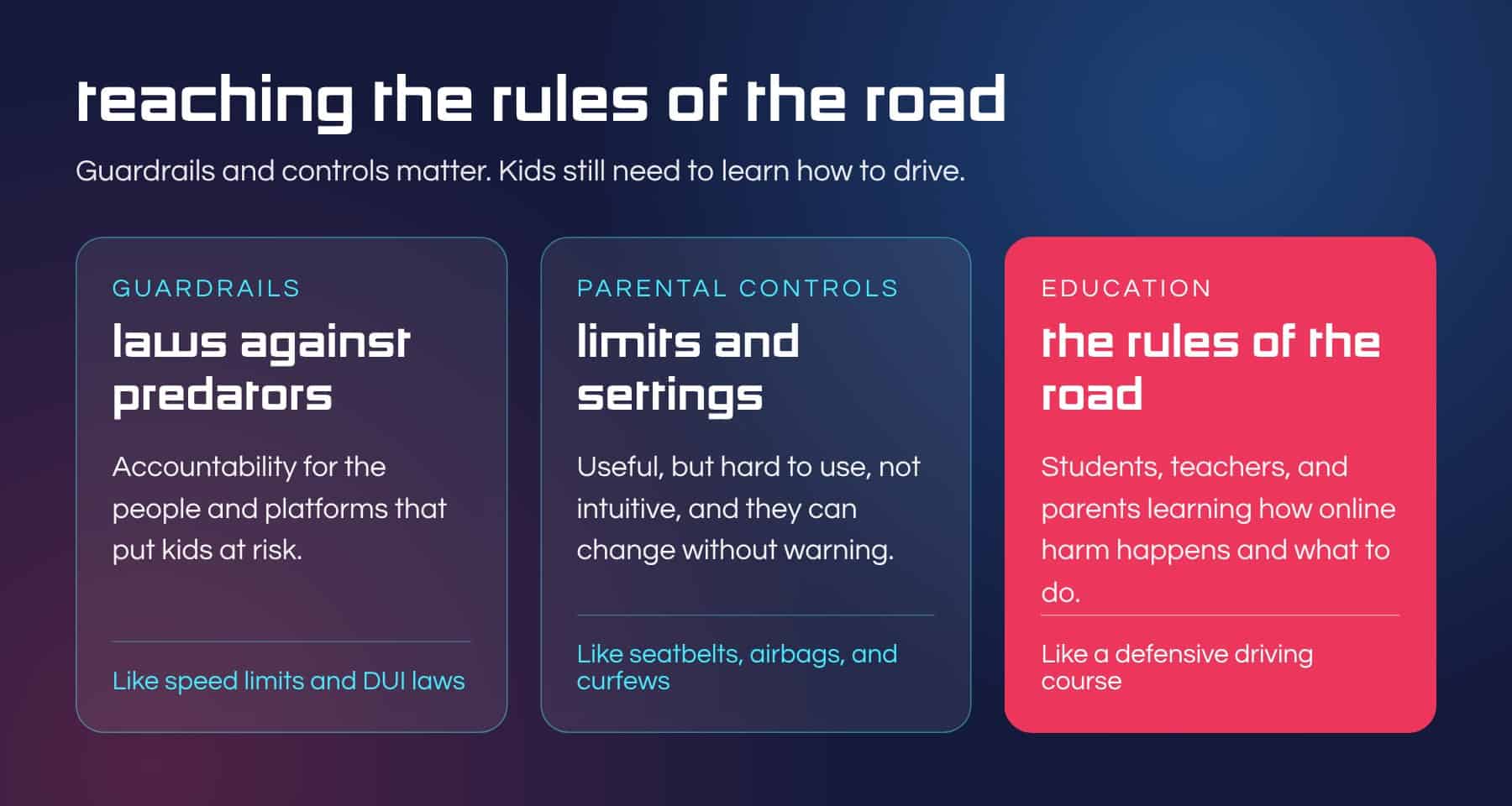
The Committee was considering several solutions to protect children from online harms. One possibility is an App Store Accountability Act, which could require age verification. There are strong feelings on both sides, and I don’t need to weigh in much. But in my quest to always ask better questions, I want to know what else can be done. Whether that bill or one like it passes, predators will use the internet to find children. No matter what parental controls we use, children will find workarounds to have fewer restrictions. It’s the nature of both criminals and children. That isn’t to say we shouldn’t have guardrails against predators or parental controls for children. Of course we should. It’s to make sure we have more.
At The Screen Guardians we say handing devices to our children the way we did was like giving them the keys to the car without teaching them the rules of the road. Guardrails against predators are like speed limit laws and laws against driving under the influence. Parental controls are akin to putting seatbelts and airbags in cars and setting limits on when and where our teens can drive. But we must still teach them the rules of the road. I would argue they don’t need typical driver’s ed, either. They need a defensive driving course!
Online Harm Isn’t Only About Predators
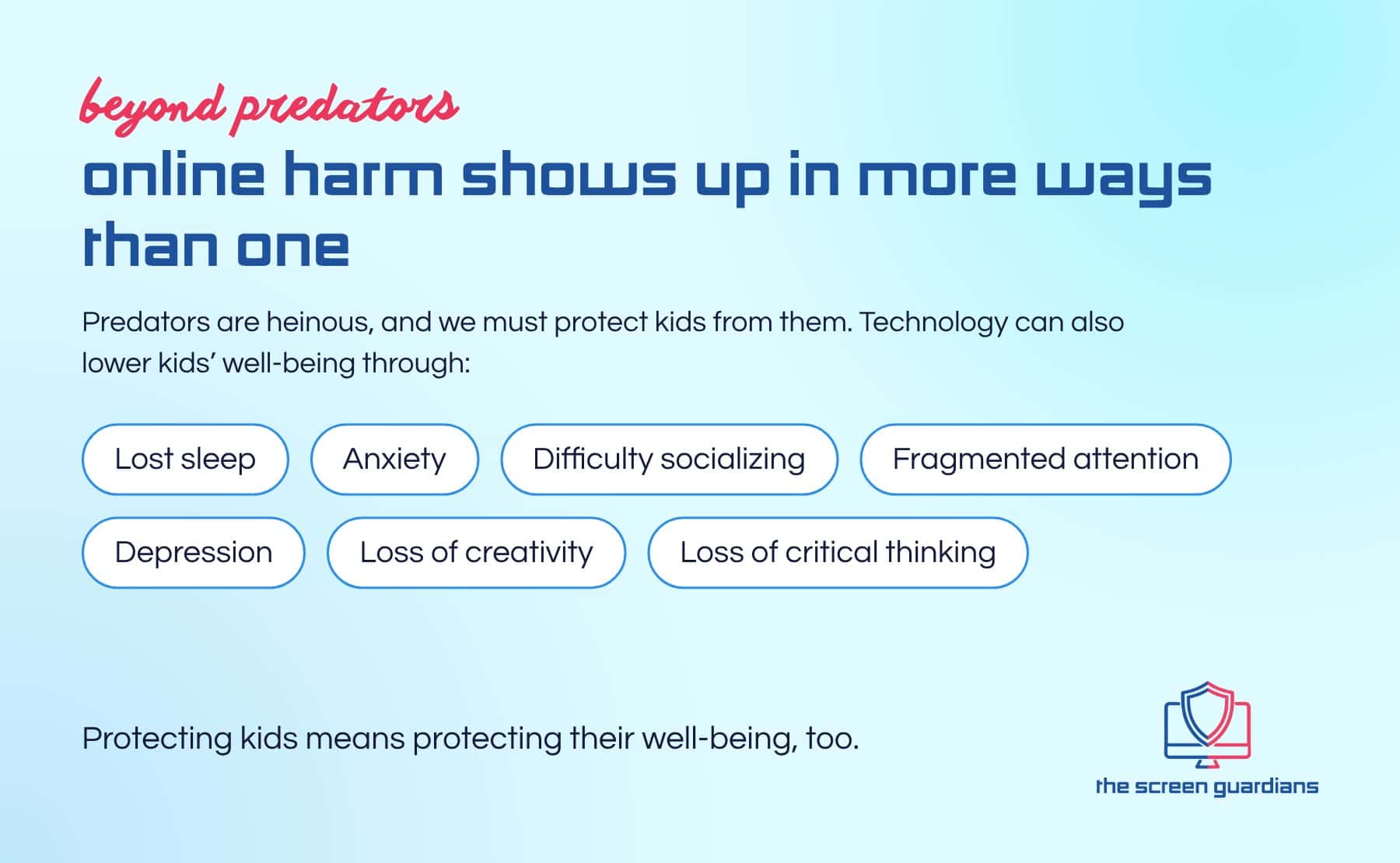
Another point the Committee has not yet considered is how children are harmed in many ways through and by technology. Predators are heinous, and we must protect our children from those harms. As well, though, interacting with technology has many other ways it leads to lower well-being in our youth: lost sleep, anxiety, increased difficulties socializing, fragmented attention, depression, and loss of creativity and critical thinking. Isn’t it right to protect them from those harms as well? Protecting children from online harm has to include their well-being, too.
The Tide Is Turning in Kansas
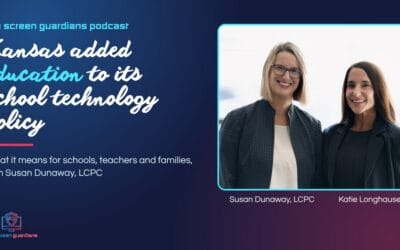
While the Committee explores keeping our children safe, the State Board of Education has been grappling with the same question for their students. Just a week prior to this committee meeting, the State Board approved a new technology policy to help guide schools in considering digital health and safety for the students they serve. They allowed us to consult with them as well, and they listened to our concerns and added an expanded definition of what digital citizenship entails (like understanding persuasive design, algorithms, and where to turn if harm occurs). They also included education for parents and teachers in their recommendations. Here’s what the new Kansas school technology policy says. It is clear that the tide is turning. Those in powerful positions now understand that in order to protect our children from digital harms, education matters.
Protecting our children from being harmed online is a big problem. It is one The Screen Guardians have been hard at work on for years. The schools who have used our program say their communities have been changed, and it’s because we educate everyone in a school ecosystem: all the students, teachers, and their parents. Everyone learns together, leading to meaningful change and improved safety.
5 Takeaways From the Hearing
If you weren’t in the room in Topeka, here is what kept coming up in the testimony on protecting children from online harm:
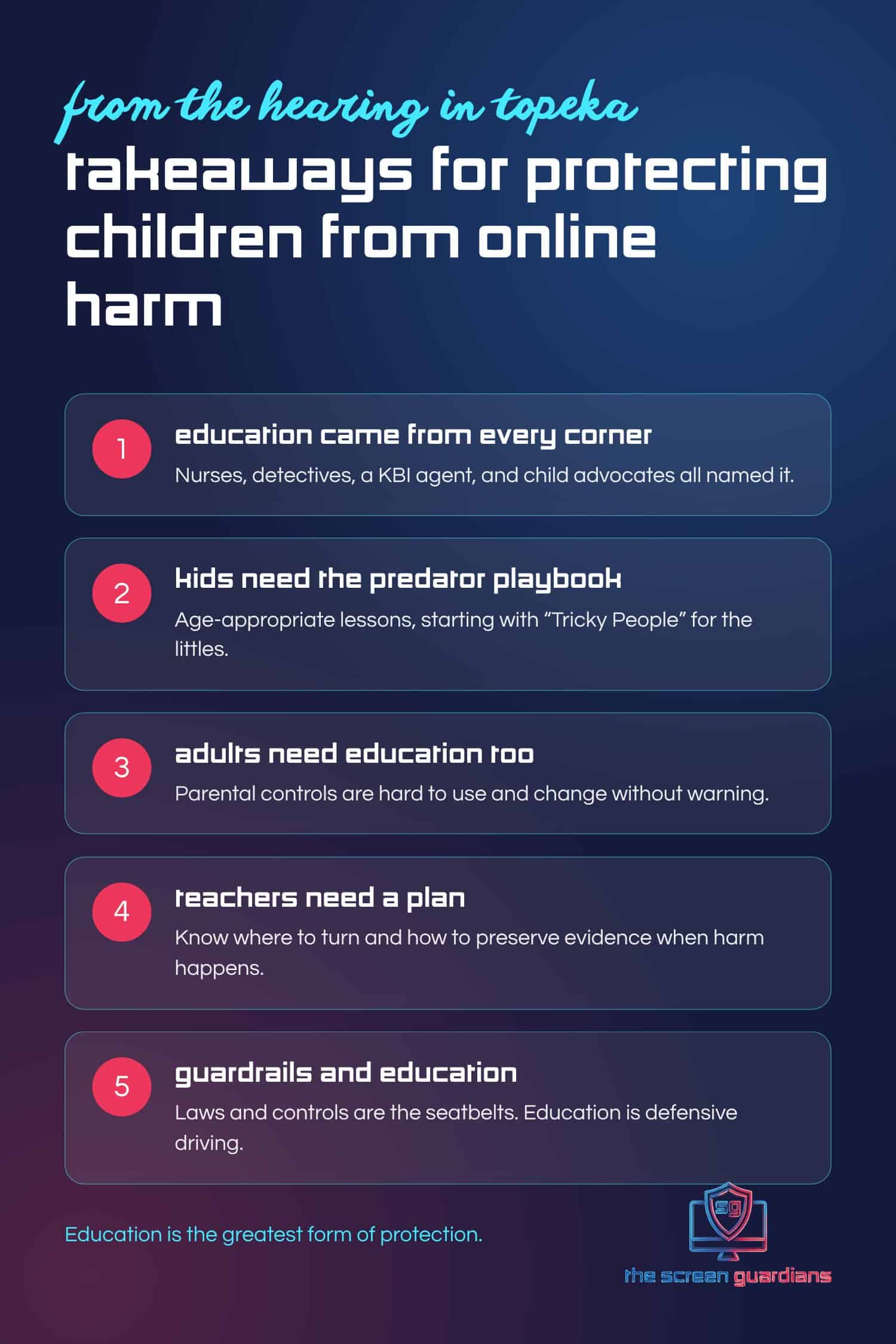
- Education came from every corner of the room. Nurses, detectives, a KBI agent, and child advocates all named it as part of the solution.
- Kids need to know the Predator Playbook. Age-appropriate lessons help them recognize manipulation, starting with “Tricky People” for the youngest students.
- Adults need education too. Parental controls are hard to use and change without warning, so parents need support, not just settings.
- Teachers need a plan for when harm happens. Knowing where to turn and how to preserve evidence protects the child.
- Guardrails and education work together. Laws and controls are the seatbelts. Education is the defensive driving course.
What This Means for Schools
If you lead a school or district, the message from Topeka is clear: protecting children from online harm starts with education. The people who see online harm up close are asking for education, for students and for the adults around them. You don’t have to build that from scratch. The Screen Guardians is a K–12 digital health and safety program taught once a week by students’ own teachers, in seven modules that include online safety. A Parent Companion goes home after every lesson, and school response guidelines developed with Kansas Bureau of Investigation input help teachers know what to do if something goes wrong. If you want to hear more from law enforcement, read what to do if your child is targeted online, from a KBI agent.
Here’s How You Can Help
I know the power of our program to influence families, schools, and communities for good. We know education is the greatest form of protection. That’s why, when those giving testimony would say education was one thing that could be done, I wanted to shout about us from the back of the room (but also, I’m an adult, so I didn’t!).
We’re here. We want to be part of the solution. We’re so thankful we are being asked into more of these rooms. If you’re reading this and you believe in us, would you share our blog, or our podcast, or our website? Your voice matters! You can follow the committee’s work on the Kansas Legislature website.
It’s such a blessing that there are so many good people looking hard at solutions to keep our kids safe online. Here’s to The Screen Guardians being a part of that solution.
Frequently Asked Questions
What is the Kansas Special Committee on Protecting Children from Online Harm?
It is a special committee of the Kansas Legislature studying how to keep children safe online. On November 16, 2026, it heard testimony in Topeka from more than 20 people, including Screen Guardians founder Katie Longhauser, nurses, law enforcement, and child advocates.
Is age verification enough to protect kids online?
Guardrails like age verification and parental controls matter, and we support them. But predators will keep using the internet to find children, and kids will keep finding workarounds. Guardrails work best alongside education that teaches children, parents, and teachers how online harm happens and what to do about it.
What is the Predator Playbook?
It is what The Screen Guardians call the common tactics predators use to approach and manipulate children online. For younger students, the same idea is taught as spotting “Tricky People.” Kids who know the playbook are better able to recognize danger and tell a trusted adult.
What did Kansas add to its school technology policy?
In November 2026 the Kansas State Board of Education adopted a technology policy that expands the definition of digital citizenship to include persuasive design, algorithms, recognizing unsafe interactions, and knowing where to get help. It also calls for education and support for educators and families.
How can a school start protecting children from online harm without adding to teachers’ plates?
The Screen Guardians is a K–12 digital health and safety program taught once a week in 30–40 minute lessons by students’ own teachers, with a Parent Companion after every lesson and school response guidelines developed with Kansas Bureau of Investigation input.
Bring This Education to Your School
Protecting children from online harm is a team effort. The Screen Guardians teaches students, teachers, and parents together, so everyone in a school community speaks the same language about online safety. Want this in your school? See how The Screen Guardians works.
Want to go deeper at home? The Parent Portal has videos, guides, and scripts for the hard conversations.
Education is the greatest form of protection.