If you’ve ever watched your child zone out in front of a screen and thought, “Is this too much?” — you’re not alone. That question is one of the most common things parents ask us. And honestly? It’s one we’ve wrestled with in our own homes, too.
Screen time for kids is one of the most searched, most debated, and most stressful topics in modern parenting. And it makes sense. Our children are growing up in a world that didn’t exist when we were young — a world where tablets show up in kindergarten classrooms, group chats start in fourth grade, and algorithms are designed to keep developing brains scrolling.
But here’s what we want you to know before you read another word: this is not a guilt trip. This is a guide. A calm, research-backed, parent-to-parent resource that will help you understand what’s actually happening in your child’s brain when they’re on screens — and give you real, doable strategies to build healthier habits at home.
No fear-mongering. No shame. Just tools you can actually use.
Table of Contents
What the Research Actually Says About Screen Time for Kids
Let’s start with the numbers — not to scare you, but to give you a clear picture of where things stand.
According to a 2025 Common Sense Media census, children ages 0–8 spend an average of about 2.5 hours per day on screens. For kids ages 8–18, that number jumps to over 7 hours per day of screen-based media use outside of schoolwork. And nearly 41% of American teens report more than 8 hours of daily screen time.
Those numbers land differently depending on your family. Maybe your five-year-old watches one show after school and you feel fine about it. Maybe your twelve-year-old is on a phone from the moment they get home until bedtime and you feel like you’re losing them. Both of those realities are valid.
Here’s what matters more than the hours: what kind of screen time it is, what it’s replacing, and how your child’s brain is responding to it.
In January 2026, the American Academy of Pediatrics (AAP) released an updated policy statement that shifted the conversation away from rigid time limits and toward three key factors: quality, context, and displacement. In other words — what are they doing on screens? What’s happening around them while they’re on screens? And what are they not doing because of screens?
That shift matters. Because it means parents can stop counting minutes and start paying attention to patterns.
Screen Time by Age: What’s Appropriate at Every Stage
One of the most helpful frameworks is knowing what’s developmentally appropriate for your child’s age. Here’s a breakdown based on the latest AAP guidance and child development research.
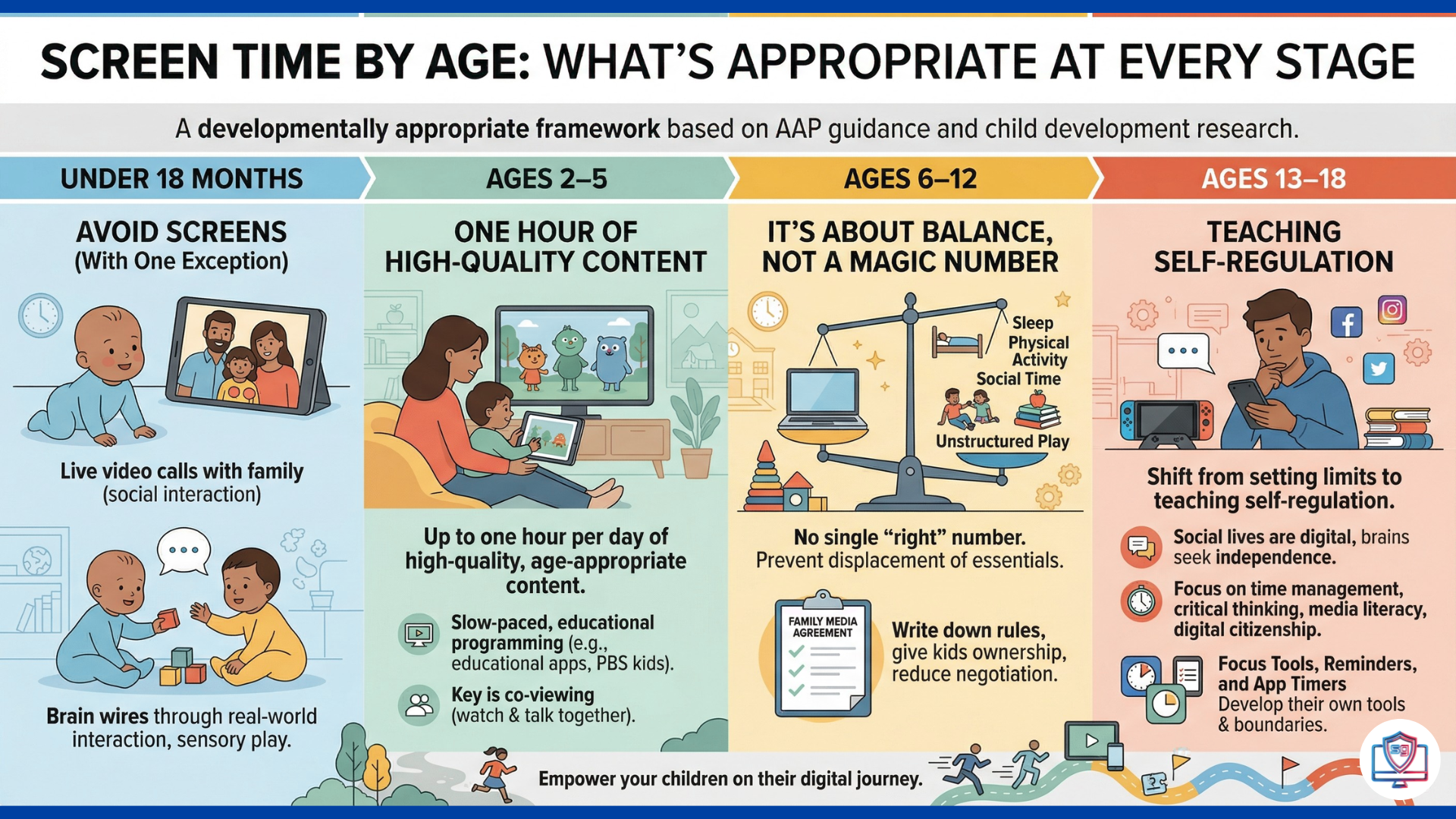
Under 18 Months: Avoid Screens (With One Exception)
The AAP recommends no screen use before 18 months, with one exception: live video calls with family or caregivers. FaceTiming grandma counts as social interaction — not passive screen time. At this stage, a baby’s brain is wiring itself through face-to-face interaction, sensory play, and real-world exploration. Screens can’t replicate that.
Ages 2–5: One Hour of High-Quality Content
For toddlers and preschoolers, up to one hour per day of high-quality, age-appropriate content is the guideline. Think slow-paced, educational programming that encourages participation — not fast-cut, ad-heavy apps designed to keep small fingers tapping. The key here is co-viewing. Watch with your child. Talk about what you see. That transforms passive watching into an interactive experience.
Ages 6–12: It’s About Balance, Not a Magic Number
This is where most families feel the tension. There’s no single “right” number of hours for this age group. What the research tells us is that screen time becomes problematic when it starts to crowd out the essentials: sleep, physical activity, face-to-face social time, homework, and unstructured play.
For school-age kids, a family media agreement can be a game-changer. It puts the guidelines in writing, gives kids ownership, and takes the daily negotiation out of the equation.
Ages 13–18: Teaching Self-Regulation
By the teen years, restriction alone doesn’t work. Their brains are wired for independence and risk-taking — and their social lives are deeply embedded in digital spaces. The goal shifts from setting limits to teaching self-regulation.
This is where brain science becomes your most powerful parenting tool. When teens understand why their brain craves the scroll — the dopamine loop, the variable reward system, the pull of social validation — they’re more equipped to recognize it and make different choices. Education builds agency. Rules without understanding breed rebellion.
What Screens Actually Do to Your Child’s Developing Brain
This is the part most screen time articles skip. And it’s the part that changes everything.
Your child’s prefrontal cortex — the part of the brain responsible for impulse control, decision-making, and long-term thinking — isn’t fully developed until their mid-twenties.
That means when your ten-year-old says “just five more minutes” and then an hour disappears — it’s not defiance. It’s brain development. The part of their brain that manages self-regulation is literally still under construction.
Here’s what’s happening neurologically: Every notification, every like, every new video in the feed triggers a small release of dopamine — the brain’s feel-good chemical. That creates a feedback loop. The brain learns: this activity = reward. And it wants more.
Apps, games, and social media platforms are specifically designed to exploit this loop. Variable reward schedules (you never know what’s coming next), infinite scroll (there’s no natural stopping point), and social validation cues (likes, comments, streaks) all activate the same reward pathways.
For a developing brain, this isn’t just distracting. It can affect attention span, emotional regulation, and sleep quality. A 2025 study found that children with 4+ hours of daily screen time were significantly more likely to report anxiety symptoms compared to peers who stayed under that threshold.
But here’s the good news: when kids learn how this system works, the dynamic changes. Understanding the “why” behind the pull gives them something rules alone never can — awareness. And awareness is the foundation of healthier digital habits.

The Real Effects of Screen Time on Children
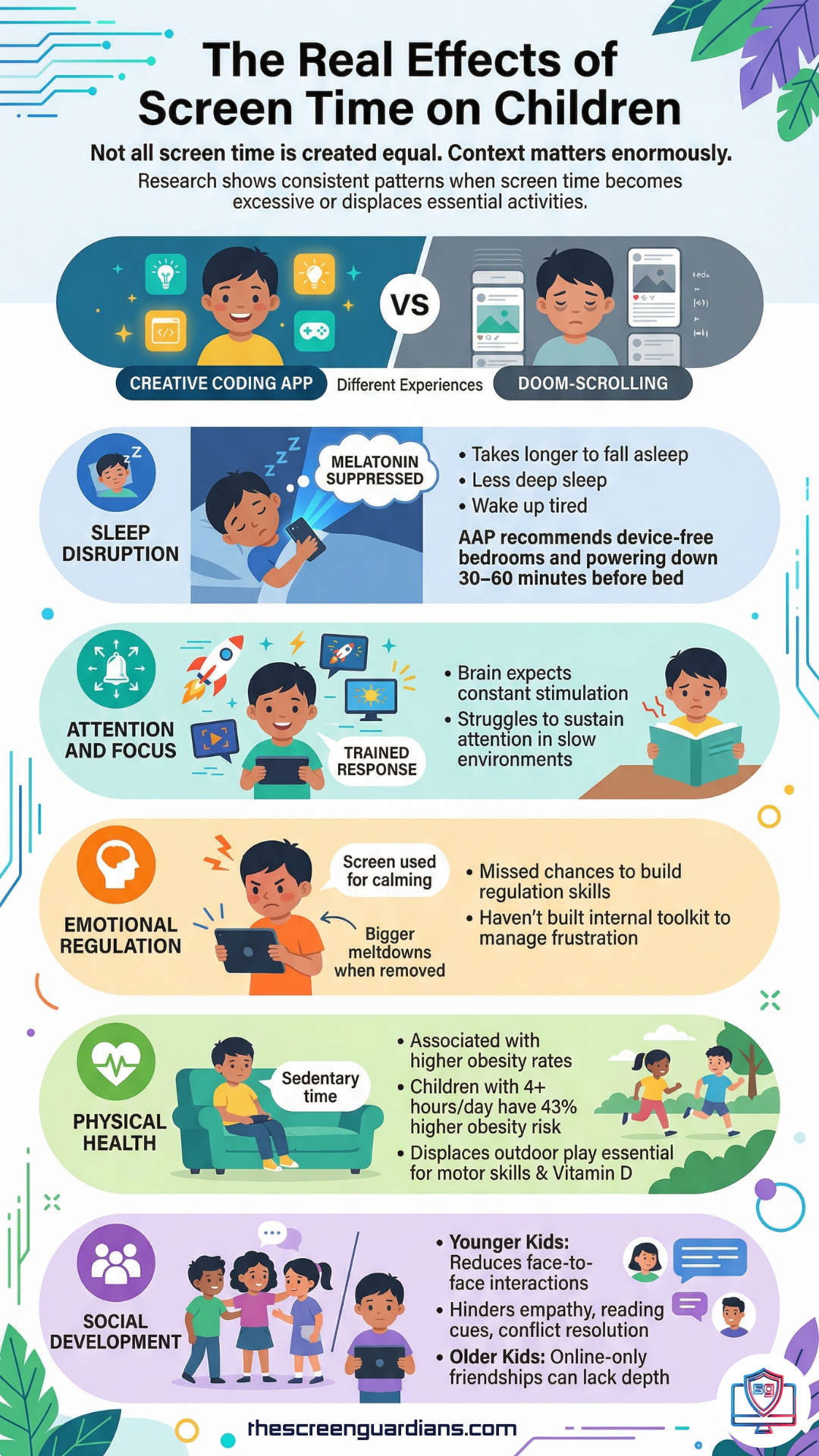
Not all screen time is created equal. Thirty minutes of a creative coding app is a very different experience than thirty minutes of doom-scrolling TikTok. Context matters enormously. That said, the research does show consistent patterns when screen time becomes excessive or displaces essential activities.
Sleep Disruption
Blue light from screens suppresses melatonin production, and stimulating content keeps the brain in “alert” mode. The result? Kids take longer to fall asleep, sleep less deeply, and wake up more tired. The AAP recommends device-free bedrooms and powering down screens at least 30–60 minutes before bed.
Attention and Focus
Fast-paced digital content trains the brain to expect constant stimulation. When kids return to slower-paced environments — like a classroom or a book — they may struggle to sustain attention. This isn’t a character flaw. It’s a trained response.
Emotional Regulation
When screens become the primary coping tool (“here, watch this so you calm down”), children don’t get the chance to develop their own regulation skills. Over time, this can lead to bigger meltdowns when screens are removed — not because screens are inherently bad, but because the child hasn’t built the internal toolkit to manage frustration without them.
Physical Health
Sedentary screen time is associated with higher rates of childhood obesity — children with 4+ hours per day face a 43% higher obesity risk. It also displaces outdoor play, which is essential for motor development, vitamin D production, and overall well-being.
Social Development
For younger kids especially, too much screen time can reduce face-to-face interactions that build empathy, reading social cues, and conflict resolution skills. For older kids, online-only friendships can feel intense but lack the depth that in-person connection provides.
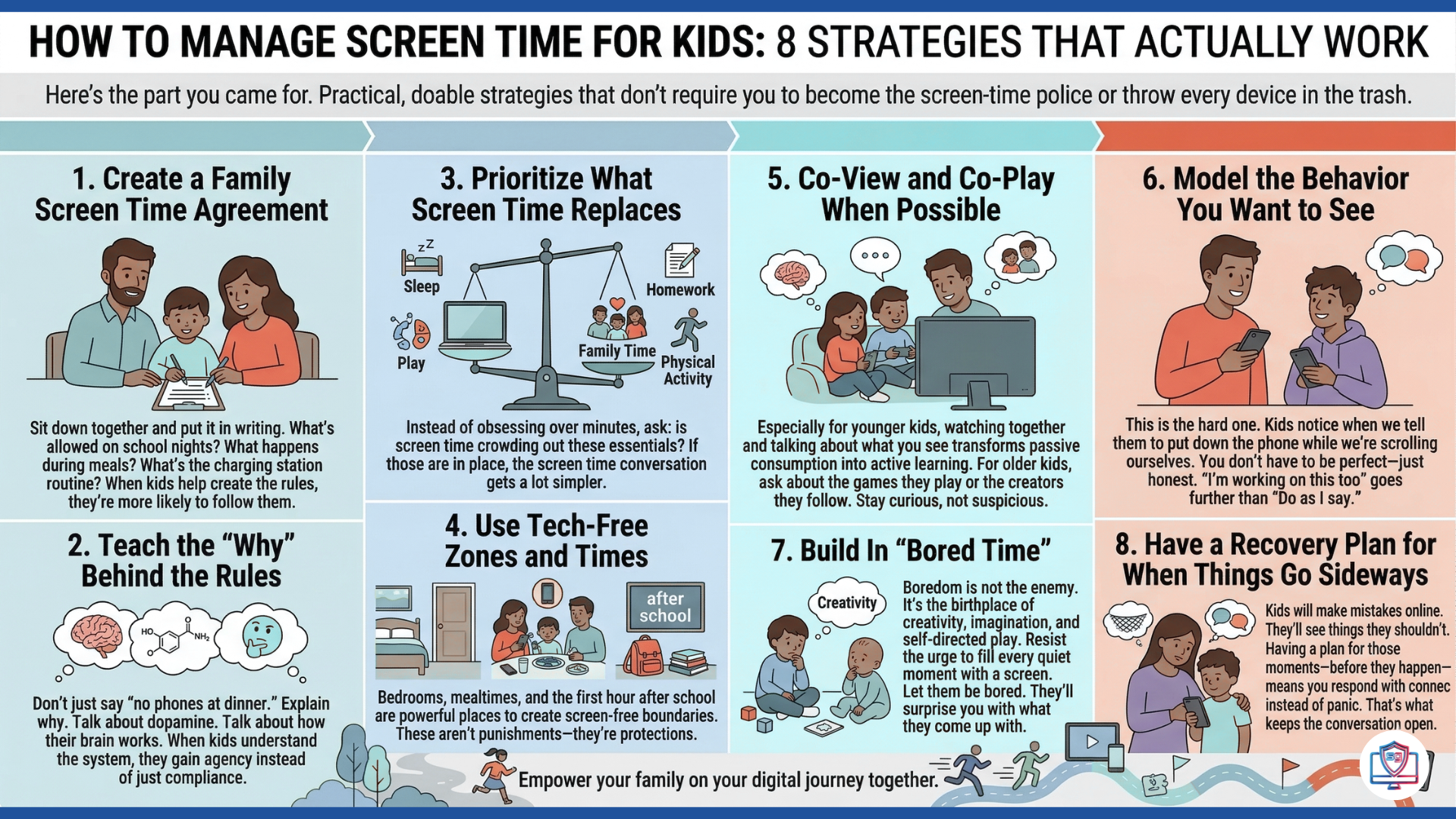
How to Manage Screen Time for Kids: 8 Strategies That Actually Work
Here’s the part you came for. Practical, doable strategies that don’t require you to become the screen-time police or throw every device in the trash.
1. Create a Family Screen Time Agreement
Sit down together and put it in writing. What’s allowed on school nights? What happens during meals? What’s the charging station routine? When kids help create the rules, they’re more likely to follow them.
2. Teach the “Why” Behind the Rules
Don’t just say “no phones at dinner.” Explain why. Talk about dopamine. Talk about how their brain works. When kids understand the system, they gain agency instead of just compliance.
3. Prioritize What Screen Time Replaces
Instead of obsessing over minutes, ask: is screen time crowding out sleep, play, homework, family time, or physical activity? If those essentials are in place, the screen time conversation gets a lot simpler.
4. Use Tech-Free Zones and Times
Bedrooms, mealtimes, and the first hour after school are powerful places to create screen-free boundaries. These aren’t punishments — they’re protections.
5. Co-View and Co-Play When Possible
Especially for younger kids, watching together and talking about what you see transforms passive consumption into active learning. For older kids, ask about the games they play or the creators they follow. Stay curious, not suspicious.
6. Model the Behavior You Want to See
This is the hard one. Kids notice when we tell them to put down the phone while we’re scrolling ourselves. You don’t have to be perfect — just honest. “I’m working on this too” goes further than “Do as I say.”
7. Build In “Bored Time”
Boredom is not the enemy. It’s the birthplace of creativity, imagination, and self-directed play. Resist the urge to fill every quiet moment with a screen. Let them be bored. They’ll surprise you with what they come up with.
8. Have a Recovery Plan for When Things Go Sideways
Kids will make mistakes online. They’ll see things they shouldn’t. They’ll send a message they regret. Having a plan for those moments — before they happen — means you respond with connection instead of panic. That’s what keeps the conversation open.
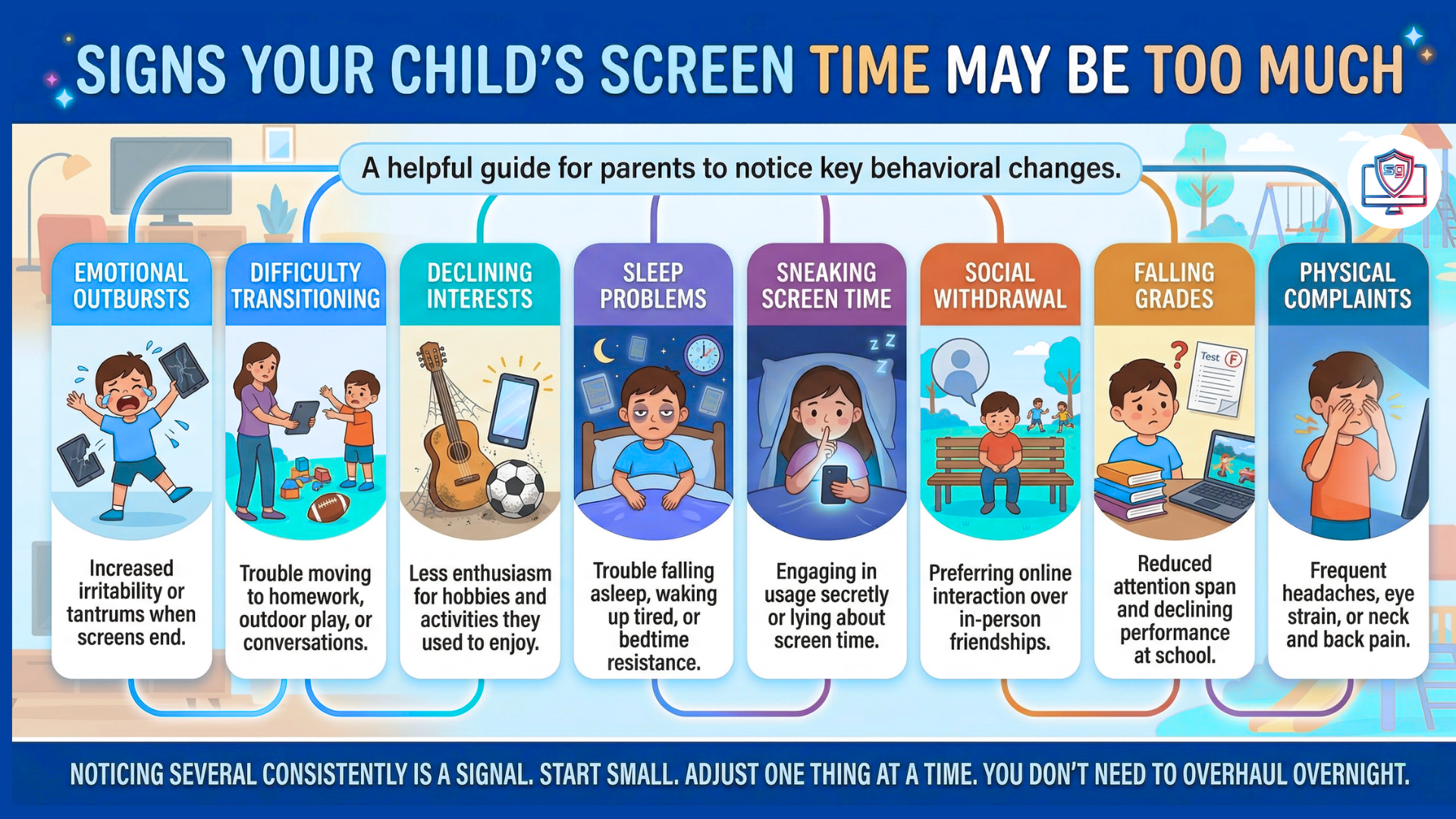
Signs Your Child’s Screen Time May Be Too Much
Every kid is different. But if you’re noticing a pattern of these behaviors, it may be time to reassess the role screens are playing in your child’s life:
- Increased irritability, tantrums, or emotional outbursts when screen time ends
- Difficulty transitioning to non-screen activities (homework, outdoor play, conversations)
- Declining interest in activities they used to enjoy
- Sleep problems — trouble falling asleep, waking up tired, resistance to bedtime
- Sneaking screen time or lying about usage
- Social withdrawal or preferring online interaction over in-person friendships
- Falling grades or reduced attention span at school
- Physical complaints — headaches, eye strain, neck pain
Noticing one or two of these occasionally is normal. Noticing several consistently is a signal. And the response doesn’t have to be dramatic. Start small. Adjust one thing at a time. You don’t need to overhaul everything overnight.
This Isn’t About Being Anti-Technology
Let’s be clear: we are not anti-technology. We’re pro-child.
Technology is not going away. And honestly? There’s a lot of good in it. Creative tools, educational platforms, connection with faraway family, exposure to ideas and perspectives they’d never encounter otherwise. The goal was never to eliminate screens. It’s to teach our kids to use them intentionally rather than impulsively.
Digital health is not about restriction. It’s about balance. It’s the ability to engage with technology in a way that supports well-being rather than undermining it. And that starts with education — for kids and for us.
Because education is the greatest form of protection.
You Don’t Have to Navigate Screen Time Alone
If reading this made you feel like there’s a lot to figure out — you’re right. There is. But you don’t have to figure it out by yourself.
At The Screen Guardians, we’ve built resources specifically for this. Our free parent course walks you through the essentials of digital health — at your own pace, with no judgment. Our Parent Portal goes deeper with coaching videos, downloadable guides, conversation starters, and scripts for the hard talks. And our podcast brings you real conversations with experts, parents, and educators who are navigating this alongside you.
Start where you are. You don’t need to be a tech expert. You just need to be a connected, curious adult.
Frequently Asked Questions About Screen Time for Kids
How much screen time is too much for kids?
There’s no single magic number. The AAP’s 2026 guidelines focus on quality, context, and what screen time is displacing rather than strict hourly limits. As a general guideline: no screens before 18 months, up to one hour of high-quality content for ages 2–5, and a balanced approach for older kids that protects sleep, physical activity, and face-to-face social time.
Does screen time cause ADHD or anxiety in children?
Screen time doesn’t directly cause ADHD, but excessive use of fast-paced digital content can mimic or worsen attention difficulties. Research consistently shows a correlation between high screen time (especially social media, 4+ hours/day) and increased anxiety symptoms in children and teens. The relationship is complex, but reducing problematic screen use often improves focus and emotional regulation.
What counts as “high-quality” screen time?
High-quality screen time is interactive, age-appropriate, and educational. It models social-emotional skills, encourages creativity or problem-solving, and ideally involves a caregiver watching or participating alongside the child. Passive, ad-heavy, or algorithmically driven content that keeps kids scrolling without engagement is on the other end of the spectrum.
How do I get my child to put down the screen without a meltdown?
Transitions are hard — especially when your child’s brain is in the middle of a dopamine-driven loop. Give advance warnings (“five more minutes”), create consistent routines around screen-off times, and have a next activity ready. Over time, teaching your child why their brain resists stopping helps them build self-awareness and makes transitions smoother.
Should I take my child’s phone away as punishment?
Taking the phone away occasionally isn’t harmful, but using it as a primary punishment can backfire. It teaches kids to see the phone as the most valuable thing in their life and can shut down communication. A better approach is a recovery plan — talking through what happened, understanding the why, and making a plan together for next time. Connection works better than control.