A K–12 digital health & safety program
Education is the greatest form of protection.
Short weekly lessons, taught by your own teachers, that help students understand how technology affects their brains, bodies, emotions, and safety. A Parent Companion after every lesson brings the same language home.
Not anti-technology. Pro-child.

Piloting in schools across multiple states
Grounded in neuroscience & child development research
Built with educators, clinicians & law enforcement
Featured in
Trusted voices on kids & digital health
KSN News
Capitol Bureau · Nov 2026
Founder Katie Longhauser cited as Kansas lawmakers plan to focus on stopping online child predators.
On Point
WBUR · Distributed by NPR
Katie joins the national conversation on the “no social media” movement and delaying smartphones.
Lou Desmond & Company
With Dr. Currie Myers
Katie on how the digital world is shaping the next generation.
More than half of kids have their own tablet by kindergarten, and about a fourth have a smartphone by age 8.
Katie Longhauser, Founder · as reported by KSN News

Why it matters
Phone policies are a start. They’re not the whole answer.
Technology came into classrooms for good reasons: to support teachers and give every student the same shot. Nobody knew yet what it would cost. Now we know more. That’s new information, not an accusation.
Schools are doing hard work with phone policies and device audits, and that work matters. But the school day ends, kids go home, and the devices turn on. A ban doesn’t teach a student why that phone is so hard to put down.
Restriction is a pause button. Education is the solution.
“When we know better, we do better.” — Maya Angelou
How it works
Not a single assembly. Real curriculum.
Turnkey and weekly, built to fit the school day without adding to your teachers’ plates.
01
Once a week, 30–40 minutes
Ready-to-teach lessons led by students’ own teachers, with slides, videos, and resources included.
02
Grade-banded K–12
The same core concepts for K–2, 3–5, 6–8, and 9–12, taught at the right developmental level.
03
A Parent Companion after every lesson
What students learned, why it matters, and conversation starters for the car ride or dinner table.
04
A plan for when something goes wrong
A shared Recovery Plan for teachers and parents, plus response guidelines developed with Kansas Bureau of Investigation input.
Seven modules that build on each other
01 The brain · 02 The body · 03 Emotions · 04 The digital bubble · 05 Cyber savvy · 06 Online safety · 07 Putting it into action
Built by people who see it up close
Brain science, classrooms, and law enforcement in one program.
Digital health touches brain development, safety, mental health, and learning all at once. So we built this with people from each of those worlds.

Founder & Program Director
Katie Longhauser, RN
Former nurse, mom of three, and advocate for children’s digital health and safety.

Brain & Classroom
Susan Dunaway, LCPC
Neurotherapist who has clinically observed how screen use affects developing brains.

Online Safety
Agent Andy Herrera
Senior Special Agent with the Kansas Bureau of Investigation, focused on crimes against children.
ST
Curriculum
Sherri Tyler
33 years in education, with expertise in special education, ELL, gifted, and at-risk learners.
“
They’re beginning to understand not just the ‘what’ but the ‘why’ behind each lesson… From a teaching standpoint, the curriculum has been incredibly easy to implement.
Michael Cook · K–8 Technology Teacher
Find your place
One mission. A role for everyone.
For schools & districts
Bring it to your students
For superintendents, principals, counselors, and curriculum leaders: see what students learn, what it asks of teachers, and what parents get.
For parent advocates
Start it at your school
Many partnerships start with one parent. We’ll give you the language to bring The Screen Guardians to your principal or school foundation.
For families
Learn alongside your kids
Real conversations about raising kids in a digital world, without the panic. Expert guests, honest stories, and tools you can use tonight.
Want to go deeper at home? Explore the Parent Portal.
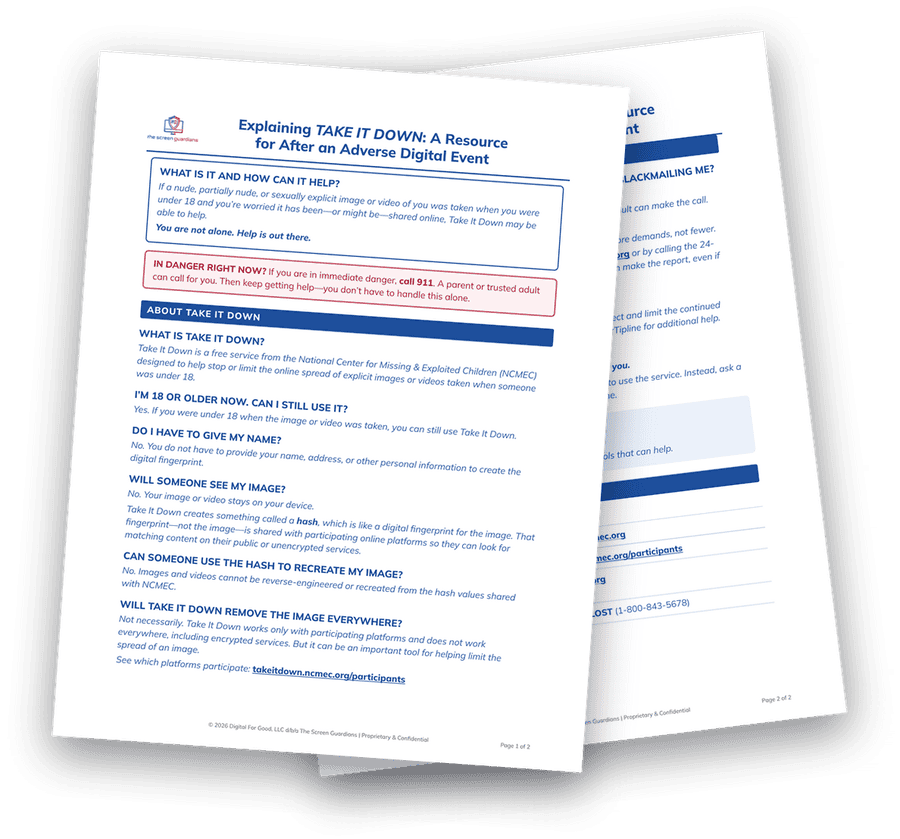
Free resource · Endorsed by the KBI
Something happened online. Here’s where to start.
If an explicit image taken when someone was under 18 has been shared, or someone is threatening to share it, there is help. Our Take It Down Response Tools guide explains how NCMEC’s free Take It Down service works, what to do if someone is making threats, and who to call. It’s endorsed by the Kansas Bureau of Investigation for responding to an adverse digital event.
Don’t download it. Don’t forward it. Don’t handle it alone.
In immediate danger? Call 911. To report, visit CyberTipline.org or call 1-800-THE-LOST.

Meet the founder
Hi, I’m Katie.
I always thought I had a pretty good handle on the digital world my kids lived in. I teach this stuff. I write school programs on this stuff. Then I read one of my daughter’s group chats. Nothing will give you a reality check faster.
I’m a former nurse and a mom of three. I started The Screen Guardians because families and schools were doing this without a map. Today I write K–12 programming, have testified before state legislatures, and work alongside clinicians, educators, and law enforcement to bring this into classrooms.
Not perfect kids, not perfect parents. Just kids who know they can come to us.
— Katie Longhauser, Founder
From the blog
Latest from the blog
Practical, honest, and grounded in research. Every single post. Grab your coffee.
Screen Time by Age: The Complete Parent’s Guide (Ages 2–18)
"How much screen time is okay for my kid?" If you've ever stood in the kitchen at 5 p.m., tablet in one hand, dinner in the other, asking yourself that exact question — you're not alone. Figuring out the right screen time by age is one of the most common (and most...
What a K–12 Digital Safety Curriculum Should Include (and Why One-Off Lessons Fall Short)
For superintendents, principals, counselors, tech coaches and curriculum planners comparing K–12 digital safety curriculum options. In today’s classrooms, teachers are expected to cover far more than just reading, math, and science—they’re now on the front lines of...
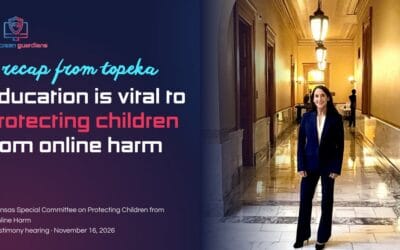
Education Is Vital to Protecting Children From Online Harm
A recap from Topeka: the Kansas Special Committee on Protecting Children from Online Harm, November 16, 2026 By Susan Dunaway, LCPC, Chief Neuroscience Officer, The Screen Guardians On Monday, November 16, Katie Longhauser, founder of The Screen Guardians, joined 22...
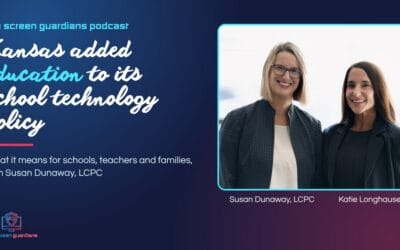
Kansas Added Education to Its School Technology Policy. Here’s What It Means.
The Screen Guardians Podcast 43 — Kansas Added Education to Its School Technology Policy, with Susan Dunaway, LCPC “We’ve handed our kids the car keys. We’ve added seatbelts, airbags, and a GPS. But have we taught them the rules of the road? We’ve taught limits, not...
After the Phone Ban: What Should Schools Teach Next?
The phones are in the pouches. The lockers. The office. Here in Kansas, “Bell to Bell, No Cell” took effect this fall. Across the country, more states and districts are adopting a phone ban in schools, too. And honestly? I’m grateful. It gives kids seven hours a day...
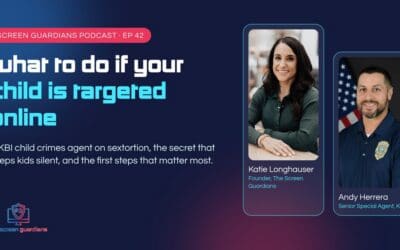
What to Do If Your Child Is Targeted Online, From a KBI Agent
Screen Guardians Podcast 42 — What to Do If Your Child Is Targeted Online, with KBI Senior Special Agent Andy Herrera Every parent I know carries a version of the same fear: the day your kid walks up and says, “Something happened online.” What do you do first? What do...
A K–12 digital health and safety program for students, teachers, and parents.
Education is the greatest form of protection.
For schools
Site designed by CORE Brand Marketing